What tire pressure should you have: a practical guide for 2026
Learn the correct cold tire pressure for your vehicle, how to check it, and how temperature and load affect readings. A practical Tire Pressure Tips guide.


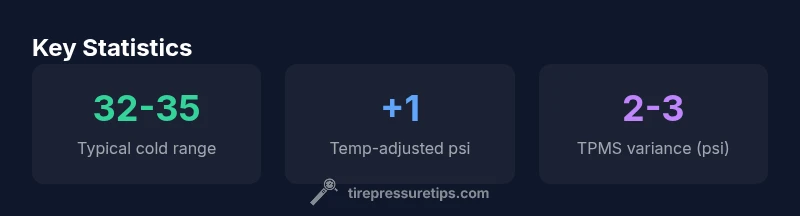
Your tires should be inflated to the vehicle manufacturer’s specified cold pressure, not a universal number. For most passenger cars, this sits around 32-35 psi on the front and rear tires, and you should check the sticker on the door jamb or in the owner's manual. Temperature, load, and TPMS accuracy can shift readings, so always start from the official spec and adjust gradually.
What tire pressure should you have
Your car’s tire pressure is not a one-size-fits-all value; it’s a specification set by the manufacturer for optimal performance, safety, and wear. The key concept is to inflate to the cold, recommended pressure printed on the door jamb sticker or in the owner’s manual. A cold reading means the tires have not been driven on for at least a few miles, so the air inside hasn’t warmed. In practice, you’ll use that spec as your starting point, then monitor changes due to weather, load, or driving style. The Tire Pressure Tips team emphasizes that following the official spec is essential, because it accounts for the vehicle’s weight distribution, tire size, and suspension geometry.
Accordingly, aim for the manufacturer’s cold psi value and verify with a reliable gauge before you drive, especially before long trips or when your load varies. Temperature and driving conditions can cause short-term fluctuations, but the baseline from the placard remains the anchor. This approach reduces the risk of uneven wear, poor fuel economy, and unpredictable handling, and it aligns with best practices recommended by tire maintenance professionals.
How to read your tire pressure specification
Every tire has a maximum safe inflation pressure printed on the sidewall, but this is not the target pressure for everyday driving. Instead, use the cold-pressure spec found on the door jamb sticker or in the owner’s manual. Your gauge will show PSI (pounds per square inch) or kPa in metric countries; convert if needed. When tires are cold, note the exact psi for each axle if your car has different front and rear targets. Remember, TPMS alerts are a helpful safety net but do not replace regular manual checks. Temperature, speed, and load can cause minor deviations, but you should not deviate from the manufacturer’s spec unless there is a documented reason to do so.
Additionally, familiarize yourself with how your vehicle’s sticker distinguishes front and rear pressures, as well as any recommended adjustments under heavy loads or towing conditions.
Practical ranges by vehicle type
There isn’t a single number for all vehicles. Most standard passenger cars specify a cold pressure around mid-30s psi. Sedans commonly land in the 32-35 psi range, while many compact cars hover near 30-33 psi. SUVs and pickup trucks often require higher targets in the mid-30s to mid-40s psi, depending on payload and tire size. Always prefer the door placard over generic rules, and be prepared to adjust for equipment like run-flat tires or low-rolling-resistance tires. If you drive an electric vehicle, you may see slightly higher ranges on the placard to accommodate weight and acceleration characteristics. In all cases, treat the placard as the definitive source and use a gauge to check when tires are cold.
If you regularly carry heavy loads or frequent passengers, plan for a small, controlled variation rather than a large alteration. This keeps tire wear even and improves ride quality, steering response, and braking performance.
Temperature, load, and driving conditions
Tire pressure is not static; it responds to temperature, load, and driving style. Cold weather lowers air pressure, causing tires to look under-inflated even when they are within spec at ambient temperature. A reasonable rule of thumb is that each 10-degree Fahrenheit drop in temperature can reduce pressure by about 1 psi. This means you may need to add a small amount of air when the temperature shifts toward winter. Heavier loads or aggressive driving can raise pressure by a similar small amount, so check after a road trip that includes extra gear or people. If you notice rapid changes or rapid TPMS warnings, inspect tires for punctures or slow leaks that could invalidate a reading.
Additionally, maintaining consistent pressure across all four tires contributes to balanced handling and extended tire life. Seasonal tire changes, highway speeds, and long trips all justify checking pressure more frequently during transition periods.
How to check tire pressure correctly
Always start with cold tires; drive-in temps can skew readings. Remove the valve cap, attach a high-quality gauge, and note the PSI for each tire. Compare to the door placard values, not the tire’s maximum rating. If a tire reads low, add air in small increments (e.g., 1-2 psi), pause, and re-check until you’re within the target range. If a tire reads high, release air slowly and re-check. Reinstall valves caps to prevent leaks, and don’t forget the spare tire if your vehicle uses one. Temperature changes mean you may need to re-check after a few days if weather shifts dramatically.
Digital gauges can reduce measurement error; keep three spare batteries or a backup gauge in the glovebox to ensure you’re never without a reliable reading.
Common mistakes and how to fix them
Common errors include inflating to the maximum tire-sidewall pressure, assuming the same target for all tires, and ignoring a consistent temperature shift that affects readings. Don’t rely on “hot” readings after a drive to adjust pressure; the air expands with heat, yielding a false high measurement. Additionally, avoid compensating for underinflation by adding too much air and then driving on a high-psi tire. Finally, neglecting TPMS alerts or neglecting to recalibrate after tire rotation or changes can lead to drift from the recommended spec. Fixes include checking tires when cold, labeling your own targets per axle, and scheduling regular maintenance checks.
TPMS and sensor considerations
Tire Pressure Monitoring Systems (TPMS) provide an early warning of pressure loss but do not replace regular manual checks. If you replace tires or change the wheels, TPMS sensors may require reprogramming or recalibration. Some sensors are built into the valve stem; others are mounted in the rim. If you notice a TPMS warning that doesn’t match a gauge reading, a sensor fault or slow leak could be present, and you should inspect the tire and valve stem for damage or corrosion. If TPMS battery has degraded, the system may miss low-pressure events; consult the vehicle manual for sensor replacement guidance and schedule a professional service if needed.
Regular maintenance and when to adjust
Periodic checks become easier when you embed them into a routine: check before long trips, after months with major temperature shifts, and when you switch seasons. Rotate tires according to manufacturer guidance to keep wear even and monitoring easier. When you rotate tires, ensure the TPMS learned values remain accurate with a quick diagnostic check. The aim is to maintain consistent pressures across all tires and avoid abrupt inflation changes that could harm tire life or vehicle handling.
The impact of underinflation on wear and safety
Underinflated tires wear more on the outer shoulders and can lead to increased rolling resistance, heat buildup, and potential blowouts in extreme cases. Overinflation reduces grip and can cause a harsh ride with uneven wear at the center of the tread. The balance lies in maintaining the recommended cold pressure for your driving conditions and limiting drastic changes unless you are guided by a professional. Regular checks help catch slow leaks and TPMS faults early, preserving tire life and safety.
How to communicate with your mechanic about tire pressure
When you visit a shop, bring your tire pressure records and the door placard values from your vehicle. Explain your typical loads and climate so the technician can recommend precise pressure targets for your tires. Ask to confirm the pressure on each tire at cold readings and to re-check after a test drive. If you notice persistent pressure loss, request a leak test and TPMS diagnostics to avoid unnecessary tire replacements.
Representative tire-pressure ranges by vehicle type
| Aspect | Typical pressure (psi) | Notes |
|---|---|---|
| Passenger car (sedan) | 32-35 psi | Refer to door placard; adjust for load |
| SUV / pickup | 35-45 psi | Check manufacturer spec; heavier tires may need higher pressure |
| Compact car | 30-33 psi | Door placard governs the exact value |
| Winter temps | Adjust upward by about 1-2 psi in very cold conditions | Temperature shifts change readings |
Frequently Asked Questions
Why isn't there a single number for tire pressure?
Because recommended pressure varies by vehicle design, tire size, and load. The best source is the door placard or owners manual, not a universal PSI.
The recommended tire pressure varies by vehicle, so refer to your door placard or manual rather than relying on a single number.
Is it okay to inflate to the maximum sidewall pressure?
No. The sidewall number is the maximum safe pressure, not the target for daily driving. Overinflation can reduce grip and cause uneven wear.
Don't inflate to the maximum sidewall pressure; use the door placard value as your target.
How often should I check tire pressure?
Check cold pressures at least once a month, and before long trips or seasonal changes. TPMS can help, but manual checks are the foundation.
Check your tires when they're cold, at least monthly and before long trips.
What affects tire pressure besides temperature?
Load, speed, and driving style can cause pressure to drift. Seasonal changes and road conditions also matter.
Load and temperature affect pressure; check after heavy loads or warm weather.
Should I use nitrogen or standard air for tires?
Nitrogen is not essential for everyday driving; standard air works fine if you maintain proper inflation and leak checks.
Nitrogen isn't required; keep up with proper inflation and leaks using regular air.
What should I do if TPMS shows a warning but the gauge reads normal?
There may be a slow leak or sensor issue. Inspect the tire, valve stem, and sensor, and consider a TPMS diagnostic if readings remain inconsistent.
If TPMS warns but your gauge reads normal, check for leaks or sensor faults.
“Accurate tire pressure starts with following the manufacturer’s specification, then making careful adjustments for load, temperature, and driving conditions.”
What to Remember
- Check your vehicle’s door placard before inflating.
- Inflate tires when cold for accurate readings.
- Follow the manufacturer’s psi range rather than a universal value.
- Account for temperature and load when adjusting pressure.
- Re-check pressures after seasonal or load changes.