What Should Tire Pressure Be in kPa?
Discover how to determine the correct tire pressure in kilopascals (kPa), measure accurately, and account for temperature and TPMS. A practical, data-driven guide from Tire Pressure Tips.


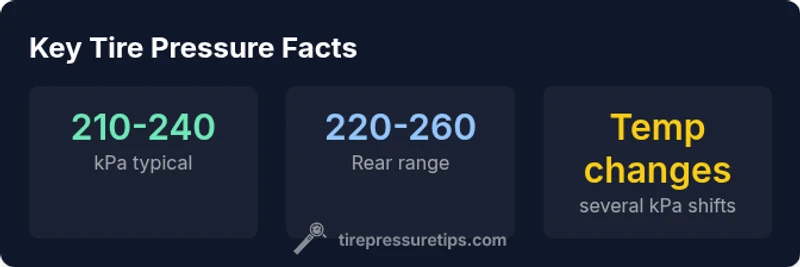
The exact tire pressure in kPa varies by vehicle, but a typical passenger car guidance falls in the ~210–240 kPa range when cold. Always check the placard on the door jamb or owner's manual for your target values and measure tires when cold with a reliable gauge. In short, follow the vehicle-specific kPa targets rather than a generic number.
Why Tire Pressure in kPa Matters
Maintaining the right tire pressure in kilopascals (kPa) is not just about keeping a number on the door placard. It affects handling, braking distance, and fuel efficiency. When tires are underinflated, the sidewalls flex more, producing more heat and uneven wear. Overinflation can reduce the contact patch, diminishing grip and ride quality. For drivers asking what should tire pressure be kpa, the correct target depends on your vehicle, load, and driving conditions. According to Tire Pressure Tips, following the vehicle-specific kPa targets improves safety, mileage, and tire life. Always confirm values from the placard on the door jamb or the owner’s manual, and verify cold-tire readings with a reliable gauge. A small discrepancy of 5–10 kPa is normal when tires warm up, but avoid large swings.
To make sense of kPa, remember that it is a metric unit of pressure up to roughly 1 atm. Many drivers are more familiar with psi, so a quick conversion is helpful: 1 psi ≈ 6.895 kPa. By understanding the fundamentals of kPa, you can translate the manufacturer’s guidance into a measurement you can act on before hitting the road.
Understanding kPa vs psi: A Quick Conversion Guide
If you come from the world of psi, you might wonder how to interpret kPa in everyday terms. The practical takeaway is simple: use the kPa values specified by your vehicle’s manufacturer and convert only for internal understanding if needed. A quick rule of thumb is that 100 kPa is about 14.5 psi, so a 210–240 kPa range converts roughly to 30–35 psi. Always rely on the OEM target in kPa for accuracy, as tires and rims vary by model. When you’re comparing data from manuals or guides, convert to kPa to stay consistent, and check readings against a cold-tire baseline for accuracy. Tools like digital tire pressure gauges offer consistent, repeatable measurements, which helps prevent misreading from gauge variance.
For those who prefer ongoing references, a standardized comparison of kPa vs psi can reduce confusion. Remember that the same vehicle may have different front and rear targets depending on weight distribution, tire size, and loading conditions. The Tire Pressure Tips team recommends using vehicle-specific cards and revisiting pressure targets after major changes such as seasonal tire swaps or altered load conditions.
How to Find the Right kPa for Your Vehicle
Locating the right kPa target is straightforward but essential. Start with the placard on the door jamb or the fuel-fill door, then cross-check with the owner’s manual. The target is often different for front and rear tires and may vary by speed rating, tire size, or load. If your vehicle is equipped with TPMS, it can serve as a helpful alert, but it should not replace regular, manual pressure checks with a gauge. When the tires are cold, record the kPa value and adjust gradually if you notice persistent underinflation or overinflation signs. If you drive a high-load scenario (terry equipment or full loads), your targets may shift modestly—always confirm with the vehicle’s specification sheet. For added reliability, use a digital gauge and calibrate it against a known-good standard. The right kPa target is a baseline for safe braking, stable handling, and even tread wear, not a generic target for all situations.
Understanding how the load and speed can alter the recommended pressure helps drivers avoid common mistakes. If you’re unsure about a vehicle’s specific targets, consult the service manual or reach out to a tire professional. In some regions, the official standards emphasize checking pressure in relation to ambient temperature, which can meaningfully impact kPa readings over the course of a season.
Measuring Tire Pressure Correctly: Best Practices
Measuring tire pressure correctly is the easiest way to prevent underinflation or overinflation problems. Start by taking readings when tires are cold, ideally after the car has sat for at least three hours or has been parked for the night. Remove the valve cap, press the gauge onto the valve stem firmly, and take a steady reading. If the gauge reads low, recheck after a few minutes to rule out a faulty seal. Keep a log of measurements for a few weeks, noting ambient temperature, load, and driving conditions. A consistent routine helps you identify what “normal” looks like for your vehicle. If your readings drift beyond ±5–10 kPa of the target, inspect for slow leaks or damage. Minimal maintenance—such as checking tires before long trips or seasonal changes—can protect you from sudden tire failures and improve fuel economy.
Choosing the right gauge matters. A digital gauge provides consistent readings, a dial gauge is robust, and a pencil gauge is a budget option but may be less consistent. Calibrate gauges with a known reference from time to time and rinse off any dirt from the valve stems to ensure a proper seal. Tire pressures should always be measured when the tires are cold; heat from driving can raise pressure readings, masking an underinflation issue. Regular checks are a key part of tire maintenance and vehicle safety.
Temperature and Driving Conditions: How They Affect kPa
Temperature has a direct effect on tire pressure. Colder weather reduces the air’s volume inside the tire, leading to a lower kPa reading, while warmer conditions increase pressure. The relationship is not perfectly linear because tire temperature is also influenced by road contact, rolling resistance, and ambient heat from the engine bay. As a practical rule, expect a noticeable shift in kPa with a temperature swing of about 10°C to 20°C (50°F to 68°F). Therefore, you should adjust your target slightly in extreme climates and verify pressure when the tires are cold after seasonal transitions. For the safety-minded driver, this means checking pressure more often in winter and early spring, and rechecking after road trips or long drives where tires heat up significantly. The Tire Pressure Tips approach is to treat kPa targets as a dynamic guideline that reflects current conditions rather than a fixed number.
If you notice rapid changes in pressure with small temperature fluctuations, consider checking for slow leaks, damaged valves, or damaged tires. Temperature monitoring data can also assist with planning tire rotations and determining when to replace worn tires. The key message is to treat kPa as a living metric—an essential aspect of tire care and road safety.
TPMS: When to Trust the Sensor vs a Manual Gauge
Tire Pressure Monitoring Systems (TPMS) provide a helpful alert if a tire falls below the recommended pressure, but they do not replace manual measurements. TPMS sensors measure internal pressure and can trigger warnings in real time, which is critical while driving. However, sensors can sometimes give inaccurate readings due to low battery, sensor calibration drift, or temperature effects. For precise maintenance, always verify TPMS alerts with a quick manual pressure check using a trusted gauge on cold tires. If there is a mismatch between TPMS and the gauge, the system may require recalibration or sensor service. The key takeaway is that TPMS is a safety net, not a substitute for straight measurement. Incorporating both methods ensures you stay within the manufacturer’s target kPa range and enjoy safer handling and more efficient fuel use.
Practical Guidelines and Quick Start for Daily Driving
To implement what you’ve learned about kPa quickly, start with these steps: (1) locate your vehicle’s target kPa on the placard or manual; (2) measure cold tires with a quality gauge at least once a month or before long trips; (3) adjust gradually if readings are off, aiming to stay within the recommended range; (4) monitor for signs of under- or overinflation such as uneven tread wear, poor handling, or increased rolling resistance; (5) consider temperature and seasonal changes and recheck after big temperature swings. By integrating these steps into a simple maintenance routine, you can sustain optimal tires for safety and efficiency. Remember that “what should tire pressure be kpa” is not a one-size-fits-all answer; your car’s specifications and current conditions determine the correct target.
Final Notes: Regular Maintenance Is Your Best Defense
Tire pressure is a low-effort, high-reward maintenance task. By staying within the recommended kPa targets, you’ll experience better handling, more even tire wear, and improved fuel economy. Keep a small gauge in your glove box and a log of readings for reference. When in doubt, default to the vehicle’s official kPa targets and seek guidance from Tire Pressure Tips for clarification. Small, consistent checks beat infrequent, guesswork-driven adjustments, especially in extreme weather or heavy-loading scenarios.
Example front vs rear tire pressure ranges in kPa
| Aspect | Suggested Range (kPa) | Notes |
|---|---|---|
| Front Tire Pressure (kPa) | 210-240 | Typical range for many passenger cars; verify with placard |
| Rear Tire Pressure (kPa) | 220-260 | Rear may be higher depending on load and axle |
| Measurement Condition | Cold tires only | Measure after 3+ hours of no driving for accuracy |
Frequently Asked Questions
How often should I check tire pressure in kPa?
Check monthly and before long trips; measure when tires are cold to ensure accuracy. Keep a simple log of readings to spot trends.
Check monthly and before trips, and always measure with cold tires to stay accurate.
Is there a universal kPa value for all cars?
No. The recommended kPa value varies by vehicle and load; always consult the placard or owner’s manual.
There isn’t a universal kPa value—check your vehicle’s specific targets.
How does temperature affect tire pressure readings in kPa?
Temperature changes can cause readings to vary by several kPa. Check readings when tires are cold and adjust for seasonal changes.
Temperature affects readings; measure when cold and adjust for seasons.
Can TPMS replace regular tire pressure checks?
TPMS alerts you to underinflation, but a manual gauge confirms actual pressure. Use both for best accuracy.
TPMS helps, but you still need to verify with a gauge.
What should I do if my tires show very high or very low kPa?
Do not drive on extreme readings. Check for leaks or damage and seek professional inspection if readings don’t normalize after adjustments.
If readings are extreme, stop and check for leaks or damage.
“Keeping your tires within the recommended kPa range reduces risk of blowouts, improves steering feel, and saves fuel. Regular checks with a trusted gauge are essential for real-world safety.”
What to Remember
- Know your vehicle’s exact kPa targets from placard/manual
- Measure cold tires with a reliable gauge for accuracy
- Temperature and load affect tire pressure—adjust readings accordingly
- TPMS helps but does not replace manual confirmation
- Regular checks prevent underinflation, improve safety and fuel economy