KPA Tyre Pressure: A Practical Guide for 2026
Learn how to check, set, and maintain kpa tyre pressure for safety, fuel efficiency, and tire life. Step-by-step guidance from Tire Pressure Tips with TPMS tips and climate considerations.


In this guide you’ll learn how to check and adjust kpa tyre pressure accurately, why correct inflation matters for safety and efficiency, and how TPMS interacts with manual readings. Follow a simple, step-by-step approach to verify your tires on a level surface, account for temperature and load, and keep your vehicle rolling safely. According to Tire Pressure Tips, regular checks catch underinflation early and save wear and fuel.
What kpa tyre pressure means and why it matters
kPa tyre pressure is the amount of air pressure inside each tire, expressed in kilopascals. This unit is the metric counterpart to psi and is commonly used in many parts of the world and in modern vehicle manuals. Understanding kPa helps you compare readings accurately with the manufacturer’s recommendation, which is often shown on the driver’s door placard or in the owner's manual. Proper inflation supports even tread wear, improves fuel efficiency, enhances handling, and reduces the risk of flats. The Tire Pressure Tips team emphasizes that maintaining the right kPa is not a one-time task—it’s part of ongoing maintenance that protects your tires and your safety. By keeping tires near the recommended kPa, you also support smoother ride quality and better braking response, especially in wet or slippery conditions.
From a practical standpoint, many drivers are surprised by how quickly changes in temperature or load can alter tire pressure. Cold mornings can drop readings, while a long highway drive can temporarily raise pressure. This is why the best practice is to check tires when they are cold and to compare results against the vehicle placard rather than an old reading. The goal is to stay within a narrow band around the manufacturer’s guidance, expressed in kPa, to balance comfort, safety, and tire longevity. As you adopt this habit, you’ll notice steadier fuel economy and steadier handling in diverse weather. As a rule of thumb, always cross-check with the original kPa spec printed by the manufacturer to avoid overfilling or underinflation.
In short, kPa tyre pressure is a simple, controllable factor that has outsized effects on safety and performance. Tire Pressure Tips recommends treating tire pressure checks as part of your weekly car-care routine, not just when a light turns on or you buy new tires. Regular attention helps protect your tires from uneven wear and helps you get the most from every tank of fuel.
How to check tyre pressure accurately
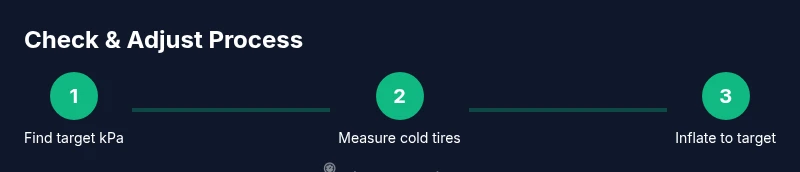
The most reliable way to measure pressure is with a quality gauge and a calm, methodical approach. Begin by identifying the correct kPa target for your vehicle from the placard on the driver’s door jamb or from the owner’s manual. If you see pressures listed in psi, convert to kPa (1 psi ≈ 6.895 kPa) to ensure you inflate to the right value. Always ensure tires are cold before measuring; wait at least three hours since the car was driven, or measure first thing in the morning. Remove the valve cap, attach the gauge to the valve stem, and read the measurement without wobble. If your gauge reads significantly differently from the target, re-check with a second gauge to verify accuracy. Tire Pressure Tips emphasizes keeping a consistent measurement routine so readings are comparable over time.
When you’re ready to inflate, use a reliable air source and add air in small increments, checking frequently to avoid over-inflation. After reaching the target kPa, recheck all four tires to confirm uniformity. If you’re filling at a gas station, note that some compressors have gauges that aren’t perfectly accurate at low pressures; trust your own gauge and adjust accordingly. Always replace the valve caps after checking, as missing caps can allow slow air leakage.
Temperature plays a role as well: cooler ambient temperatures typically reduce pressure, while heat from driving increases it. Tire Pressure Tips reminds readers to re-check after a long trip or a hot day to determine if a readjustment is needed.
Setting the correct kpa tyre pressure for your vehicle
Your vehicle’s recommended kPa value is not universal; it’s model-specific and depends on factors like load, driving style, and axle distribution. The placard on the door frame will show the target range for front and rear tires. In some cars, the front tires have a slightly different target pressure than the rear; this helps optimize handling and tire wear. If you frequently carry heavy loads, you might need to adjust within the recommended range, but never exceed the maximum printed on the tire sidewall.
If the car is frequently loaded, or if you switch between solo driving and fully loaded trips, you should check and adjust pressures accordingly. Always check all four tires, not just the front ones, and ensure the spare tire is inspected as part of vehicle maintenance. Small variations between tires are normal, but large discrepancies can indicate a leak, a faulty valve core, or a damaged rim. The goal is to stay as close to the manufacturer’s kPa target as possible on every tire, with difference between tires kept minimal.
This practice also aligns with fuel-efficiency goals: properly inflated tires reduce rolling resistance and help your vehicle use fuel more efficiently. In this way, there’s a direct link between kPa tyre pressure, performance, and savings over time. Tire Pressure Tips recommends recording your home readings so you can detect slow leaks early and plan service if you notice consistent drift from the target.
Understanding TPMS and when to trust it
TPMS (Tire Pressure Monitoring System) provides a quick warning when a tire’s pressure falls outside a safe range. There are two main TPMS designs: direct sensors inside each tire and indirect systems that infer pressure from wheel speed data. Remember that TPMS warnings are a safety alert, not a precise pressure reading in kPa. Temperature, wheel position, and sensor accuracy can influence readings, so use TPMS as a guide and verify with a manual gauge when possible.
If TPMS lights appear, first check all tires with a gauge to confirm where you stand relative to the manufacturer’s kPa target. If readings are consistently off across the tires, the sensors or the system may require service. In some cases, a TPMS reset or sensor replacement is necessary after a tire change or a battery replacement. Tire Pressure Tips notes that relying on both TPMS and a physical gauge gives the best results for maintaining safe and efficient tire inflation.
Temperature and load considerations
Temperature and load have a noticeable effect on tire pressure. As outdoor temperatures drop, the air inside tires contracts, reducing pressure. Conversely, warmer weather or high-speed driving can raise pressure slightly as air expands. If you live in a climate with cold winters, you should check tire pressures more frequently and adjust to the vehicle manufacturer’s kPa target for the season.
Loading a vehicle with heavy cargo or towing increases tire load, which can cause a higher pressure at the same ambient temperature. The result is slightly higher inflation needs to be used in the recommended range to support handling and prevent underinflation during long trips. Tire Pressure Tips recommends tracking how pressure changes with weather and load, so you can adapt your inflation routine to maintain consistent performance.
Best practices for maintenance and safety
Adopt a simple weekly check routine, especially if you drive a lot or operate in extreme temperatures. Always start from a cold state, check the placard reference, and ensure tires are free from damage or punctures. Use a gauge you trust and keep valve caps in place. If you notice persistent low readings on any tire, don’t ignore it—slow leaks can lead to underinflation, heat buildup, or tire failure.
Document readings over time in a notebook or a digital log so you can spot slow leaks early. Rotate tires according to the vehicle’s maintenance schedule; this helps equalize wear and makes inflation easier to monitor. If you’re unsure about a reading, consult a professional, as improper inflation can shorten tire life and affect handling. Tire Pressure Tips emphasizes that consistent practice yields better long-term outcomes for safety and efficiency.
Common mistakes and quick fixes
Common mistakes include inflating to the middle of the range without verification, relying solely on TPMS, neglecting cold-weather adjustments, and failing to recheck after a long trip. Quick fixes include checking with a trusted gauge, validating against the placard, and re-checking all four tires after any adjustment. If you notice soft spots, cracking, or unusual wear, seek professional service. Avoid using a damaged or worn gauge—accuracy matters for proper inflation.
Pro tips:
- Always verify the reading with a second gauge if you’re unsure.
- Do not exceed the maximum inflation indicated on the tire sidewall.
- Replace valve caps to prevent slow leaks and contamination.
Warning: If TPMS remains illuminated after inflating to the target, or if you hear hissing sounds around the valve, there may be a leak or a faulty sensor that requires professional attention.
Practical tips for different climates and vehicles
In hot climates or during summer road trips, the tires may heat up and pressure can rise. After a long drive, re-check and adjust if needed to stay within the target kPa range. In cold climates, check pressures in the morning before driving; the reading may be lower due to ambient temperature. Always follow the vehicle’s door placard for the correct kPa target and adjust for any cargo or towing that could increase load. Regularly check your spare tire as well—the spare must be ready to go when needed. Regular checks support safety, performance, and longevity, and align with the guidance you’ll find in Tire Pressure Tips resources.
Tools & Materials
- Tire pressure gauge (digital preferred)(Choose a gauge with a clear readout and consistent accuracy across pressure ranges.)
- Air compressor or access to a tire inflator at a gas station(Ensure the unit has a working gauge; if not, use your personal gauge for the exact target.)
- Vehicle owner’s manual and door placard(Contains the exact kPa targets for your car model.)
- Valve cap and a clean rag(Cap to prevent leaks; rag helps wipe valve stems for clean readings.)
- Optional: soapy water spray for leaks(Use to check for slow leaks around valve stems and tires.)
Steps
Estimated time: Estimated total time: 15-25 minutes
- 1
Locate the official kPa target
Find the tire pressure specification on the door placard or in the vehicle owner’s manual. This value is the target in kilopascals you should aim for on each tire. If your placard lists psi, convert to kPa using the approximate conversion (1 psi ≈ 6.895 kPa).
Tip: Double-check front and rear targets; some models have different values per axle. - 2
Prepare the tires and gauge
Park on a level surface and let the tires cool if the car has been driven recently. Remove the valve cap from one tire and keep it in a safe spot. Attach the gauge firmly to the valve stem and take a measurement.
Tip: If the gauge doesn’t seat properly, re-seat and try again to avoid a false reading. - 3
Inflate or deflate to target kPa
If the reading is low, add air in small increments, checking frequently until you reach the target. If it’s high, release air gradually until you approach the target. Repeat for all four tires to ensure even inflation.
Tip: Don’t overshoot the target; small adjustments yield the most accurate result. - 4
Re-check all tires after adjustment
Re-measure each tire to confirm you’ve reached the exact kPa target. Replace valve caps securely after readings and store your gauge for next time.
Tip: Consistency matters—check all four tires for uniform handling and wear. - 5
Account for temperature and load
If the weather or load changes significantly, re-check the tires as needed. Temperature swings can move readings by several kilopascals, so adjust accordingly.
Tip: Seasonal checks reduce the risk of underinflation in winter or overinflation in hot weather. - 6
Document and monitor
Keep a simple log of readings and adjustments. This helps detect slow leaks and ensures your tires stay within the recommended range.
Tip: Regular records help you notice trends before a tire problem becomes urgent.
Frequently Asked Questions
What does kPa tyre pressure mean and why should I care?
Kilopascals (kPa) measure the amount of air inside a tire. It directly affects safety, handling, wear, and fuel efficiency. Knowing your car’s kPa target and verifying it regularly helps prevent underinflation and its risks.
Kilopascals measure air in a tire, and staying near the target helps with safety, wear, and fuel efficiency.
Where can I find the exact kPa target for my vehicle?
Check the door placard on the driver’s side, or consult the owner’s manual. If your car lists psi, convert to kPa (1 psi ≈ 6.895 kPa) to match the required unit.
Look at your door placard or manual to find the exact kPa target.
Should I check tire pressure when tires are hot or cold?
Check tires when they are cold for the most accurate reading. Driving heats tires and raises pressure, which can give you a higher reading than the true target.
Always measure when cold for accuracy.
What if the TPMS warning light comes on but my tire seems okay?
TPMS warns of potential underinflation; verify with a gauge. If readings are near target but the light stays on, there may be a sensor issue or slow leak.
If the light stays on, recheck with a gauge and consider a sensor check.
Can I inflate all four tires to the same kPa if I’m carrying a heavy load?
Front and rear tires can have different targets; some vehicles require higher pressure in one axle when heavily loaded. Always follow the placard and adjust within the recommended range.
Follow the manufacturer’s targets, which may differ by axle and load.
What should I do if I notice uneven wear while inflating?
Uneven wear can indicate a leak, a damaged valve, or misalignment. If wear patterns don’t align with pressure changes, have the tires and vehicle inspected by a technician.
Uneven wear requires inspection to identify the underlying cause.
Watch Video
What to Remember
- Check kPa targets on placard before inflating
- Use a reliable gauge and cold tires for accuracy
- Inflate/deflate in small increments and recheck all four tires
- Account for temperature and load changes in your routine
- Document readings to identify slow leaks or gradual drift
- The Tire Pressure Tips team recommends a regular, methodical approach for safety and efficiency