What Is Good Tire Pressure for the Toyota RAV4
Discover the optimal cold tire pressure for the Toyota RAV4, how to measure it accurately, and how to adjust for load and seasonal changes. Practical tips from Tire Pressure Tips.


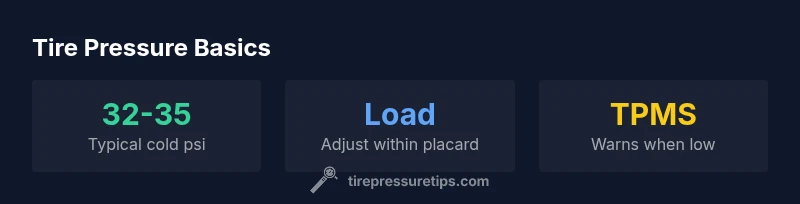
Typical cold tire pressure for most Toyota RAV4 models sits in the 32-35 psi range, with front tires often at the higher end. Always confirm the exact value on the door placard, then adjust for load and speed. Avoid inflating to the sidewall maximum, which is a safety limit, not a target. For precise guidance, refer to your model-year’s specifications.
Why Tire Pressure Matters for a RAV4
Maintaining proper tire pressure is a foundational aspect of vehicle safety, fuel efficiency, and tire longevity. For the Toyota RAV4, the “what is good tire pressure for rav4” question hinges on cold readings taken when the tires are at ambient temperature, not after a long drive. Tire pressure affects rolling resistance, traction, and cornering stability, particularly important in family-oriented SUVs like the RAV4 that see a mix of city commuting and light off-road use. According to Tire Pressure Tips, staying within the manufacturer’s recommended range reduces the risk of uneven tread wear and improves overall handling. The recommended range is not a single number for every situation; it includes a range that accommodates different loads, speeds, and tire types. By starting within the placard-specified band, you set a reliable baseline that helps you gauge when adjustments are truly needed.
How to Find Your Exact Recommendation (RAV4)
To determine the precise tire pressure for your RAV4, start with the door placard located on the driver’s door jamb. This placard lists the cold pressure values for the front and rear tires, typically presented as two numbers. If you’re carrying extra cargo or passengers, you may need to adjust within the recommended band. For model-year nuances and trim-specific variations, consult the owner’s manual and any official Toyota guidance for your exact configuration. If you don’t have the placard handy, call or visit a dealership with your VIN, and they can confirm the target pressures. Regularly checking the placard helps you avoid the common mistake of inflating to a visually “firm” tire, which can be misleading. Having a trusted gauge and a quick routine makes this process quick and repeatable.
Cold vs. Hot Tires: How Temperature Changes Pressure
Tire pressure readouts vary with temperature. Cold readings (before driving) reflect the pressure you should aim for; after driving, pressures rise due to heat. In colder months or in climates with frequent temperature swings, you may notice noticeable pressure changes from morning to afternoon. The general rule is to check pressure when tires are cold, ideally before a drive or after the car has sat for several hours. If you must top up after a trip, recheck once the tire cools to confirm you haven’t overshot the target range. This nuance is especially relevant for the RAV4, which is commonly used in all-season conditions.
Front vs Rear Pressure on the RAV4 and Why They Differ
Most RAV4 configurations have slightly different targets for front and rear tires. The front tires often require higher inflation due to weight distribution and steering loads, while the rear tires carry a different load pattern that can tolerate a slightly lower target within the placard range. Don’t assume uniform pressure across all four tires; check the placard numbers for each axle and adjust accordingly. If you frequently carry heavy loads, you might see the rear numbers shift within the recommended band. Keeping the front slightly higher can help maintain balanced handling and steering feel.
Considering Load, Speed, and Tire Type
The official recommendation for the RAV4 isn’t static; it accounts for load, driving style, and tire type. Heavier cargo or passengers increase axle load, which may justify a slight pressure increase within the specified range. If you’re using winter tires or low-rolling-resistance tires, consult the tire maker’s guidance and Toyota’s notes for any model-year-specific adjustments. Performance-oriented trims or highway driving at higher speeds may also justify staying toward the upper end of the band for stability. Always verify with the placard and your tire’s load index to ensure compatibility.
Measuring Pressure Accurately: Tools and Techniques
Invest in a quality tire pressure gauge and learn a simple routine. Before measuring, ensure the tire is cold, remove the valve cap, place the gauge onto the valve stem, and read the pressure directly. If the gauge shows lower than the placard value, add air in small increments, rechecking after a minute for stabilization. Avoid rapidly wobbling the gauge or letting air escape while reading. If you have an automated air pump, you can set the target PSI, but always verify with a manual gauge. Accurate readings depend on temperature awareness, proper gauge calibration, and a consistent measurement procedure.
Common Mistakes and How to Avoid Them
A few frequent errors undermine accuracy: inflating to the sidewall max, using a hot tire reading, or neglecting to consider load. The max PSI on the tire’s sidewall is the limit, not the target; overinflation can reduce traction and increase ride stiffness. Hot readings give a false sense of security; always measure when cold. Also, neglecting variations between front and rear pressures can lead to uneven tire wear and handling quirks. Establish a routine, and keep a small gauge in the glove box for frequent checks.
Seasonal Guidance: Winter, Summer, and TPMS
Seasonal changes affect tire pressure. Colder temperatures reduce pressure, so you may need to top up slightly in fall and winter to stay within the placard range. Conversely, hot summer days can increase pressure, so you may need to release a small amount to avoid overinflation. For RAV4 owners, a quick monthly check—especially during seasonal transitions—helps maintain consistent performance. If you notice frequent TPMS warnings during the winter, it may indicate a colder ambient environment or a leak; consult a professional if needed.
TPMS and Sensor Maintenance for Your Rav4
TPMS is a safety feature that helps monitor tire pressure and alert you to underinflation. If you inflate to the correct range and still see a warning, you may have a sensor issue or a slow leak. Replacing or diagnosing TPMS sensors often requires professional equipment and calibration. Regular tire inspections, including checking valve stems for leaks and ensuring sensor batteries are functional, support accurate readings. For most drivers, a routine check-in to verify both the flat-spot and tread depth, alongside pressure, keeps overall vehicle safety at a high level.
RAV4 Tire Pressure Quick Reference
| Item | Recommended Pressure (cold) | Notes |
|---|---|---|
| Front axle pressure | "32-35 psi" | "Varies by model and load" |
| Rear axle pressure | "32-34 psi" | "Often slightly lower than front" |
| Load adjustment | "+/- 1-2 psi" | "Based on cargo and passenger weight" |
| Seasonal effect | "Cold temps reduce pressure" | "Check pressure after cold soak" |
Frequently Asked Questions
What is the recommended tire pressure for a Toyota RAV4?
Check the door placard on the driver’s door jamb for the exact front and rear pressures. The range typically falls within the low 30s psi, but model-year and load can shift the ideal value.
Check the door placard; keep within the official range, adjusting for load.
Can I inflate tires to the max PSI listed on the sidewall?
No. The sidewall max is a limit, not the target. Use the placard values and only go up to those within the allowed range.
Don't use the sidewall max as the target; follow the placard.
How does load affect tire pressure on a RAV4?
Heavier loads may require a slight increase within the recommended range. Always verify against the placard and adjust gradually.
If you’re carrying a lot, you might need a small increase within the range.
Does TPMS require recalibration after adjusting pressure?
Not always. Some systems recalibrate automatically after inflation. If warnings persist, drive for a short distance and verify.
Usually auto-calibrates; drive a bit if warnings linger.
How often should I check tire pressure?
Check at least monthly and before long trips, especially during seasonal transitions.
Monthly checks keep you in the safe range.
What about winter tires and pressure on a RAV4?
Winter tires may respond differently to temperature fluctuations. Follow the placard and check pressure more frequently in cold weather.
Follow placard, check more often in winter.
“Maintaining proper tire pressure is one of the most cost-effective ways to improve safety, fuel efficiency, and tire longevity.”
What to Remember
- Check the door placard first for exact numbers
- Measure cold for accuracy and consistency
- Adjust within the recommended range for load
- Use a reliable gauge and verify after inflation
- Seasonal temperature changes matter for readings