How to Check Tire Pressure on Toyota RAV4
Learn how to check and adjust tire pressure on a Toyota RAV4. This step-by-step guide covers cold-pressure targets, TPMS awareness, gauge choices, and safety tips to maintain tire health and fuel efficiency.


This guide shows you how to check tire pressure on a Toyota RAV4 accurately and safely. You’ll learn the recommended cold-inflation pressures for all tires, how to use a tire pressure gauge (digital or analog), and how to interpret TPMS alerts. By following these steps, you’ll improve fuel efficiency, tire wear, handling, and overall safety on the road.
Why Checking Tire Pressure on a Toyota RAV4 Matters
Maintaining correct tire pressure isn’t just about avoiding a flat or a ding on your wheel rim. For a Toyota RAV4, proper inflation supports predictable steering, balanced handling, and even tire wear across the all-season tires many drivers choose for daily commuting or weekend adventures. Underinflated tires generate more rolling resistance, which can lower fuel efficiency and increase engine load over long trips. Overinflated tires can reduce the tire’s contact patch with the road, resulting in harsher rides and faster wear in the center of the tread. Regular checks also help you spot slow leaks early, giving you time to address punctures or wheel valve issues before they become roadside problems. According to Tire Pressure Tips, instituting a simple monthly routine keeps you aware of changes that occur due to weather, loading, or tire maintenance. The habit pays off in safer braking, steadier cornering, and longer tire life, all of which matter whether you drive a compact commuter or a family-friendly RAV4.
Tools & Materials
- Tire pressure gauge (digital preferred)(Accurate readings; check calibration occasionally)
- Owner's manual or door placard(Exact cold-inflation values for your RAV4)
- Air compressor or access to gas station with air pump(To adjust tire pressures quickly)
- Valve cap wrench or small tool (optional)(Ease of removing caps; avoid losing them)
- Soap and water (optional)(Detect slow leaks around valve stems)
Steps
Estimated time: 10-15 minutes
- 1
Find the target pressure on the placard
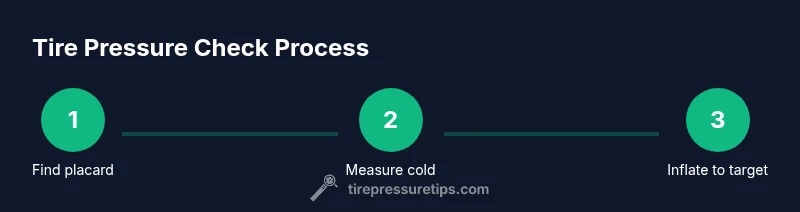
Open the driver’s door and read the tire section on the placard. Note the values for both front and rear tires and for normal vs heavy-load conditions if listed. This is your cold-inflation target before any driving has heated the tires.
Tip: Double-check that you’re reading the placard for the correct tire position (front vs rear). - 2
Ensure tires are cold
Take measurements only after the car has been parked for several hours or after the car has cooled down overnight. Measuring hot tires gives inflated readings that don’t reflect the target cold value.
Tip: If you’ve just driven, wait at least 3 hours before measuring. - 3
Remove the valve cap
Loosen and remove the valve cap to expose the valve stem. Put the cap somewhere safe so it doesn’t get lost while you measure.
Tip: Keep the cap in your pocket or on the tool tray during measurement. - 4
Attach the gauge and read the pressure
Firmly press the gauge onto the valve stem and take a steady, single reading. If you’re using a digital gauge, read the displayed number; with an analog gauge, read the indicator on the scale.
Tip: Repeat once to confirm accuracy; a single reading can be affected by a quick breath of air. - 5
Inflate or deflate to the target
If the reading is below the placard value, add air until you reach the target. If it’s above, release air in small increments until you’re within range.
Tip: Don’t exceed the maximum inflation printed on the sidewall; use the placard as your guide. - 6
Re-check the inflated tires
After inflation, re-measure to confirm you’ve hit the target. Reattach the valve cap after you’re done.
Tip: Take a second measurement to ensure consistency, especially on older tires. - 7
Check the spare tire pressure
If your Rav4 has a spare tire, don’t neglect it. Check its pressure per the placard or owner’s manual and inflate if needed.
Tip: Spare tires can lose air over time even when not used. - 8
Record readings and set a reminder
Log the pressures in a notebook or notes app and set a monthly reminder to re-check. This creates a habit and helps you track changes over seasons.
Tip: Keep the log near your toolkit for easy reference.
Frequently Asked Questions
Do I need to check tire pressure when tires are hot or cold?
Check tire pressure when the tires are cold for accurate readings. Heat from driving temporarily increases tire pressure and skews results. If you’ve been driving, wait several hours before measuring.
Always check when cold; hot readings aren’t reliable.
What if the TPMS light stays on after inflating?
A TPMS light after inflation may indicate a sensor issue or a slow leak somewhere in the system. Inspect valve stems and tires, and consider a professional diagnostic if the light remains.
If the light stays on after inflation, you may have a sensor problem—get it checked.
Can I use any tire gauge?
Yes, but accuracy matters. Digital gauges are easier to read and typically more precise; ensure you calibrate and store it properly.
Digital gauges are recommended for accuracy.
How often should I check tire pressure?
Aim to check at least once a month and before long trips, especially with seasonal changes or heavy loads.
Monthly checks and before trips are wise.
Should I check spare tire pressure?
Yes. Keep the spare inflated to the recommended pressure so you’re ready if you need it.
Keep the spare properly inflated too.
What is cold-inflation pressure?
Cold-inflation pressure is the value specified on the placard, measured when the tire is cold and at room temperature.
It’s the value listed on the placard when the tire is cold.
Watch Video
What to Remember
- Check tires when cold before trips.
- Match pressures to the placard values.
- Use a reliable gauge and recheck to confirm.
- Don’t forget the spare tire.
- Set a monthly check reminder.