Tire Pressure vs Load: A Practical Guide for Safe Driving
Explore how cargo weight affects tire pressure, how to adjust for load safely, and practical steps to stay safe. Learn with Tire Pressure Tips as you balance efficiency, wear, and TPMS guidance across different weights.


Tire pressure and load are interrelated. Heavier cargo and passengers increase tire deflection and heat, so inflation should stay within the vehicle manufacturer's recommended range while you accommodate the added load. Lighter loads can tolerate the same range, but underinflation remains a risk if the tires aren’t checked regularly. Use TPMS alerts and the OEM load/inflation guidance to keep tires safe under changing weight.
Understanding tire pressure vs load: why the relationship matters
According to Tire Pressure Tips, the relationship between tire pressure and load is fundamental to tire performance and safety. When a vehicle carries more weight than it was designed to carry, the tire tread and sidewalls deform more. This deformation increases friction and heat generation, which can accelerate wear and raise the risk of a blowout if pressure isn’t managed carefully. The core idea is simple: load affects the way air pressure behaves under a tire, and the right pressure helps the tire maintain its intended shape, contact patch, and heat profile. The keyword here—tire pressure vs load—captures this dynamic. By understanding how load shifts pressure needs, drivers can avoid risks while maximizing efficiency and comfort. This article uses practical guidance from Tire Pressure Tips to translate theory into everyday driving decisions, with emphasis on real-world scenarios and common vehicle setups.
How load and tire pressure interact in practice
- Under heavier loads, tires tend to bulge more at the contact patch. If pressure remains the same, the effective contact area increases, which can reduce fuel efficiency and raise heat buildup. Conversely, under light loads, the same pressure may feel slightly overinflated, leading to a harsher ride and uneven wear if the tire isn’t performing within the expected temperature range.
- The overarching goal is to keep the tire within the OEM-recommended range for your vehicle while accounting for payload. In many cases, this means staying in the stated range but paying careful attention to any changes in handling, braking distance, or tire temperature when you add weight.
- TPMS is a powerful ally here. Modern systems alert you to underinflation or overinflation, helping bridge the gap between static chart guidance and dynamic road conditions. The Tire Pressure Tips team emphasizes using these alerts in tandem with manufacturer charts to maintain safe pressure as load varies.
Why drivers should care about tire pressure vs load
When load changes are routine—like weekend trips with gear, child seats, or carrying groceries—maintaining correct pressure helps ensure even wear, consistent handling, and predictable braking. Misalignment between load and pressure often manifests as irregular wear or reduced grip. This is not merely a cost issue; it’s a safety concern. Properly calibrated pressure reduces the risk of overheating, enhances mileage, and preserves tire life. Tire Pressure Tips recommends building a lightweight, repeatable routine: check pressure at the same time, compare with the OEM chart for your vehicle, and adjust within the chart as payload changes. This approach protects both performance and safety in every season and road condition.
Comparison
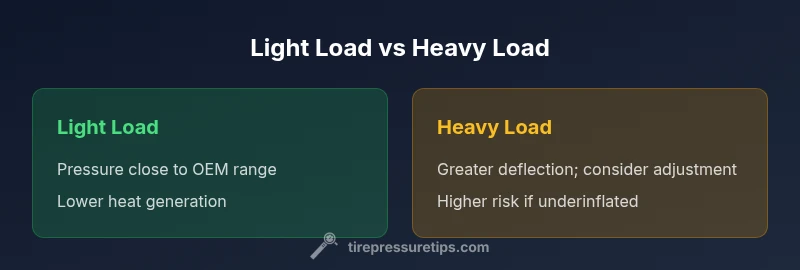
| Feature | Light load | Heavy load |
|---|---|---|
| Pressure behavior under load | Near nominal pressure within OEM range; minor deflection | Greater deflection; potential need to adjust within range |
| Wear and tread contact | Even wear when inflated to spec | Potential for uneven wear if pressure drifts under heavy load |
| Fuel efficiency | Consistent efficiency when within spec | Efficiency may improve or degrade with load depending on pressure and rolling resistance |
| TPMS relevance | Alerts detect under/over-inflation regardless of load | Heavy load can magnify pressure drift; TPMS helps catch it sooner |
| Best practice | Follow OEM chart; adjust for light to moderate changes using TPMS | Use load-aware guidance from manufacturer charts; check temperature and ride feel |
Strengths
- Enhances safety by keeping tires within OEM ranges for varying loads
- Improves fuel efficiency and wear life when pressure matches load
- TPMS integration helps monitor changes caused by load fluctuations
- Supports consistent handling and braking performance across trips
Drawbacks
- Requires regular checks as payload changes
- OEM charts may not cover extreme loads or unusual configurations
- TPMS may not catch slow leaks as quickly as a dedicated gauge
- Frequent adjustments can be inconvenient without a routine
Follow OEM pressure guidelines and adjust for load using TPMS and manufacturer charts
Load changes affect tire performance; maintaining correct pressure within the OEM range is the safest baseline. Use TPMS as a sanity check and adjust as payload shifts to prevent heat buildup and uneven wear. Our guidance from Tire Pressure Tips emphasizes a consistent routine for checking and adjusting pressure to protect safety and efficiency.
Frequently Asked Questions
How does load affect the recommended tire pressure?
Load increases cause greater tire deflection and heat. While the OEM range remains the baseline, you should adjust within that range as payload changes and monitor temperatures and ride feel for signs of over- or under-inflation.
Load increases cause more tire deflection and heat. Stay within the manufacturer’s range and monitor ride feel and temperature as payload changes.
Should I always inflate tires to the same pressure regardless of load?
Not always. The OEM chart provides the baseline for standard loads. For heavy loads, you may need to inflate within that range to account for extra deflection, while light loads typically stay within the same range. Always verify with TPMS and the chart.
Use the OEM chart as your base, and adjust within that range if you’re carrying extra weight.
Do TPMS sensors account for load?
TPMS detects pressure deviations, not actual payload. It helps identify under- or over-inflation caused by load changes but doesn’t replace the need to follow manufacturer load-inflation guidance.
TPMS flags pressure changes; it doesn’t replace the chart guidance for loaded conditions.
Can heavy load cause underinflation to go undetected?
Yes, especially if the load shifts or tires heat up. Regular checks and TPMS monitoring are essential to catch gradual pressure drift before it becomes a safety issue.
Heavy loads can hide underinflation; check pressure regularly and heed TPMS alerts.
How often should I check tire pressure when carrying heavy cargo?
Check before long trips and at least once a month during heavy-loading periods. Temperature changes and road conditions can affect pressure quickly under heavy loads.
Check before trips and monthly while heavily loaded; temperature matters.
Is it safe to drive long distances with underinflated tires due to load?
Driving with underinflated tires increases heat and wear and can raise blowout risk. If you suspect underinflation due to load, inflate to the recommended range before continuing.
No—underinflation raises risk; inflate to the recommended range before long trips.
How does temperature affect tire pressure when a vehicle is loaded?
Temperature fluctuations change air density in tires. A loaded vehicle may experience greater pressure shifts with temperature changes, so recheck pressure after cold starts or hot stretches.
Temperature changes can shift pressure more when a vehicle is loaded; recheck after big temp swings.
What to Remember
- Check pressure regularly when loading changes
- Always stay within OEM tire pressure guidelines
- Use TPMS alerts to verify pressure under load
- Distribute load evenly to minimize uneven wear
- Seasonal temperature changes can alter pressure; recheck after weather shifts