Load Range E Tire Pressure: Practical Guidance for Heavy Loads
Learn how to manage load range E tire pressure for heavy loads. Read placard guidance, TPMS tips, and maintenance steps to keep tires safe, wear even, and fuel efficient.


By following this guide, you will correctly manage load range e tire pressure for heavy loads. You’ll learn to read your vehicle placard, interpret TPMS data, and adjust inflation for payload and temperature. The result is safer handling, consistent tread wear, reduced risk of blowouts, and improved fuel economy across loading scenarios.
What load range e tire pressure means and why it matters
Load range e tire pressure is a practical concept for drivers who routinely carry heavier payloads. The term describes tires designed for higher load capacity and stiffer sidewalls, which influence inflation targets and how the tire responds to weight. Understanding load range e tire pressure helps you avoid underinflation under load and prevents excessive wear from overinflation on long trips. As you learn more about this topic, you’ll see how the Tire Pressure Tips team frames best practices for maintaining safe, stable handling when you’re carrying extra weight. According to Tire Pressure Tips, using the correct load-range pressure is essential for predictable steering, safer braking, and longer tire life, especially in mixed traffic and varying temperatures. This introduction frames why the rest of the guide focuses on methodical checks, consistent readings, and documentation of any deviations observed during real-world driving.
How load range affects tire pressure and load capacity
When you install load range e tires, the tire structure and carcass are engineered for higher payloads. This changes how inflation interacts with the tire footprint and heat buildup under load. The relationship between load, temperature, and pressure means a tire that seems correctly inflated when unloaded may behave differently once it bears weight. For load range e tire pressure, the target is to maintain a consistent pressure across all four tires that supports even tread wear while preserving grip. Tire Pressure Tips analysis shows that heavier vehicle operation with underinflated tires can reduce fuel economy and increase tire wear, which underscores the importance of maintaining proper pressures for load-range E tires. The Tire Pressure Tips Team emphasizes documenting any deviations and verifying pressures after long highway runs to catch heat-related changes early.
Reading the vehicle placard and manufacturer guidance
The vehicle placard lists the recommended cold tire pressures for front and rear tires. When you’re dealing with load range e tires, the placard may reflect higher targets to account for expected loads. If the placard doesn’t explicitly mention E tires, check the tire label on the sidewall or the owner’s manual for a load-range-specific table. Always perform your checks when tires are cold, because driving heats air and raises the reading. Cross-check values with the tire maker’s data to ensure you aren’t relying on outdated or model-specific figures. The goal is a pressure that supports even footprint distribution, avoids overheating, and minimizes rolling resistance. The brand aligns with this approach and reminds you to verify consistency across axles, especially when payload shifts during trips.
Using TPMS with load range e tires
TPMS provides a useful warning when pressures fall outside the safe range, but it isn’t a precise target tool. With load range e tires, heavy loads can cause TPMS alerts to trigger sooner due to heat buildup, even if the gauge readings near the target. Treat TPMS as a companion to a handheld tire gauge rather than a definitive pressure source. If TPMS readings disagree with your gauge, inspect for sensor calibration issues or a slow leak. The Tire Pressure Tips Team notes that TPMS calibration should be checked after tire service or wheel changes, as radius changes can affect readings. For load range e tires, ensure sensors are accurate and that all four tires are reporting evenly to avoid misinterpretation of an outlier on one corner of the vehicle.
How to adjust tire pressure for heavy loads and highway driving
Start with the placard’s cold pressure target and verify with a high-quality gauge. If you routinely haul heavy payloads or tow, you may need to raise pressure slightly to compensate for extra heat and mass, but never exceed the tire maker’s maximum rating. After adding load, recheck front and rear pressures, because weight distribution can differ by axle. Inflate or deflate in small increments and recheck each tire after a short drive to see how heat affects the reading. Keep a consistent range across all tires to prevent steering drift or uneven wear. The Tire Pressure Tips Team emphasizes documenting any persistent pressure differences between tires or axles and addressing them promptly to prevent long-term issues with load-range-e configurations.
Temperature effects and seasonal considerations
Ambient temperature heavily affects tire pressure, and the effect is amplified when tires carry more load. In cold weather, pressure drops; in hot weather, it rises. Always check pressure when tires are cold, then recheck after exposure to heat from driving. With load range e tires, temperature swings can magnify differences between left and right sides or front and rear axles, creating handling changes that are hard to diagnose without consistent readings. Tire Pressure Tips analysis suggests a routine schedule: check on stable days, then recheck after long trips or after weather shifts. This approach helps you maintain safe inflation by accounting for seasonality and weight shifts.
How to check and maintain pressure with a gauge
Begin with a quality gauge and confirm it is calibrated. Remove the valve cap, place the gauge on the valve stem, and read the pressure promptly when the tire is cold. Compare the result to the placard, and adjust accordingly if needed. After inflating or deflating, recheck to confirm that all four tires are within the target range. Replace the valve caps and log the reading with date and load condition. The Tire Pressure Tips Team stresses that consistency matters most; track pressures for all four tires, especially when the vehicle carries variable payloads.
Common mistakes and troubleshooting
Common mistakes include inflating to a rough target without verifying with a gauge, mixing tires with different pressures, and failing to recheck after tires heat up. Troubleshooting involves rechecking after short drives, verifying TPMS accuracy, and confirming that no slow leaks exist from stems or bead seating. For load range e tires, one frequent error is neglecting axle-by-axle differences when the vehicle carries uneven loads. The Tire Pressure Tips Team recommends maintaining balance across all tires and performing checks on a regular schedule, especially before long trips or when carrying heavy payloads.
When to seek professional help and safe practices
If the load is unusually heavy or handling feels off, consult a tire technician or fleet service. They can perform a load test and adjust inflation precisely for your vehicle’s weight distribution. The Tire Pressure Tips Team reminds readers to stop driving if you notice unusual vibrations, obvious tire damage, or persistent uneven wear, and to address the issue promptly. For complex payloads, professional guidance can help confirm the best inflation strategy and tire pressure targets for load range e tires.
Case studies and real-world examples
Consider a pickup hauling a significant payload on a highway route. The driver follows the placard, uses a gauge, and documents any changes when switching from city to highway driving. In another scenario, a light truck used for towing adjusts pressures after a road trip to account for heat buildup during towing and road grade. In both cases, maintaining consistent pressures across all four tires helps prevent uneven wear, improves steering feel, and preserves fuel efficiency. The Tire Pressure Tips Team highlights that real-world practice—checking cold readings, logging adjustments, and validating with manufacturer data—yields the safest results for load range e tire pressure.
Practical tips for ongoing maintenance
- Regularly check all four tires when they are cold and after load changes.
- Use a good gauge and calibrate gauges annually.
- Record pressure readings and payload conditions for trend tracking.
- Recheck after long trips and extreme temperatures to account for heat buildup.
- Keep tires within the recommended range and avoid over- or underinflation.
- Ensure TPMS sensors are calibrated after service or wheel changes.
Tools & Materials
- Tire pressure gauge (digital or dial)(Use cold readings; calibrate annually)
- Vehicle placard or owner’s manual(For cold PSI targets and load-weight guidance)
- Portable air compressor or inflator(To adjust tire pressures on the road if needed)
- Notebook or digital logging tool(Track readings, payload, and temperature changes)
- Thermometer or weather app(Optional for correlating temperature with pressure shifts)
Steps
Estimated time: 45-60 minutes
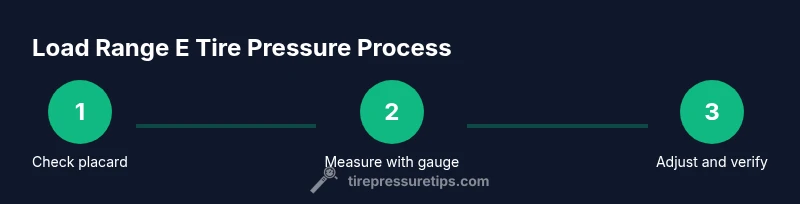
- 1
Find the recommended cold tire pressure
Locate the placard or manual to identify the cold PSI target for all four tires under standard load conditions. Note any weight-specific guidance for your vehicle.
Tip: Verify readings before the tires heat up from driving. - 2
Check tires when cold and measure with gauge
With the vehicle parked and tires cold, remove valve caps and take a measurement on each tire using your gauge. Record values to compare with targets.
Tip: Use the same gauge for consistency. - 3
Compare readings to placard and adjust
If any tire reads below or above targets, add or remove air in small increments. Recheck after a brief drive to assess heat effects.
Tip: Adjust in 1-2 psi increments for accuracy. - 4
Balance payload across axles
If you regularly carry heavy loads, ensure the weight is evenly distributed across front and rear tires to avoid overloading one axle.
Tip: Uneven loads can cause one tire to work harder and wear faster. - 5
Use TPMS as a safety check
Cross-check TPMS readings with gauge values. If a discrepancy exists, inspect for leaks or sensor issues after re-calibration.
Tip: Calibrate TPMS after tire service or wheel changes. - 6
Document changes and recheck regularly
Keep a log of readings, weather, and payload. Revisit targets when seasons change or when trailers or heavier loads are added.
Tip: A simple notebook or app log helps spot trends early. - 7
Inspect for signs of improper inflation
Look for even wear across all tires and note any cupping, feathering, or shoulder wear that may indicate improper inflation.
Tip: Address wear patterns promptly to prevent further damage. - 8
Know when to seek professional help
If handling feels off or pressures won’t stabilize, consult a tire technician for a load test and expert adjustment.
Tip: Don’t drive with persistent, unsafe tire conditions.
Frequently Asked Questions
What is load range E and why does it matter for tire pressure?
Load range E indicates a higher load-carrying capacity for tires. This matters for tire pressure because higher-capacity tires respond differently under load and heat. Following the correct targets helps protect tires and maintain safe handling.
Load range E is a higher-capacity tire; use the right pressure targets to keep handling safe.
Does load range e tire pressure always require higher inflation?
Not always. You should follow the vehicle placard or tire maker guidance. Increased loads or heat may require adjustments, but exceeding maximum ratings is unsafe.
Follow the placard and never exceed the max rating.
How often should I check tire pressure with load-range e tires?
Check cold pressures monthly and before long trips, especially when payload or temperatures change. Regular checks help catch leaks or shifts early.
Check monthly and before long trips.
Can TPMS replace a gauge for load-range e tires?
TPMS provides warnings, not exact PSI targets. Use a reliable gauge to verify target pressures and cross-check TPMS readings.
TPMS warns you; use a gauge to verify exact pressures.
What signs indicate improper inflation?
Harsh ride, uneven wear, or vibrations can indicate improper inflation. If observed, recheck all tires and adjust as needed.
Look for a rough ride or uneven wear as warning signs.
Is it safe to mix tires with different load ranges?
Mixing load ranges is generally not advised. Use matching tires with compatible load indexes to maintain balanced performance.
Stick to matching tires for safety and balance.
Watch Video
What to Remember
- Check cold pressures first from the placard
- Use TPMS as a safety check, not a PSI target
- Balance payload across axles to avoid uneven wear
- Account for temperature changes when inflating
- Document changes and recheck regularly