Digital Tire Pressure Guide: Mastering Readings with a Digital Gauge
Learn how to use a digital tire pressure gauge, interpret TPMS readings, and maintain optimal tire pressure year-round with practical steps, tips, and safety notes from Tire Pressure Tips.


You will learn how to measure and adjust tire pressure using a digital gauge, interpret TPMS indicators, and establish a practical maintenance routine. You’ll need a digital tire pressure gauge, an inflator, and your vehicle’s recommended psi. This guide emphasizes accuracy, safety, and consistency to improve fuel efficiency and tire life.
What digital tire pressure means and why it matters
Tire pressure digital readings come from directly measuring the air pressure inside each tire with a digital gauge. This method provides a numeric value you can trust to reflect the current state of the tire, rather than relying on TPMS alerts alone. Accurate readings help ensure even tire wear, better fuel efficiency, and safer handling. When you compare digital readings to the vehicle manufacturer’s recommended pressure, you align your tires with the best balance of ride quality and fuel economy.
In Tire Pressure Tips’ approach, the emphasis is on repeatability and verification. Digital tire pressure tools, when used consistently, reduce uncertainty and help you catch slow leaks early. Remember: the goal is to maintain the recommended psi across all tires, including the spare, and to adjust for the load and driving conditions. The concept of tire pressure digital becomes practical when you treat readings as data you log and verify over time. This is especially important for owners who drive in variable weather and seasons across 2026.
wordCountBlock
Tools & Materials
- digital tire pressure gauge(Choose a unit switchable model with psi/kPa; seek ±1 psi accuracy)
- air inflator / compressor(Ensure it can reach at least 60 psi and has a gauge if necessary)
- valve-cap removal tool or clean rag(Keep caps clean and accessible; store in glove box)
- vehicle owner’s manual or placard(Use it as the reference for recommended psi values)
- logbook or app for readings(Track psi over time to spot slow leaks)
- backup gauge (optional)(Cross-check readings if you suspect inaccuracy)
Steps
Estimated time: 15-25 minutes per vehicle check
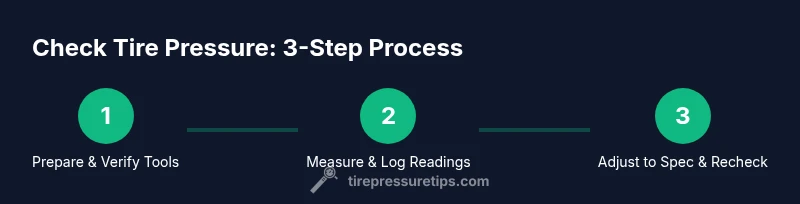
- 1
Prepare tools and vehicle
Assemble your digital gauge, inflator, rag, and logging method. Park on a flat surface and ensure the car is cool before testing. This reduces measurement variance and avoids unsafe pumping conditions.
Tip: Have a clean workspace and record the vehicle’s psi target from the placard. - 2
Check tires when cold
Tires should be cold for a baseline reading. If you’ve just driven, wait at least 3 hours or cool down before testing to avoid inflated readings.
Tip: Avoid testing immediately after a trip to prevent overestimating pressure. - 3
Attach gauge and read
Remove the valve cap, attach the digital gauge straight onto the valve stem, and read the display. Note psi and the unit (psi or kPa) shown by the gauge.
Tip: Make sure the gauge is seated squarely to prevent air leakage during measurement. - 4
Compare with the spec
Find the recommended tire pressure on the door placard or in the owner’s manual. Compare the measured psi to this spec for each tire.
Tip: Record the reading to a log to track changes over time. - 5
Adjust as needed
If low, add air in small increments (2–3 psi at a time) and recheck. If high, release air slowly and recheck. Do not overshoot the target.
Tip: Always return to the target pressure on all four tires after adjustments. - 6
Recheck and seal
Recheck all tires after adjustments and reinstall valve caps. Confirm the log reflects the final values.
Tip: Close the valve caps securely to protect against dust and leaks.
Frequently Asked Questions
What does tire pressure digital mean?
It refers to using a digital gauge to measure air pressure at the valve stem, providing a numeric psi value for accuracy and monitoring. This complements TPMS alerts by giving you exact readings.
Digital tire pressure means using a digital gauge to get an exact psi reading at the valve stem, which helps you verify TPMS indicators.
Are TPMS readings the same as gauge readings?
Not always. TPMS shows a warning when pressure is low, but it doesn’t always display the exact psi for each tire. A gauge provides precise numbers you can verify against the spec.
TPMS warns you, but a physical gauge gives the exact pressure so you can verify and adjust.
How often should I check tire pressure?
Check monthly and before long trips, ideally when tires are cool. Regular checks help catch slow leaks and maintain even wear.
Check at least once a month and before trips, when tires are cool.
Can digital gauges be inaccurate?
Yes. Gauges can drift or become damaged. If readings seem off, test with a second gauge or recalibrate if your model supports it.
Gauges can drift; compare with another gauge if readings seem off.
Do I need to reset TPMS after adjusting pressure?
Usually not. If you adjust to the recommended spec, the TPMS should reflect normal pressure during driving. Some vehicles require a reset after tire changes or sensor work.
Most of the time you don’t need a TPMS reset after adjusting pressure, unless you’ve changed tires or sensors.
What if one tire reads differently from others?
Inspect for a slow leak, puncture, or damaged valve stem. If readings remain inconsistent, seek professional inspection to avoid unsafe driving.
If one tire reads differently, check for leaks or damage and consider a professional check.
Watch Video
What to Remember
- Measure when cold to ensure accuracy.
- Always target the manufacturer’s psi spec.
- Use a digital gauge for precise readings.
- Log readings to detect slow leaks.
- Recheck after any adjustment for reliability.