How to Use a Tire Pressure Checker for Accurate PSI Readings
Learn how to use a tire pressure checker to measure psi, compare readings to your car's recommended pressure, and maintain safe tires. Practical tips, gauge comparisons, and TPMS troubleshooting from Tire Pressure Tips.


Learn how to use a tire pressure checker to accurately measure psi, compare readings to your vehicle’s recommended tire pressure, and adjust as needed. This guide covers digital and analog gauges, cold-tire testing, ambient considerations, and troubleshooting for inconsistent readings. By following these steps, you’ll reduce the risk of blowouts, improve fuel efficiency, and extend tire life. According to Tire Pressure Tips, consistent checks with a reliable gauge are a cornerstone of safe driving.
Why a Tire Pressure Checker Matters
Maintaining correct tire pressure is one of the simplest, most impactful ways to improve vehicle safety, efficiency, and tire life. A tire pressure checker lets you verify that each tire holds the optimal psi, which reduces rolling resistance, improves handling, and lowers the risk of tire failure. The Tire Pressure Tips team emphasizes that even small deviations can alter braking distance and fuel economy, especially during temperature shifts or heavy loads. Inconsistent readings often point to a slow leak, a faulty valve stem, or a damaged wheel, and early detection prevents costly repairs.
For drivers, the key idea is to use your vehicle’s recommended tire pressure as the standard, not the pressure you see on old tires or a guess. You’ll find the official spec on the driver’s door jamb placard, the owner's manual, or the glove box label. If you drive a family sedan or compact SUV, plan to check every month and before long trips. If you notice numb steering, abnormal wear, or vibrations, recheck with a different gauge to confirm the result. A reliable tire pressure checker should read consistently across gauges; if readings vary widely, the gauge may be inaccurate. The aim isn’t to blame the gauge but to ensure safe, efficient operation.
In practice, checking pressure is quick: with cold tires, remove the valve cap, press the gauge onto the valve stem, and read the psi. Record the value and compare against the spec; if low, fill gradually using a known-good air source, then recheck. If high, release air in small increments and recheck. The advantage of the Tire Pressure Tips approach is to turn a dip into a routine that anyone can perform, increasing confidence in every drive. The approach also aligns with broader maintenance practices advised by Tire Pressure Tips.
Types of Tire Pressure Checkers
Tire pressure checkers come in several styles, each with its own strengths. Digital gauges provide a clear readout on an LCD screen and are easy to use, but they rely on a battery and can be affected by temperature. Analog dial gauges offer a traditional, durable option and can be very accurate when calibrated, though they require a quick eye for the scale. Pencil-type gauges are compact and affordable, but their readings can be less stable if not pressed evenly. Snap-on gauges are convenient for quick checks and can be reshaped to fit harder-to-reach valve stems.
Choosing the right gauge depends on your needs: accuracy vs. convenience, budget, and how often you check tire pressure. Regardless of type, a gauge should have a clear scale, a snug fit on the valve stem, and a known calibration method. If you rely on TPMS, you still should verify readings with a dedicated gauge, especially after temperature changes or long trips. A consistent approach to gauge use—zeroing, checking battery, and cross-checking with another gauge—helps ensure reliable readings.
Preparing for a Reliable Reading
Accuracy starts before you press the gauge. First, ensure the tires are cold, meaning the car has been stationary for at least three hours or driven less than a mile. Temperature affects air pressure, so measure when tires are at ambient temperature rather than after a long drive. Remove the valve cap, inspect the valve stem for damage, and wipe away any dust that could affect the seal. If you’re using a digital gauge, calibrate it if the manufacturer recommends a calibration step; with an analog gauge, check that the needle returns to zero when fully released.
Choose a stable, flat surface to take readings, and avoid taking measurements on hot pavement or in direct sun, which can heat tires and skew results. For consistency, take readings in the same location each time and, when possible, use the same gauge. If you’re measuring a spare tire, remember it may have a different recommended pressure than your regular tires. By following these preparations, you reduce variability and improve the reliability of your readings.
Interpreting Readings and Variations
Reading tire pressure is only half of the task; interpreting what the numbers mean is the other. Compare each reading to the manufacturer’s recommended pressure, found on the door jamb placard or in the manual. If a tire is low, inflate gradually with a known-good air source, recheck, and repeat until it matches the spec. If a tire reads higher than expected, release air in small increments and recheck. Small differences between tires are normal, but persistent discrepancies may indicate leaks, a faulty valve stem, or a damaged bead.
If readings differ significantly between gauges on the same tire, use a different gauge to confirm. Inconsistent results can also come from over-tightening the valve cap or from dirt on the valve stem. Keep a simple log of readings over time to notice trends—this helps plan maintenance before problems escalate. Always verify results with a second gauge if any reading seems questionable.
Maintenance and Longevity of Your Gauge
To keep your tire pressure checker accurate, store it in a temperate environment away from direct sun and moisture. Replace batteries promptly in digital models, and periodically check seals and the gauge’s sensitivity. Calibrate or replace analog gauges when the needle becomes sluggish or the scale drifts. Keep a spare gauge in your toolkit so you’re never without a reliable reading tool. Regular checks with a dependable gauge are a core habit for safe driving and optimal tire care, something the Tire Pressure Tips team strongly endorses.
Quick Reference: Daily Checks
For those who want a fast routine, perform a quick check before trips longer than a few miles, after seasonal temperature shifts, or when luggage loads increase. Always measure on cold tires, compare with the spec, and adjust as needed. If you notice continual low readings across multiple tires, seek professional assistance to inspect for leaks or valve issues. Keeping up with these checks is a straightforward habit that yields safer roads and longer tire life.
Tools & Materials
- Tire pressure gauge (digital or analog)(Choose a gauge with clear readability and a snug valve connection)
- Owner's manual or door jamb placard(Used to confirm the manufacturer's recommended psi)
- Air compressor or canisters of compressed air(Optional but helpful for inflating tires to exact pressure)
- Valve core tool (optional)(Useful if you need to replace a faulty valve stem)
- Pen and notebook or digital log(Record readings for trend monitoring)
Steps
Estimated time: 8-12 minutes
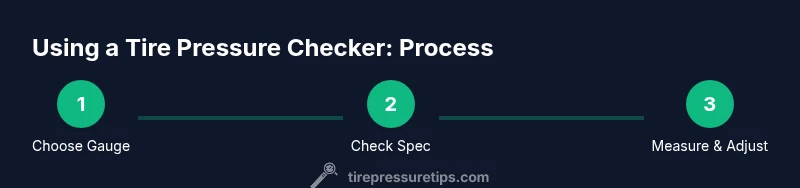
- 1
Choose the right gauge
Select a tire pressure checker you trust. Ensure it is within its calibration range and the display or scale is easy to read. If you’re testing multiple vehicles, consider carrying a spare gauge as a backup. A reliable gauge reduces measurement errors and increases confidence.
Tip: Test the gauge on a known 0-pressure reference if available to verify accuracy. - 2
Find the official psi spec
Locate the vehicle’s recommended tire pressure on the door jamb placard or owner’s manual. This spec is for cold tires and accounts for typical load. Do not rely on the maximum tire pressure listed on the tire sidewall for daily driving.
Tip: Record the spec for each axle if your vehicle has different front and rear pressures. - 3
Check gauge calibration
If your gauge allows, calibrate according to the manufacturer’s instructions. A zeroing check is especially important for analog dial gauges. Calibration ensures you’re reading true pressure rather than scale drift.
Tip: If calibration is not possible, compare with a second gauge to cross-check readings. - 4
Measure cold tires
Take readings with the tires cold, after the vehicle has been stationary for at least three hours. Temperature affects air volume, so cold measurements yield the most accurate psi values. Remove the valve cap and firmly press the gauge onto the valve stem.
Tip: Avoid pressing the gauge too hard or skewing the seal; a clean, square attachment gives the most stable reading. - 5
Inflate or deflate as needed
If a tire is underinflated, add air in small increments (5–10 psi at a time) and recheck after each addition. If overinflated, release air gradually until you reach the target. Recheck all tires after adjustments to ensure consistency.
Tip: Always prefer gradual adjustments and recheck to avoid overshooting the target pressure. - 6
Document and monitor
Record the final readings for each tire and monitor trends over time. Keeping a simple log helps catch slow leaks early and informs maintenance planning. If readings still vary widely after multiple checks, seek professional evaluation.
Tip: Keep your log with date, tire position, and reading to track changes across seasons.
Frequently Asked Questions
How often should I check my tire pressure?
Check at least once a month and before long trips. Temperature changes can cause pressure to vary, so periodic checks help maintain safe tire performance.
Check at least monthly and before long trips to account for temperature changes that affect pressure.
Can I rely on TPMS instead of using a gauge?
TPMS alerts you to pressure loss but is not a precise measurement. Use a tire pressure checker to confirm exact psi and ensure it matches the manufacturer’s spec.
TPMS warns you about low pressure, but you should still measure psi with a gauge to know the exact value.
Should I check tire pressure when tires are hot or cold?
Always check when tires are cold for the most accurate reading. Hot tires can show higher psi due to heat expansion.
Check tires when they’re cold for accuracy; avoid taking readings after driving.
What about the spare tire?
Spare tires should be checked according to the vehicle’s maintenance schedule and may have different pressure requirements. Consult your manual.
Check the spare as instructed in your manual; it may have different pressure needs.
What is a normal PSI range for most cars?
Normal ranges vary by vehicle; always refer to the door placard or manual for the exact figure. Do not rely on a guess or tire sidewall maximums.
Refer to your door placard or manual for the exact PSI range for your car.
Why do readings vary between tires?
Small variations are common due to load differences and positions. Large discrepancies warrant inspection for leaks or valve issues.
Some variation is normal, but large differences should be checked for leaks or valve problems.
Watch Video
What to Remember
- Check tires when cold for accuracy.
- Use the door placard as your PSI target.
- Calibrate gauges regularly and cross-check when in doubt.
- Document readings to spot leaks early.