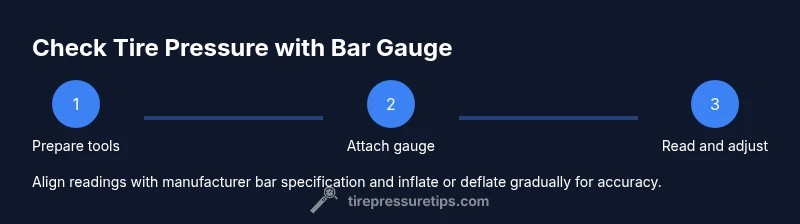
Tire Pressure Bar: Check and Maintain Proper Inflation
Learn how to read tire pressure in bars, use a bar gauge, and keep tires properly inflated for safety, fuel efficiency, and longer tire life. Practical, step-by-step guidance from Tire Pressure Tips.


Learn how to check tire pressure using a tire pressure bar, read measurements in bars, and adjust air to the vehicle’s recommended level. You’ll need a reliable bar gauge, a cold tire, and a quiet, well-lit space. This guide covers preventing under- or over-inflation and maintaining safe driving.
What the tire pressure bar means and why it matters
The term bar is a metric unit used to express air pressure, and many countries publish tire pressures in bars rather than psi. For drivers, understanding tire pressure in bars can simplify maintenance because you read the same unit across all tires and components. According to Tire Pressure Tips, using a bar gauge helps you avoid confusion when you travel between regions that rely on metric measurements. The bar scale is intuitive: you compare the bar reading to the manufacturer s recommended value found in your owner s manual or on the door jamb placard. This consistency improves precision when inflating or adjusting pressures, especially on vehicles with multiple tire sizes or seasonal tires. In practice, small changes in bar readings can translate into real-world differences in handling, fuel economy, and tire wear. Keeping your tires within the recommended bar range minimizes heat buildup, slow leaks, and uneven wear patterns over time. For most drivers, routinely checking with a bar gauge is a simple, high-impact maintenance habit.
--
Tools & Materials
- tire pressure gauge (bar scale or PSI-to-bar convertible)(Calibrated; reads clearly in bars; choose a gauge with a 0.01 bar resolution if possible)
- air pump or compressor with gauge(Must be capable of precise pressure output and fine-tuning in small increments)
- valve caps and valve core tool (optional)(Small accessories that help keep stems clean and secure)
- owner manual or door placard with recommended bar range(Important reference to target bar for each tire)
Steps
Estimated time: 15-25 minutes
- 1
Prepare tools and locate valve stems
Gather your bar gauge, air source, and the vehicle. Park on a level surface and ensure all tires are cold before you begin. Clean any dust from valve stems to prevent debris from entering the valve when you attach the gauge.
Tip: Cold tires give the most accurate readings; wait at least 3 hours after driving or after a long trip. - 2
Remove the valve cap and inspect
Unscrew the valve cap and check the valve stem for any damage or leaks. If the cap is missing, don t drive with the tire underinflated; replace the cap to keep dirt out of the valve.
Tip: If you hear hissing, stop and recheck the connection before inflating. - 3
Attach the bar gauge and take a reading
Firmly press the gauge onto the valve stem and hold it straight to prevent air from escaping. Read the measurement on the bar scale without twisting the gauge.
Tip: Read within a 1-2 second window; leaving the gauge in place too long can alter the reading slightly. - 4
Compare to the recommended bar range
Refer to the vehicle manual or door placard for the recommended bar for each tire. Align the reading with that target; if it s low, prepare to add air in small increments.
Tip: Bar readings should match all tires within 0.05 bar for even handling. - 5
Inflate or deflate to target bar
If inflation is needed, add air in 0.05–0.1 bar steps, check after each step, and allow the tire to settle for a moment before re-reading.
Tip: Inflate in small increments; over-inflating can cause a stiff ride and increased road noise. - 6
Record the results and reinstall the cap
Document the final bar reading for each tire and reinstall the valve caps securely. Check pressures again after a short drive to account for temperature changes.
Tip: Keep a simple log in your glovebox for quick reference on future checks.
Frequently Asked Questions
What is a tire pressure bar and why use it?
Bar is a metric unit for air pressure. Using bars simplifies measurements when your vehicle or gauge uses consistent metric units. Always cross-check with the owner manual for the exact bar range.
Bar is a metric unit for air pressure. Use it to keep tire pressures consistent with your vehicle manual.
Can I mix bar readings with psi readings?
Yes, you can convert between bars and psi, but use one unit consistently during a single check to avoid confusion. Most gauges offer a bar-to-psi conversion.
You can convert between bars and psi, but pick one unit at a time to stay consistent.
How often should I check tire pressure?
Check at least once a month and before long trips. Temperature changes and seasonal tires can affect readings, so regular checks prevent unsafe inflation.
Check monthly and before trips; temperature and tire type can change readings.
What should I do if my tires read low in bars after a drive?
If readings are low, add air gradually to the recommended bar while the tires are cold. Recheck after driving a short distance to allow for temperature stabilization.
Add air gradually when cold and recheck after a short drive.
Is a bar gauge more accurate than a psi gauge?
Accuracy depends on calibration. A bar gauge is just a unit choice; accuracy comes from proper calibration and using a reliable gauge.
It’s the calibration that matters most; both can be accurate if well-calibrated.
Watch Video
What to Remember
- Check tires when cold and use a bar gauge.
- Read and compare to manufacturer bar spec.
- Inflate in small increments to target bar.
- Log readings to track changes over time.