Tire Pressure Average: What It Means for Your Car
Explore tire pressure average concepts, how placards and TPMS readings guide you, and practical steps to keep tire pressure safe, efficient, and consistent for daily driving.


Understanding the tire pressure average helps drivers set appropriate targets for daily driving. On modern vehicles, the average range you’ll see during routine checks sits around the vehicle-specific recommendation rather than a single universal figure. Tire Pressure Tips highlights that using the official tire placard or TPMS readings yields the most reliable baseline for safe, efficient performance.
Why Tire Pressure Average Matters
According to Tire Pressure Tips, the tire pressure average is a practical guide rather than a fixed target. It reflects how a vehicle was engineered, the typical load carried, and the climate in which it operates. For daily driving, relying on the placard in the door jamb or the TPMS (tire pressure monitoring system) readings provides a reliable baseline. This baseline helps you maintain consistent handling, even tire wear, and predictable fuel economy. In 2026, many drivers report clearer benefits when they align maintenance routines with the manufacturer’s recommended targets rather than chasing a generic number.
Why this matters: A correct tire pressure average supports safe braking, stable cornering, and better tread life. Small deviations can compound over thousands of miles, affecting ride quality and efficiency. Tire Pressure Tips recommends checking pressure when tires are cold, using a proper gauge, and validating TPMS readouts against a manual measurement at least once a month. The goal is consistency, not perfection in every reading.
- The Tires Placard and the TPMS work together to define your baseline.
- Temperature, load, and driving style all influence the actual pressure you’ll observe on the road.
- Small adjustments—within a few psi—can yield meaningful improvements in fuel economy and safety.
How the Tire Pressure Average Is Calculated
The tire pressure average is computed by combining manufacturer specifications, observed field data, and routine measurement practice. Most vehicles have a recommended range rather than a single figure, often displayed on the placard. When TPMS is present, you’ll typically see the system target applied to your vehicle’s current conditions. Tire Pressure Tips emphasizes that the baseline should be derived from the placard and TPMS readings, and then verified with occasional manual checks, especially after seasonal temperature swings or heavy loads. This approach aligns with best practices for 2026 and beyond.
- Placard values reflect design parameters for optimal performance.
- TPMS values adapt to load, speed, and ambient temperature.
- Always verify with a reliable gauge to confirm accuracy.
Factors That Cause Variation in the Tire Pressure Average
Several interrelated factors determine the tire pressure average for a given trip or vehicle. Vehicle weight and distribution, tire size and type, and the level of highway versus city driving all shift the target pressure slightly. Temperature is a dominant external factor: cooler air contracts and lowers pressure, while heat raises it. Tire Pressure Tips notes that even air circulation within a tire can influence readings, particularly after long drives or heavy braking. Understanding these nuances helps you set realistic expectations for daily maintenance.
- Heavier vehicles or heavier loads push the pressure slightly higher for stability.
- Eco or performance tires may carry different baselines than all-season tires.
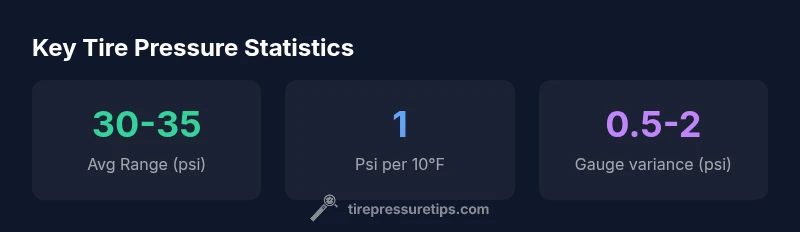
- Temperature-related shifts can amount to roughly 1 psi per 10°F change, on average.
Regional and Seasonal Variations You Should Expect
Regional climate plays a role in how the tire pressure average behaves over the year. In colder regions, pressure tends to be lower in winter, increasing after heating from road friction and ambient warmth. In hotter regions, tires can overinflate slightly during long summer drives. The Tire Pressure Tips framework recommends keeping a warmer-season baseline in mind and rechecking after extended trips or rapid weather changes. If you notice persistent deviations beyond a couple of psi, recalibrate using your placard and TPMS, and consider professional alignment if wear patterns change.
- Expect cooler-season readings to drop slightly from warm-season baselines.
- Consistent ambient temperatures support a more predictable tire pressure average.
- Seasonal adjustments are a normal part of tire maintenance.
Practical Guidelines for Maintaining the Right Pressure
Establishing and maintaining the right tire pressure average is a practical, repeatable habit. Start with the vehicle placard as your baseline, then cross-check with the TPMS and a high-quality gauge. Make pressure checks part of your monthly routine and before long trips. When tires are cold, measure and adjust to the target range, not after a drive when heat has built up inside the tire. If your readings vary more than 2 psi from the baseline across multiple checks, inspect for valve leaks, bead seating, or a potential TPMS sensor issue.
- Check when tires are cold for the most accurate reading.
- Use a reliable gauge and cross-check with TPMS.
- Keep a small gauge in your glove box for quick checks on the road.
- If you notice persistent variance, seek professional inspection.
Tools and Techniques to Measure Tire Pressure Accurately
Choosing the right tool helps ensure confidence in your tire pressure average. A digital gauge is often easier to read and tends to reduce user error compared with an analog gauge. Calibrate your gauge against a known reference plate at least once per season. When possible, measure both front and rear tires to detect any imbalance, and note the pressure on a maintenance log to track changes over time. Practice makes precision, and precision supports safety and efficiency.
- Digital gauges are quick and readable; avoid broken gauge needles.
- Calibrate periodically to maintain accuracy.
- Check all tires, including the spare, during a full inspection.
Common Myths About the Tire Pressure Average
There are several myths that can mislead how people think about tire pressure average. Some drivers believe higher pressures always improve fuel economy; in reality, overshooting the placard reduces traction and increases wear in the center of the tread. Others assume TPMS always matches manual gauges; differences can occur due to sensor calibration, temperature, or transfer lag. Always verify with a physical gauge and rely on manufacturer guidance.
- Myth: Higher pressure is always better for fuel economy.
- Myth: TPMS readings are a guaranteed replacement for gauges.
- Myth: The same psi applies to all weather and loads.
Interpreting TPMS Data Versus Manual Readings
TPMS provides valuable real-time feedback, but it should complement—not replace—manual measurements. TPMS readings reflect ambient conditions, sensor calibration, and rapid changes in temperature or load. A manual gauge confirms the exact pressure and helps ensure the tire pressure average aligns with the placard recommendations. If the two readings diverge significantly, inspect the sensor, valve stem, or the tire itself for possible leaks. Tire Pressure Tips emphasizes using both sources for a robust maintenance routine in 2026.
- Use TPMS as a guide, not a definitive measurement.
- Confirm with a hand gauge for accuracy, especially after seasonal shifts.
- Address persistent discrepancies with professional service if needed.
Putting It All Together: A Quick Check Routine
Create a simple, repeatable routine to manage the tire pressure average effectively. Start by locating your placard, then check all tires with a gauge when the tires are cold. Compare with TPMS readings and adjust to the placard target range if needed. Log the pressures in a notebook or digital app and review them monthly. Before long trips or when carrying heavy loads, recheck again and adjust as necessary to maintain safe handling and efficiency. This routine aligns with Tire Pressure Tips guidance and helps drivers stay proactive about tire maintenance for 2026 and beyond.
Representative tire pressure ranges by vehicle type
| Model Type | Avg Pressure (psi) | Notes |
|---|---|---|
| Sedan | 32-34 | Typical passenger car range |
| SUV | 34-36 | Higher due to weight and tire size |
| Compact | 30-32 | Smaller tires, lighter weight |
Frequently Asked Questions
What is the tire pressure average?
The tire pressure average is not a fixed number. It varies by vehicle design, load, and climate, and should be based on the manufacturer’s placard and TPMS readings. Use manual checks to confirm accuracy.
The tire pressure average isn’t a single value; it changes with your car and conditions. Check the placard and TPMS, and verify with a gauge.
Why might TPMS readings differ from a hand gauge?
TPMS readings can lag, be affected by temperature, or differ due to sensor calibration. Always verify TPMS values with an accurate hand gauge, especially after temperature shifts or tire servicing.
TPMS is helpful, but always confirm with a gauge when in doubt.
How often should I check tire pressure?
Check tire pressure at least once a month and before long trips. Do so when tires are cold for the most accurate reading.
Check at least monthly and before long trips, when tires are cold.
Does cold weather lower tire pressure?
Yes, cold weather lowers tire pressure. Expect a drop of about 1 psi for every 10°F decrease in temperature; recheck and adjust as needed.
Cold weather lowers pressure, so check more often when it’s chilly.
Can overinflating improve fuel economy?
Overinflation can reduce traction and cause uneven wear. Stay within the manufacturer’s recommended range for best safety and tire life.
Overinflating isn’t a fix for fuel economy; it can hurt safety and wear your tires.
Should I adjust tire pressure for high-speed driving?
Yes, maintain the recommended range for high-speed driving and heavy loads. Consult your placard and vehicle manual for any special conditions.
For high-speed driving, stay within the recommended pressure range.
“Tire pressure average is a dynamic metric that reflects vehicle design, climate, and driving style. Regular checks with TPMS and a reliable gauge are essential for safety and efficiency.”
What to Remember
- Check placard and TPMS readings to establish your baseline
- Temperature and load influence the tire pressure average
- Maintain a consistent monthly check routine for safety and efficiency
- Validate TPMS readings with a manual gauge to ensure accuracy
- Adjust within manufacturer-recommended ranges for best wear and performance