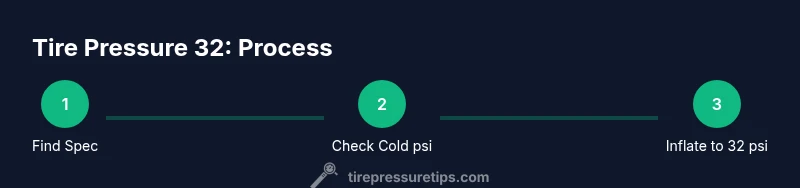
Tire Pressure 32: Check, Inflate, and Maintain
Learn how to reliably set tire pressure to 32 psi, check cold tires, and maintain optimal tire pressure across seasons. This step-by-step guide covers tools, safety, TPMS considerations, and practical tips for drivers and car owners.


By following these steps, you’ll confidently set and maintain tire pressure at 32 psi for improved handling, fuel efficiency, and tire wear. Before you start, you’ll need a reliable gauge, a source for your vehicle’s recommended pressure (door placard or owner’s manual), and access to a stable surface away from heat. This guide covers checks, adjustments, and maintenance for all seasons.
Why tire pressure 32 matters for your vehicle
Maintaining the right tire pressure is essential for safety, efficiency, and comfort. The tire pressure 32 psi target is a common benchmark that often balances grip, wear, and rolling resistance across many passenger cars. However, the exact pressure you should run depends on the vehicle, load, and driving conditions. According to Tire Pressure Tips, using the manufacturer’s recommended cold tire pressure is the safest starting point, and 32 psi is a sensible default for many models where the placard shows similar values. The key is to understand how 32 psi translates to real-world performance.
First, understand that tire pressure is not a fixed number across all tires. Front and rear axles might have different specs, and the correct cold pressure can shift with outdoor temperature. When tires are cold (not driven for at least 3 hours and not heated by road), the gauge will read the true pressure. Any significant deviation from the recommended value reduces grip in corners, alters braking distance, and changes steering feel. Underinflation, for instance, causes the tire’s outer edges to wear faster and can increase rolling resistance, while overinflation concentrates wear on the tread center and reduces the tire’s ability to grip irregular road surfaces.
When you set tires to 32 psi, you’ll often notice improved steering response, more balanced wear over the tire’s footprint, and better fuel efficiency. The Tire Pressure Tips team notes that consistent maintenance is more impactful than chasing a perfect single measurement; the goal is to keep all four tires within the vehicle’s spec range. In practice, 32 psi serves as a reliable starting point for many drivers, especially those who carry normal loads and drive in moderate climates. Always verify with your own car’s placard and adjust for unusual conditions such as heavy cargo, towing, or extreme heat.
How to find your vehicle's recommended tire pressure
Knowing the exact target for tire pressure 32 requires checking the vehicle maker’s guidance. Most cars list a recommended cold pressure on a sticker located on the driver’s door jamb, sometimes in the glove compartment or in the owner’s manual. Some manufacturers include separate values for the front and rear tires; others provide a single value for all four corners. When you see the placard or manual, write down the number for your current load and driving scenario. Brand guidance from Tire Pressure Tips emphasizes that following the manufacturer’s spec is the safest baseline. If your placard shows a value close to 32 psi, you can use 32 as a practical reference, but never exceed the max pressure printed on the tire sidewall. Temperature, altitude, and cargo weight can subtly shift the “right” pressure, so it’s wise to recheck as conditions change.
Next, confirm that your tires are cold before measuring. A “cold” reading means the vehicle hasn’t been driven for at least three hours or hasn’t heated by road friction. Warmer tires read higher and can mislead you into overinflation. If you recently drove, wait until the tires cool down, then measure again. For many drivers, 32 psi aligns with the placard values, especially on sedans and light SUVs with standard passenger tires. If your vehicle requires different pressures per axle, apply those numbers to each wheel accordingly. Finally, note that some high-performance or off-road tires carry different ranges; in that case, use the target range specified by the OEM or tire manufacturer and adjust your approach to 32 psi only when appropriate.
A practical approach is to keep an accessible record of the recommended pressures for each tire and to audit them at least once a month or before long trips. The Tire Pressure Tips team also recommends carrying a gauge in your glove box or console so you can verify the pressure when you refill at a gas station. By staying consistent, you can minimize wear, improve fuel economy, and maintain predictable handling across road conditions.
Checking current pressure and targeting 32 psi
To reach tire pressure 32 reliably, you must measure accurately and adjust as needed. Start by ensuring that all tires are cold and that the gauge is working correctly. Remove the valve cap, place the gauge on the valve stem, and press straight down to get a reading with minimal lean. If the reading is below 32 psi, add air using a compressor until the gauge reads 32; if it’s above, release air in small increments and recheck until you reach the target.
Repeat for each tire, including the spare if you regularly rotate it into service. After you inflate, recheck all four tires to ensure they maintain 32 psi when cold. It’s common to see a small variance after inflation due to gauge tolerance; aim to stay within ±0.5 psi of 32 wherever possible. If you notice that a tire drops pressure quickly, inspect for punctures or leaks with a soapy water test or consult a professional. A consistent payback comes from regular checks—setting a monthly reminder can help you stay aligned with your vehicle’s spec and avoid the costs of unexpected tire damage. Tire Pressure Tips analysis shows that frequent checks lead to fewer tire-related incidents and more predictable driving dynamics over time.
Maintaining 32 psi across seasons and loads
Seasonal changes and vehicle load can nudge your tire pressures away from the ideal value, even when you start at 32 psi. In hotter months, ambient heat can raise tire pressure, potentially causing overinflation-like behavior if you inflate to 32 psi at the start of a warm day and drive into heat. Conversely, in cold weather, pressures drop as air contracts—so a tire that read 32 psi in the morning might fall below that by evening. The best practice is to measure when tires are cold and revert to the manufacturer’s target if your climate or cargo requires adjustments. If you frequently carry heavy loads or tow, your axle-specific pressures may diverge from a 32 psi target; in that case, you should rely on the OEM values per axle and only use 32 psi as an approximation for average conditions.
In daily driving, a consistent 32 psi can help balance tread wear, grip, and fuel efficiency. It preserves the contact patch shape for better traction on wet and dry surfaces and keeps the sidewalls resilient against road irregularities. Always check the tires after long trips or when the vehicle has been parked in very hot sun; temperature fluctuations can mask true pressure levels, especially if you only check after a drive. Tire Pressure Tips also highlights that the valve stems, rims, and TPMS sensors all influence the accuracy of your readings, so periodic calibration and sensor checks matter. By aligning your routine with these realities, you protect your tires and keep your ride predictable throughout the year.
Common mistakes, safety considerations, and TPMS guidance
Many drivers make avoidable mistakes when managing tire pressure 32. A common pitfall is inflating to a number that matches the tire’s maximum rating rather than the vehicle’s recommended pressure. This practice increases risk of poor ride quality and can lead to tire damage. Another frequent error is neglecting to check the spare tire, which can leave you stranded if it becomes underinflated or damaged. Don’t ignore warning lights from the TPMS; a tire that remains underinflated after inflation indicates a leak, a damaged valve stem, or a compromised seal. Always recheck after a first inflation attempt and seek professional assistance if you see persistent drops in pressure.
When you follow these precautions, you’ll maintain safe handling and consistent tire wear. The TPMS sensors play a crucial role in alerting you to pressure changes, but they aren’t a substitute for regular manual checks. The Tire Pressure Tips team encourages drivers to adopt a simple maintenance ritual: inspect tire pressures monthly, inspect the TPMS system annually, and adjust for heavy loads or extreme weather. A robust routine reduces the likelihood of punctures, improves braking performance, and helps you get the most from your tires over their lifespan.
Tools & Materials
- Tire pressure gauge (digital preferred)(Calibrated, reads in psi; have a backup gauge on hand)
- Access to vehicle door placard or owner’s manual(To confirm the recommended cold psi per tire/axle)
- Portable air compressor or gas-station air pump(Needed to adjust psi on-site)
- Pen, paper, or digital note to record readings(Optional but helpful for tracking over time)
- Soapy water solution (for leaks)(Bubbles indicate leaks at valve stem or bead)
Steps
Estimated time: 25-35 minutes
- 1
Find your vehicle’s recommended tire pressure
Locate the cold tire pressure value on the driver’s door placard or in the owner’s manual. Note separate values if your car specifies different pressures for the front and rear tires. This will guide your target pressure, including whether 32 psi is appropriate for your setup.
Tip: If the placard shows a value near 32 psi, 32 psi is a reasonable starting point. Always use the exact OEM spec when it differs. - 2
Gather tools and prepare tires
Bring a reliable gauge and a compatible air source. Ensure tires are cold and on a stable surface. Remove valve caps to access the valve stems. If you plan to check all four, consider performing them one at a time to minimize heat buildup.
Tip: Cold tires give the most accurate readings; avoid inflating right after a long drive. - 3
Check current pressures
Attach the gauge to each valve stem and read the current pressure. Compare each reading to your vehicle’s recommended value. If any tire reads significantly below 32 psi, plan to inflate it; if above, release air until the reading aligns with the target.
Tip: Record the readings for future reference—patterns over time can reveal slow leaks. - 4
Inflate or deflate to 32 psi
Using the air source, add or remove air in small increments (about 1 psi at a time). Recheck after each adjustment until the gauge reads 32 psi on all relevant tires. Don’t chase too exact a second; most methods allow a ±0.5 psi tolerance.
Tip: After adjusting, recheck all four tires to ensure consistency across the vehicle. - 5
Recheck after a cooldown
If you inflated during a warm spell, allow tires to cool for 15-30 minutes and recheck. Temperature changes affect readings and the real tire pressure when cold.
Tip: Keep a small reminder to recheck on the next cool morning for accuracy. - 6
Document and monitor
Note the final pressures and the date. Create a routine to check monthly and before long trips. If pressures drift frequently, seek professional inspection for unseen leaks or sensor faults.
Tip: A simple log helps you spot patterns and prevent unexpected flats.
Frequently Asked Questions
What does 32 psi mean for my tires?
32 psi is a target pressure for many passenger tires, indicating pounds per square inch of air pressure when tires are cold. Always verify with the vehicle’s door placard or owner’s manual, as the exact value can vary by model and axle.
32 psi is a common target for many cars, but you should follow your vehicle’s exact spec from the placard or manual.
Should I use 32 psi if the placard says something else?
No. Use the value printed on the placard or in the owner’s manual for your car. 32 psi is a useful target when it aligns with the OEM spec, but not a universal requirement across all vehicles.
Always follow the car’s official pressure spec, even if 32 psi seems convenient.
Cold vs hot tires: when should I measure?
Measure when tires are cold for the most accurate reading. Hot tires read higher due to heat, which can lead to overinflation if you inflate while warm.
Measure when cold to get a true reading.
Can front and rear pressures differ at 32 psi?
Yes. Some cars require different pressures per axle. Always check the placard for front and rear values. If both are near 32 psi, you can use 32 as a practical target, but only if the OEM specs allow.
Some cars have different front and rear specs—check the placard first.
How often should I check tire pressure?
Check at least once a month and before long trips, especially when the weather changes. Regular checks prevent underinflation or overinflation and extend tire life.
Check monthly and before trips.
What should I do if TPMS warns me pressure is low?
Treat a TPMS warning seriously. Recheck pressures with a gauge, look for punctures or leaks, and reset sensors if needed after repairs. If the warning persists, have the system inspected by a professional.
Don’t ignore TPMS warnings—check pressures and inspect for leaks.
Watch Video
What to Remember
- Check cold tires to verify accurate pressure.
- Follow the vehicle’s OEM spec; use 32 psi as a starting point when appropriate.
- Recheck after adjustments and temperature changes to stay within target range.
- Use a gauge you trust and keep a log of readings for trend spotting.
- Address persistent pressure loss promptly with a professional inspection.