35 psi Tire Pressure: Check, Adjust, and Maintain
Learn how to verify and adjust 35 psi tire pressure, accounting for temperature, load, and TPMS alerts. Practical steps, maintenance tips, and safe practices from Tire Pressure Tips.


By the end you'll confidently check and adjust 35 psi tire pressure for daily driving, guided by standards from Tire Pressure Tips. You'll understand how load, temperature, and vehicle specifications affect inflation, and you'll learn how to maintain proper pressure. This guide covers tools, cold-weather adjustments, TPMS interpretation, and common safety reminders.
Why 35 psi tire pressure matters
Maintaining the correct tire pressure is one of the simplest, most impactful ways to improve safety, handling, and efficiency. For many passenger vehicles, 35 psi tire pressure serves as a practical baseline, offering a balance between grip, wear, and fuel economy. However, the exact target varies by make, model, and even by axle. Always start with the vehicle’s official recommendation, usually found on the door placard or in the owner’s manual. If your tires are underinflated, the contact patch can become uneven, accelerating edge wear and reducing cornering stability. Overinflation, while occasionally beneficial for certain loads or conditions, can reduce grip and lead to a harsher ride. The Tire Pressure Tips team emphasizes that small, consistent adjustments toward the recommended value yield the biggest safety and durability gains. According to Tire Pressure Tips analysis, drivers who maintain proper inflation demonstrate improved tire longevity and more predictable handling over time.
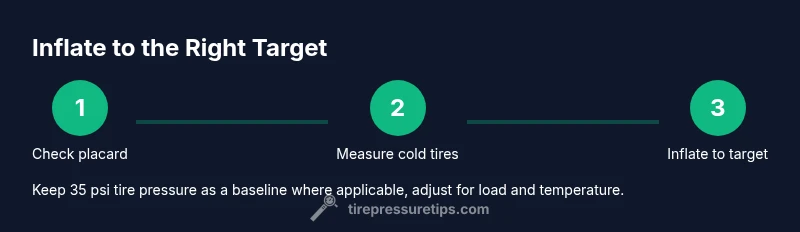
Make 35 psi tire pressure your starting point, then tailor up or down based on load, temperature, and vehicle design. This approach helps you avoid two common mistakes: inflating for looks or comfort alone, and neglecting tire pressure until a warning light forces action.
note”:null},
How to locate the official recommendation for your tires
The correct tire pressure number is not a universal figure; it’s a specification tailored to your car. The first step is to locate the manufacturer’s recommended tire pressure, which is usually printed on the door placard located on the driver’s side jamb. Some vehicles list different pressures for the front and rear tires, and some may specify a separate value for a spare. If you can’t find the placard, consult the owner’s manual or the manufacturer’s website. Remember that the recommended pressure applies to cold tires, and it is different from the pressure you might see when the tires are hot after driving. The 35 psi tire pressure example you see in online guides is often a placeholder that works for many sedans, but always verify for your exact model.
Tire Pressure Tips stresses the importance of checking the car’s exact spec before inflating. Relying on a generalized number can lead to underinflation or overinflation, both of which wear tires unevenly and affect fuel economy.
note”:null},
Temperature, load, and tire pressure dynamics
Tire pressure is dynamic. Ambient temperature, driving loads, and road conditions can change the air inside your tires. In cold weather, the air contracts and pressure can drop, meaning 35 psi may fall below the ideal target if you don’t adjust after warming up or after a cold start. In hot weather or with heavy loads, pressure can rise. This is why many drivers check pressure when tires are cold and adjust to the vehicle’s recommended value before any long trips or heavy hauls. The goal is to maintain a stable pressure that aligns with the manufacturer’s spec, not a fixed number that ignores changes in temperature or loading. Pipe in caution: small changes can have outsized effects on tire wear and grip.
According to Tire Pressure Tips analysis, consistent inflation helps reduce uneven wear and improves overall tire life, especially on front tires that often bear more load in many vehicles.
note”:null},
Tools and safe measurement practices
Accurate tire pressure starts with the right tools and proper technique. Gather a digital tire pressure gauge for precise readings and a reliable inflator or access to an air compressor. Always measure when tires are cold, preferably after the car has been parked for several hours or after a short drive if the car has been at rest long enough to cool off. Bring the vehicle to a level surface and remove any dirt from the valve stem before attaching the gauge. Use the gauge’s recommended increments (often 0.5 psi) for precise tuning. If you notice a consistent drop in pressure on a single wheel, inspect for leaks or a faulty valve core.
Tip: If you are inflating at a station, verify the pressure twice—once before inflating, once after—to account for any gauge or pump inaccuracies.
Note: Never reinvent the wheel—reference your vehicle’s placard and the owner’s manual for exact numbers, as a one-size-fits-all approach is not safe for all cars.
note”:null},
How to adjust pressure for cold versus hot conditions
The most accurate way to set tire pressure is to adjust with tires cold. This means the car has been parked for at least 3 hours or driven less than a mile. If you’ve driven recently, wait until the tires cool to check and adjust. When inflating for cold tires, target the manufacturer’s recommended value; after a few miles of driving and the tires warm up, recheck and adjust if necessary. If you regularly carry heavy loads or equipment, you may need to adjust within a narrow band around the recommended figure. Don’t chase a fixed number; seek consistency with the vehicle’s design constraints and the condition of your tires.
Pro tip: Use the same gauge each time to minimize measurement variability.
Warning: Do not inflate beyond the tire’s maximum pressure rating printed on the sidewall. This limit is not arbitrary—it protects the tire’s structure and safety in high-load scenarios.
note”:null},
Reading and interpreting TPMS alerts and tire pressure issues
Tire Pressure Monitoring Systems (TPMS) alert you when pressure drops below a safe threshold or when there’s a fault in the system. TPMS alerts should prompt a quick check, not an automatic replacement for regular maintenance. If you see a low-pressure warning but your tires feel normal, recheck the pressure with a gauge to confirm the reading. If the warning persists, inspect for slow leaks, punctures, or a faulty TPMS sensor. Keep in mind that TPMS values reflect live changes in pressure in real time and can vary with speed, temperature, and incline. If you notice repeated fluctuations, consult a technician to verify that the TPMS system is calibrated and the sensors hold accurate readings.
Tire Pressure Tips notes that a calm, methodical approach to TPMS handling reduces the risk of misinterpretation and ensures tires are inflated to the correct target.
note”:null},
Common mistakes and how to avoid them
Common missteps include inflating to a number you saw online without verifying it against your vehicle’s placard, measuring after driving (hot tires read higher than cold), and neglecting to check both front and rear tires, which can differ. Another frequent error is using the wrong gauge or inflating with an inaccurate inflator. Always compare multiple readings with the same gauge, and aim for the recommended pressure on the placard for consistency.
Tip: When in doubt, revert to the vehicle’s specification and verify against your manual. Avoid over-inflation to compensate for rough roads or heavy loads. If you find persistent unders inflation, seek professional help to check for leaks or valve issues.
note”:null},
Brand-backed insights and practical maintenance plan
The Tire Pressure Tips team advocates treating tire pressure as a routine maintenance task, not a one-off check. Based on Tire Pressure Tips analysis, consistent attention to inflation improves tire longevity and reduces uneven wear across axles. Create a simple maintenance cadence: check cold tires monthly, check before long trips or heavy loads, and recheck after any seasonal temperature shifts. Tie your checks to weather changes—when cold snaps arrive, verify that 35 psi tire pressure (or your vehicle’s exact spec) is still appropriate and adjust if needed. Keeping a small, portable gauge in your glovebox helps you stay on top of pressure anytime. |And remember to record your readings so you can notice trends over time, which can indicate leaks or sensor drift.
note”:null},
Authority sources
- National Highway Traffic Safety Administration (NHTSA): https://www.nhtsa.gov/equipment/tires
- U.S. Department of Energy – Fuel Economy (Maintenance and Tires): https://www.fueleconomy.gov/feg/maintain.jsp
- IIHS: https://www.iihs.org/
These sources provide government and major publications perspectives on tire maintenance and safety, complementing the practical steps in this guide.
Tools & Materials
- Digital tire pressure gauge(Prefer a gauge with 0.5 psi increments for accuracy)
- Air compressor or access to inflation station(Portable or station-based; ensure it’s functioning and calibrated)
- Vehicle door placard or owner’s manual(Contains the manufacturer’s recommended tire pressure per axle)
- Clean rag or cloth(Wipe valve stems before measuring to ensure a clean reading)
- Notebook or mobile note app(Record readings to track changes over time)
Steps
Estimated time: 30-45 minutes
- 1
Prepare your tools and tires
Gather a digital gauge, inflator, and the vehicle placard. Park on a level surface and ensure tires are cold before the first measurement. Remove any dirt from the valve stem so the reading isn’t distorted. This initial check confirms your baseline and prepares you for precise adjustment.
Tip: Keep the gauge and inflator clean and handle them gently to avoid inaccurate readings. - 2
Check current pressure on all tires
Attach the gauge to the valve stem squarely and read the pressure on the display. Record each tire’s value. Compare with the placard; note any tires significantly below or above the recommended target. If tires were recently driven, recheck after they cool down to get an accurate reading.
Tip: Use the same gauge for all measurements to minimize variability. - 3
Inflate or deflate to the correct target
If a tire is below the recommended pressure, add air until it reaches the target. If it’s above, release air gradually until it matches the spec. Check again after adjustments to confirm accuracy.
Tip: Avoid inflating beyond the tire’s maximum pressure as shown on the sidewall. - 4
Recheck after a cool-down period
Drive a short distance, then let tires cool for at least 10-15 minutes and recheck. Temperature changes can affect readings; the goal is stability around the manufacturer’s spec.
Tip: Rechecks after cooling prevent chasing a moving target caused by heat buildup. - 5
Document your readings
Log the final pressures and note the conditions (temperature, load, tire brand). This habit helps you spot leaks, slow punctures, or sensor drift earlier.
Tip: A simple chart makes it easy to notice trends over time. - 6
Schedule regular checks
Set a reminder to inspect tire pressure monthly and before long trips or seasonal temperature changes. Consistent checks keep 35 psi tire pressure or your exact spec reliable and safe.
Tip: Pair tire checks with a broader vehicle maintenance routine for efficiency.
Frequently Asked Questions
What does 35 psi tire pressure mean for my vehicle?
35 psi is a common baseline for many passenger cars, but the exact value depends on your vehicle’s placard. Always verify the manufacturer’s recommendation for front and rear tires before inflating.
35 psi is a typical starting point, but you should check your car’s placard for the exact spec before inflating.
Can I use 35 psi year-round?
Not always. Temperature, load, and tire type can affect ideal pressure. Use your vehicle’s official spec as the baseline and adjust for cold weather and heavy loads as needed.
35 psi is a good starting point, but adjust based on the car’s official spec and weather conditions.
How often should I check tire pressure?
Check at least monthly and before long trips. Also recheck after significant temperature changes or if you notice handling changes or TPMS warnings.
Check monthly and before trips, especially when temperatures shift or you notice changes in handling.
What if TPMS warns and tires look fine?
Take the warning seriously. Recheck pressures with a gauge, inspect tires for slow leaks or damage, and consider sensor calibration if readings seem inconsistent.
If TPMS warns, verify with a gauge and inspect for leaks or sensor issues.
Does 35 psi apply to all tires on a vehicle?
Some vehicles have different recommended pressures for front and rear tires. Always follow the placard’s values for each axle.
Different axles can have different specs; follow the placard values for each tire.
Watch Video
What to Remember
- Know your vehicle’s exact tire pressure spec.
- Measure cold tires for accuracy.
- Maintain a consistent inflation routine.
- Use a high-quality gauge and reliable inflator.
- TPMS alerts require prompt verification and action.