Tire Pressure 30 PSI: A Practical Guide to Safe Inflation
Learn how to check, adjust, and maintain tire pressure at 30 psi for safe driving, improved fuel economy, and longer tire life. Includes step-by-step guidance, TPMS tips, and temperature considerations.


Goal: Learn how to verify and maintain tire pressure at 30 psi for everyday driving. According to Tire Pressure Tips, this guide explains where to check pressure, how temperature affects readings, and how to adjust for load and speed. The Tire Pressure Tips team emphasizes starting with cold tires and using a reliable gauge. We also cover TPMS alerts and safety tips.
Tire pressure 30 psi: why a specific target matters
Maintaining tire pressure at 30 psi is a practical starting point for many passenger vehicles, but the actual target can vary by model, load, and driving conditions. The Tire Pressure Tips team emphasizes that consistency matters more than chasing a single number: choose the official value from your door jamb placard or owner manual and stick to it. Underinflation leads to faster tire wear, reduced fuel efficiency, and poorer handling, while overinflation can reduce grip and increase the risk of a blowout on rough roads. Reading a cold tire at the correct pressure gives you a reliable baseline, against which you can compare readings over time and across seasons. In everyday driving, staying close to your recommended psi promotes even tread wear and better stability, especially when cornering or braking hard. Always verify both front and rear pressures if your vehicle specifies different values, and adjust for seasonal temperature changes so your tires perform as intended.
As part of practical tire care, remember that 30 psi is not a universal truth for every vehicle. Always cross-check the placard on the door jamb—the manufacturer’s guidance reflects your specific tire size, axle configuration, and load expectations. By keeping to the recommended range, you can optimize rolling resistance, steering response, and overall safety. This is why Tire Pressure Tips recommends treating tire pressure checks as a regular habit, not a one-time event.
If you drive with mismatched pressures across axles, you may notice uneven wear or handling quirks. Keeping front and rear pressures aligned with the vehicle’s official guidance helps balance grip, braking, and ride quality.
How to check tire pressure accurately
Checking tire pressure accurately starts with the right timing and the right tools. Always check when tires are cold, ideally before you drive or after the vehicle has sat for at least three hours. Locate the correct pressure value from the door jamb placard, owner’s manual, or fuel filler cap. Remove the valve cap, attach your gauge firmly, and read the pressure without rushing. If you’re using a digital gauge, press and hold until the number stabilizes; with a dial gauge, read where the needle stops. Repeat the process on all four tires to ensure consistency, and don’t forget to check the spare tire if your vehicle requires it. When readings are high, deflate in small, controlled bursts to the target value; when readings are low, inflate gradually and recheck. Re-cap the valve to keep out dust and moisture, and always read tire pressure when the tires are cold to avoid heat-induced inflation.
Keep your gauge clean and store it in a protective case to preserve accuracy. If your vehicle has a TPMS alert, use it as a supplementary signal, but rely on a manual gauge for the final determination. A trusted gauge fosters confidence during routine maintenance and reduces the risk of under- or over-inflation.
For best results, record each tire reading in a maintenance log. This practice makes it easier to spot trends, such as seasonal shifts or gradual leaks, and helps you plan timely tire care.
Temperature, load, and tire pressure: what changes readings
Ambient temperature and load play a significant role in tire pressure readings. Colder weather naturally reduces air pressure inside tires, while warmer conditions can raise readings after highway driving or heavy use. If you measure in the morning and then again after a hot day, you may see a difference that isn’t a tire fault but a temperature shift. Heavy loads, towing, or aggressive driving can push pressures higher, especially on the rear axle, so consult the placard values that correspond to your common configuration and adjust accordingly. Seasonal changes often require a small adjustment to preserve the intended contact patch and tread wear pattern. Remember that tire pressure is a function of both the tire and the vehicle, so always refer to the manufacturer’s guidance rather than relying on a single memory number.
Practical tip: when temperatures swing widely, perform a quick check at the start of the season to verify you’re still near the recommended range. This keeps handling predictable and tires wearing evenly across the year.
Tools: gauges and TPMS essentials
Selecting a gauge you trust is the first step toward accurate readings. Choose a digital, dial, or pencil-style gauge that reads within a small range around 30 psi and is easy to read. A good gauge should be sturdy, portable, and repeatable so you can verify results across checks. An air compressor at home or at a gas station is convenient for infrequent maintenance, but always verify the final pressure with your own gauge to avoid inconsistencies. Your vehicle’s TPMS can alert you to low pressures between checks, but it isn’t a substitute for manual verification. Regularly inspect valve stems for damage or corrosion and replace worn valve caps to prevent dust ingress. Keeping tires, gauges, and valve stems clean helps maintain accuracy and reduces risk during inflation. With the right tools, checking and adjusting tire pressure becomes a quick, repeatable part of your routine.
If you encounter a persistent TPMS warning without a corresponding pressure reading discrepancy, consult the vehicle handbook or a tire professional. TPMS can indicate a sensor issue or slow leak that requires further inspection.
Step-by-step overview for setting tire pressure to 30 psi
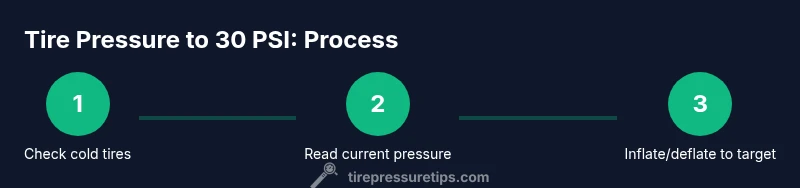
Here’s a concise overview of the process: start with cold tires, locate the recommended pressure for each axle, prepare your gauge and compressor, read the current pressure, inflate or deflate to the target, recheck on all tires, and finish by reinstalling valve caps and noting readings for your maintenance log. Following this sequence helps ensure accuracy and consistency across checks, which in turn supports even wear and better fuel economy. A quick note: always verify the air source’s pressure while inflating, and avoid filling beyond the maximum pressure listed on the tire’s sidewall or the placard guidance. Keeping a simple log improves long-term tire health and helps you spot leaks early.
Common mistakes and how to avoid them
Common mistakes derail tire pressure accuracy and performance. Checking hot tires is misleading because heat raises readings; always measure cold. Using a worn or inaccurate gauge can give false readings, so replace or calibrate gauges regularly. Relying on a single average number without considering axle-specific values or load can cause imbalances; use the manufacturer’s recommended pressure for each axle if provided. Overinflating beyond the tire’s maximum pressure or beyond the vehicle placard can reduce grip and increase the risk of a blowout on rough roads. Not rechecking after any adjustment leaves you blind to lingering issues, and neglecting valve caps can allow dust or moisture to contaminate readings. Develop a routine: inspect tires, check pressure, and verify results with a second method when possible.
Maintaining tire pressure for safety and efficiency
A consistent tire pressure strategy improves safety and efficiency in everyday driving. Treat tire pressure checks as a regular habit—monthly or anytime you notice a change in handling, noise, or ride quality. Align front and rear pressures with vehicle guidance to balance steering response and stability. Keep your maintenance logs current so you can track seasonal shifts or recurring slow leaks. Remember that TPMS is a vital safety feature, but it should complement, not replace, manual readings with a trusted gauge. Proper inflation reduces rolling resistance, supports even tread wear, and ensures reliable performance in emergency maneuvers.
If you drive in rapidly changing conditions, consider a quick mid-season check before long trips to reduce the risk of underinflated tires during heavy highway use.
Real-world scenarios: winter vs summer and highway vs city driving
In winter, cold temperatures exaggerate low-pressure readings, so check more frequently and adjust to the lower end of the recommended range when you expect snow or ice. In summer, heat can push readings upward; recalibrate after high-speed driving or long trips to maintain the target. Highway driving tends to heat tires gradually; a pre-trip check helps ensure optimal pressure before sustained speeds. City driving with frequent stopping can generate uneven heat patterns and varying pressures; a mid-trip check is beneficial for safety. These scenarios illustrate why one fixed pressure value isn’t enough—the goal is to stay as close as possible to the vehicle’s recommended range under your typical conditions.
Authoritative sources you can trust
- https://www.nhtsa.gov/equipment/tires
- https://www.consumerreports.org/car-maintenance/how-to-check-tire-pressure/
- https://www.nhtsa.gov/road-safety/tires-wheels
Tools & Materials
- Tire pressure gauge(Choose a gauge with a range that includes 30 psi and accuracy within ±1-2 psi)
- Air compressor or access to a gas station air pump(Ensure the gauge on the pump is accurate or use your own gauge for final verification)
- Vehicle owner’s manual or door jamb placard(Use as the official target pressure for each tire)
- Chocks or wheel wedges(Prevent vehicle movement while inflating/deflating)
- Valve caps and wipe cloth(Replace caps to keep out dust; wipe stems for accurate readings)
Steps
Estimated time: 15-25 minutes
- 1
Check tires cold
Ensure tires are cold before measuring, ideally after the car has sat for at least three hours or before driving. This avoids heat-related pressure increases from recent driving.
Tip: If you’ve driven recently, wait until tires cool down to recheck. - 2
Locate the recommended pressure
Find the exact psi value on the door jamb placard or owner’s manual for each axle. Some vehicles list different values for front and rear tires; use the correct one.
Tip: When in doubt, use the lower of the two values for mixed guidance. - 3
Read current pressure
Remove the valve cap, attach the gauge firmly to the valve stem, and read the pressure. Repeat to confirm accuracy. Record the value on a quick maintenance log.
Tip: If the reading leaks or hisses, reseat the gauge and try again. - 4
Inflate to the target
If pressure is below target, inflate in small increments and recheck after each addition. Stop when you reach the recommended value.
Tip: Don’t rush; underinflation is safer than overinflation when you’re unsure. - 5
Deflate if overinflated
If the tire is above target, release air in small bursts and recheck until you hit the target. Avoid overcorrecting.
Tip: Excessive deflation requires re-inflation to exact pressure later. - 6
Recheck all tires
After adjusting one or more tires, recheck every tire to ensure they remain at the target pressure. Temperature can cause slight changes.
Tip: Recheck after 5–10 minutes to allow the tire to settle. - 7
Replace caps and store gauge
Reinstall valve caps securely and store your gauge in a known place. This helps prevent dirt entry and keeps readings accurate.
Tip: Carry a spare valve cap in your toolkit as a quick replacement if needed. - 8
Document readings
Log the final readings for future reference and trend analysis. Tracking changes over time helps identify slow leaks and seasonal shifts.
Tip: Note the date, tire position, and ambient temperature for future comparisons.
Frequently Asked Questions
Is 30 psi the correct tire pressure for every vehicle?
No. Vehicle manufacturers specify tire pressure per model and axle. Use the placard or owner’s manual. Differences between front and rear axles are common, and load or speed can influence the target range.
No. Always check your vehicle’s official tire pressure recommendation on the placard or manual. Front and rear pressures can differ, and loading conditions can shift the target range.
Can I read tire pressure when the tires are hot?
Reading hot tires can give falsely high results due to heat. Always measure when tires are cold for the most accurate base reading.
Avoid checking hot tires. Wait until they’re cold for an accurate reading.
What should I do if TPMS shows a warning but readings are normal?
TPMS could indicate a sensor issue or slow leak. If readings are consistently within range, inspect sensors, seals, and valve stems or have the system checked by a tire professional.
If the TPMS warning persists but readings look normal, have the TPMS system inspected for sensor issues or leak paths.
How often should I check tire pressure?
Check at least monthly and before long trips. Temperature changes and wear can shift pressures, so regular checks keep tires safe and efficient.
Check at least once a month and before long trips; temperature and wear can change readings.
Does adding air any time improve tire life?
Maintaining proper inflation is a key factor in tire longevity. Consistent pressure helps even tread wear and fuel efficiency, but avoid overinflation.
Keeping tires at the right pressure helps their life and efficiency, but never overinflate.
Watch Video
What to Remember
- Check tires when cold to get accurate readings
- Use a reliable gauge and follow the vehicle placard
- Temperature and load can shift readings; adjust accordingly
- TPMS helps but does not replace manual checks
- Maintain a simple log of readings for maintenance