Tire Pressure 31: Your Practical Guide to 31 PSI
Learn how to check, inflate, and maintain tire pressure at 31 psi for safety, fuel efficiency, and longer tire life. This guide covers cold readings, tools, step-by-step actions, TPMS basics, and common mistakes.


By following this guide you will learn how to set and verify tire pressure at 31 psi for your vehicle. Start with a cold tire reading, use a reliable gauge, and adjust with an air compressor or deflator until each tire reaches 31 psi. Regular checks help safety, fuel economy, and even tire wear.
What 31 psi means and why it matters
31 psi is a common baseline for many passenger cars, but the exact target can vary by tire type and vehicle. According to Tire Pressure Tips, staying near 31 psi helps balance braking efficiency, cornering stability, fuel economy, and even tread wear. The door jamb sticker on your car reflects the manufacturer’s testing under typical loads, so use that as your primary reference. If you routinely carry heavy loads, tow a trailer, or drive at high speeds, your target might shift slightly. In this section we explore why this number matters, how manufacturers derive it, and how small deviations can influence handling, grip, and tire longevity over the life of the tires.
Understanding cold vs hot tire pressure
Reading tire pressure while the tires are cold is critical. A tire that has warmed from recent driving can show higher psi than its cold reading, which leads to overinflation if you inflate based on a hot measurement. A good rule is to measure when the vehicle has been parked for at least 3 hours or more, or after a minimum of 6 hours if the car sits outside in cold weather. Temperature can swing psi by a few units, so consider seasonal changes when evaluating 31 psi in your tires. Always recheck after the car cools to confirm stability.
How to locate the correct 31 psi specification for your vehicle
Start with the door jamb sticker on the driver side; this label lists the recommended front and rear tire pressures. If the sticker shows a range or different numbers for front and rear, follow the axle-specific values. Your vehicle owner’s manual can provide context for varying load conditions, such as when carrying passengers, cargo, or high-speed driving. If you use different tires than those originally installed, confirm the new recommended pressures from the tire manufacturer or the vehicle manual. In short, don’t assume a single number for every situation—verify the exact spec for your setup.
Tools and environment for accurate measurement
Precision matters when targeting 31 psi. Use a reliable tire pressure gauge, preferably digital for ease and accuracy. An air compressor with a built-in gauge or a standalone gauge can help you adjust quickly. Park on level ground, away from direct heat sources, and ensure valve stems are clean. Don’t forget to replace valve caps after measuring, and keep notes of your readings for trend monitoring. A well-lit, flat workspace makes the task safer and more accurate.
Step-by-step: Check current tire pressure
- Park on a level surface and ensure the vehicle is off. 2) Verify tires are cold before you read any pressure. 3) Remove the valve cap from each tire. 4) Place the gauge firmly on the valve stem and read the psi; record the numbers. 5) Compare each tire’s reading to the vehicle’s recommended 31 psi. 6) If a tire reads well below or above, prepare to adjust in the next step. 7) Replace the valve cap after each measurement. 8) Repeat for all four tires. Pro tip: take readings early in the morning when temperatures are cooler for consistency.
Step-by-step: Inflate or deflate to 31 psi
- For tires below 31 psi, attach the air hose and gradually add air in small increments, pausing to recheck frequently. 2) If a tire reads above 31 psi, release air using the gauge’s release valve and recheck until you reach the target. 3) After adjusting, recheck all four tires with the gauge to confirm uniform pressure. 4) If your gauge lacks accuracy, repeat with a second gauge to confirm. 5) Replace valve caps and ensure the stems are clean. 6) For best accuracy, recheck after the car has cooled for another 2–3 hours.
Temperature, load, and tire pressure interactions
Ambient temperature and load affect tire pressure. In cold weather, psi tends to drop; in heat, it can rise. The tires carrying heavier loads also require adjustments to accommodate added stress. The 31 psi target remains a guideline, but you should prioritize the vehicle’s published specification per axle. Consistently checking and adjusting in response to temperature and load changes helps maintain optimal handling and tire wear.
TPMS and 31 psi: how sensors relate to your gauge readings
Tire Pressure Monitoring Systems (TPMS) alert you when a tire drops below or rises above their thresholds, which are not always exactly 31 psi. Use a manual gauge to verify measurements, especially if the TPMS warning lights illuminate. In some cases TPMS thresholds can vary by vehicle model or sensor age. If a TPMS alert conflicts with a gauge reading, trust the physical measurement first and then recalibrate TPMS if needed with your dealer.
Maintenance routine to keep tires near 31 psi under changing conditions
Create a simple maintenance cadence: check cold tire pressure at least once a month and before long trips, especially in extreme temperatures or when carrying heavy loads. Mark the readings in a notebook or a tire app and observe trends. If you notice persistent deviations, consider inspecting tires for damage, valve leaks, or incorrect installation. Regular checks help maximize fuel efficiency, tire life, and safety, a core principle championed by the Tire Pressure Tips team.
Tools & Materials
- Tire pressure gauge (digital or analog)(Read in psi; verify accuracy with a calibration check quarterly.)
- Air compressor or access to air at a gas station(Prefer units with a built-in gauge for quick checks.)
- Vehicle owner's manual and door jamb sticker(Used to confirm axle-specific pressures and special conditions.)
- Notebook or tire pressure app(Track readings over time to spot leaks or gradual changes.)
- Valve caps and a clean rag(Keep stems clean to ensure accurate readings.)
Steps
Estimated time: 20-40 minutes
- 1
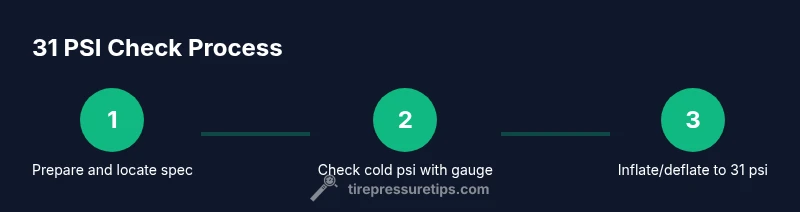
Prepare and locate the 31 psi spec
Park on a level surface, shut off the engine, and locate the recommended tire pressure on the door jamb sticker or in the owner's manual. Make a note of front vs rear specifications if they differ and identify the correct axle for each tire. This ensures you target the right pressure for your setup.
Tip: If you are unsure, start with the lower of the two values on the sticker and adjust after measurement. - 2
Park on level ground and verify cold conditions
Before taking readings, ensure the tires are cold to avoid inflated readings from recent driving. If the car has been driven recently, wait at least 3 hours or measure after the car has been parked in shade for several hours. Temperature consistency improves reading accuracy.
Tip: Avoid measuring after a short freeway drive; it skews results. - 3
Read current psi with gauge
Remove the valve cap, press the gauge onto the valve stem firmly, and read the psi without wiggling. Do this for all four tires and record each value. If you see a leak or a fluctuating reading, recheck after several minutes with the same gauge or a different gauge for confirmation.
Tip: Hold the gauge straight to avoid measurement error from slant readings. - 4
Inflate or deflate to 31 psi
For tires below 31 psi, add air in small increments, pausing to recheck after each increment. For tires above 31 psi, release air in small increments and recheck. Aim to reach the target on all tires with minimal overshoot.
Tip: Never force air to reach 31 psi; gradual adjustments improve accuracy. - 5
Recheck after adjustment
With all tires adjusted, recheck once more to confirm each tire sits at 31 psi. Reinstall valve caps and ensure there are no leaks around stems. If a tire continues to read high or low, inspect the valve core or seek professional inspection.
Tip: Use the same gauge for final checks to minimize variance. - 6
Document and monitor
Record the readings in your notebook or app. Note the ambient temperature and any load changes. Monitor patterns over time to catch slow leaks or abnormal tire behavior early.
Tip: Set a monthly reminder to review all four tires. - 7
Verify alignment with TPMS
If you rely on TPMS, compare its alerts with your gauge reading. If TPMS warnings persist after adjusting to 31 psi, consider a TPMS reset or sensor check with a professional.
Tip: TPMS is a backup; do not rely solely on sensors for exact pressure.
Frequently Asked Questions
Is 31 psi suitable for all tires?
No. 31 psi is a common baseline, but always follow the vehicle manufacturer’s specification on the door jamb label. Some tires or loads may require higher or lower psi.
31 psi is a common target, but always follow your car’s official spec on the label.
Do all tires require the same pressure?
Not necessarily. Front and rear tires can have different recommended pressures, and the correct figure can vary with tire size, load, and speed expectations.
Front and rear pressures can differ; check the label for each axle.
How does temperature affect tire pressure readings?
Temperature changes can cause psi fluctuations. Warmer tires read higher and cooler tires read lower; measure when cold for consistency.
Temperature changes affect psi; measure when cold for consistency.
Should I ignore TPMS and rely only on gauge readings?
No. TPMS provides a warning when pressure deviates from the target. Always confirm with a gauge, then address any underlying leaks if readings don’t align.
TPMS warns you, but always verify with a gauge and address any leaks.
Can I adjust the spare tire to 31 psi?
Spare tires often have different recommendations. Check your vehicle manual and the spare tire’s own label before inflating.
Spare tires have their own spec; check the manual before inflating.
How often should I check tire pressure?
Check at least once a month and before long trips. More frequent checks are wise in extreme temperatures or when tires are new.
Check at least monthly and before long trips.
Watch Video
What to Remember
- Check cold tires for accurate psi
- Follow axle-specific 31 psi specs
- Use a reliable gauge and recheck after adjustments
- Account for temperature and load effects
- Regularly monitor tire pressure for safety and efficiency