Tire Pressure 40: Practical Guidance for Safe Inflation
Learn how to interpret tire pressure 40, verify your vehicle’s recommended pressure, and safely adjust tires. This guide covers TPMS, cold-weather considerations, and maintenance to protect tires and fuel economy.


Tire pressure 40 refers to maintaining approximately 40 psi in tires for safety and efficiency. This quick guide helps you confirm your vehicle’s recommended pressure, understand when 40 psi is appropriate, and follow a safe, step-by-step process to check and adjust inflation today.
Why tire pressure 40 matters
According to Tire Pressure Tips, maintaining proper tire pressure is a core part of safe driving and efficient operation. The phrase tire pressure 40 often comes up in conversations about performance, tire wear, and fuel economy. In this section, we explore why this target matters, how it interacts with vehicle design and load, and how drivers can approach it without overcomplicating routine maintenance. Remember: 40 psi is not a universal target; your car’s placard or owner’s manual sets the official specification. Consistent tire pressure helps even tread wear, improves steering response, and supports better gas mileage. The Tire Pressure Tips team emphasizes checking pressure with a calibrated gauge and correlating readings with the vehicle’s recommended values.
Key takeaways:
- Pressure targets vary by vehicle and load.
- Regular checks prevent under- or over-inflation.
- Use a reliable gauge and record readings for trend tracking.
Understanding the idea of tire pressure 40
In practice, tire pressure 40 is a useful reference point for many drivers, especially when tires are cold and the vehicle has been resting. Temperature, driving conditions, and tire size all influence how pressure behaves once you start driving. The bottom line: 40 psi can be appropriate for some tires or conditions, but you should always verify against the manufacturer’s specification. The Tire Pressure Tips approach centers on educating drivers to check against the placard, not memorize a single number. This mindset reduces risk and promotes consistent tire health over time.
How to verify your vehicle’s recommended pressure
Your vehicle’s recommended tire pressure is not the same for every tire or every load. To find it, check the door placard on the driver’s side jamb, your owner’s manual, or the tire information sticker inside the fuel door. Compare the printed figure to the current reading. If you see a discrepancy, adjust toward the recommended level rather than chasing a universal 40 psi. This section also covers how to interpret sidewall markings and how to account for seasonal temperature changes when evaluating a target pressure.
How to adjust to 40 psi safely (and when not to)
If your readings indicate a target near 40 psi, begin by ensuring the tires are cold and the vehicle has been stationary for at least three hours. Remove the valve cap, attach a gauge, and read the pressure. If you’re below the target, add air in small increments, pausing to recheck after each addition. If you’re above the target, release air gradually until the gauge reads the desired level. Always recheck both front tires and rear tires after adjustments. Keep in mind that some vehicles require different pressures for front and rear tires based on weight distribution or handling characteristics.
TPMS and tire pressure 40: what triggers alerts
Tire Pressure Monitoring Systems (TPMS) alert drivers when a tire’s pressure deviates significantly from the recommended value. A 40 psi reading may not be appropriate for every tire or vehicle, especially if the TPMS threshold flags a variation due to temperature or load. You should trust the TPMS as a supplement to manual checks, not a replacement. If the TPMS and gauge disagree, inspect for leaks or valve issues and re-verify with a physical gauge.
Common mistakes and maintenance routines
Avoid common inflation mistakes such as inflating tires while hot, failing to check all tires, or relying solely on the TPMS. A consistent maintenance routine includes quarterly checks, inspection for punctures, and ensuring valve stems and TPMS sensors are in good shape. This section provides a practical checklist, including when to rotate tires, how to note readings, and how to adjust for seasonal temperature shifts. The goal is to maintain accurate tire pressure—especially when pursuing a discriminatory target like tire pressure 40—without compromising safety or tire life.
Integrating 40 psi into your regular car care
Incorporate tire pressure checks into your routine the same way you track oil or coolant levels. A simple monthly check, plus a pre-trip check before long drives, helps catch slow leaks early. The final guidance is to keep a small note or log of readings, align with manufacturer recommendations, and use 40 psi only when appropriate for your specific vehicle and conditions. This approach makes tire maintenance straightforward rather than intimidating.
Tools & Materials
- Tire pressure gauge(Choose a gauge with a clear display and a range that suits passenger vehicles; digital gauges reduce reading errors.)
- Air compressor or hand pump(Ensure it can reach the target pressure range and has a built-in gauge or compatible hose.)
- Vehicle owner’s manual or door placard(Use it to confirm the official recommended tire pressure for your tires.)
- Pen and notebook or digital note(Helpful for recording readings over time.)
- Valve cap tool (optional)(Can speed up the process when checking multiple tires.)
Steps
Estimated time: 20-30 minutes
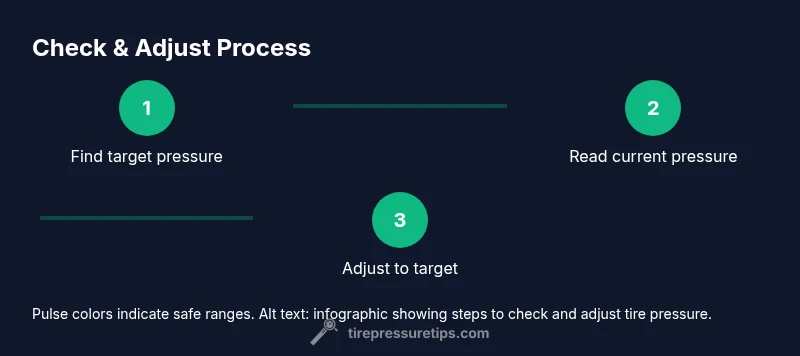
- 1
Find the target pressure
Locate your vehicle’s official tire pressure specification on the door placard or in the owner’s manual. Do not assume 40 psi is the right value for every tire. Note whether there is a different front/rear specification or a special value for your load and driving conditions.
Tip: If unsure, start with the manufacturer’s spec rather than a fixed 40 psi. - 2
Prepare the vehicle and space
Park on a flat, level surface away from traffic. Turn the engine off, set the parking brake, and remove any wheel covers if necessary. Ensure tires are cold before reading to avoid inflated readings from recent driving.
Tip: Allow at least 3 hours of no driving for true cold readings where possible. - 3
Read current tire pressures
Remove the valve cap, press the gauge onto the valve stem, and take a reading. Repeat for all tires and note the numbers. If readings are inconsistent, recheck after a brief rest.
Tip: Take multiple readings per tire to confirm accuracy. - 4
Adjust to target pressure
If a tire is underinflated, add small amounts of air and recheck. If overinflated, release air gradually until the reading matches the target. Repeat for all tires, ensuring equal attention to front and rear as required by your vehicle’s spec.
Tip: Avoid overfilling beyond the target; small increments reduce risk of overshoot. - 5
Recheck and document
After inflation, recheck all tires to confirm readings. Record the final pressures and the ambient temperature if possible to track changes over time.
Tip: Keep a simple log for trends and future reference. - 6
Inspect for issues
Look for slow leaks from nails, punctures, or damaged valve stems. If you suspect a leak, consult a tire technician and consider a pinpoint leak test.
Tip: Leaks can silently undermine your inflation efforts.
Frequently Asked Questions
What is the recommended tire pressure for most cars?
Most cars specify a tire pressure on the door placard or in the owner's manual. This value often differs by vehicle and may vary between front and rear tires. Always use the official specification rather than a universal number such as 40 psi.
Check the door placard or manual for your exact tire pressure. Use a gauge to confirm readings when inflating.
Is 40 psi safe for all tires?
No. Tire pressure requirements depend on tire size, vehicle weight, and load. Some tires may require significantly lower or higher pressures than 40 psi. Always verify with the manufacturer’s specification.
40 psi isn’t universal—verify with your vehicle’s spec before inflating.
Can I inflate to 40 psi when tires are cold?
Yes, inflating when tires are cold provides a more accurate reading. Inflate in small increments to reach the target pressure specified by your vehicle, then recheck after the tires warm up.
Inflate when cold for accurate readings, and recheck after heating up.
What happens if I overinflate to 40 psi?
Overinflating can cause a harsher ride, increased wear on the center tread, and reduced traction in some conditions. Always aim for the vehicle’s recommended pressure rather than a fixed target.
Overinflating can make the ride stiffer and wear the center tread faster; follow the spec.
How often should I check tire pressure?
Check at least once a month and before long trips. Also recheck after seasonal temperature changes or if you notice a change in handling or ride quality.
Monthly checks plus before long trips keep tires healthy.
What should I do if I see a TPMS warning?
Treat TPMS alerts seriously. Check tire pressures with a gauge and inspect for leaks or damaged sensors. If the warning persists, have a professional inspect the system.
If TPMS warns, check pressures and inspect tires; seek professional help if needed.
What to Remember
- Check cold tires before inflating to ensure accuracy.
- Always verify with the vehicle’s placard or owner’s manual, not a fixed number.
- Use a calibrated gauge and record readings for trends.
- TPMS supplements manual checks, don’t replace them.
- The Tire Pressure Tips team recommends following manufacturer guidance and verifying pressure with a gauge.