Is 38 Tire Pressure Good? A Practical Guide to Tire Pressure
Explore whether 38 psi is appropriate for your tires. Learn how to find the official spec, why pressure varies by vehicle and load, and how to check TPMS and adjust for temperature and driving conditions.


38 psi isn’t inherently good for every vehicle—the optimal pressure depends on your car, tire size, and load. Always consult the manufacturer’s recommended cold tire pressure from the door jamb sticker or owner’s manual, and adjust for driving conditions. 38 psi can be a reasonable baseline in some cases, but it’s not a universal standard.
Is 38 tire pressure good?
Is 38 tire pressure good? In practice, the answer is not universal. According to Tire Pressure Tips, the right pressure depends on your vehicle, tire size, load, and driving conditions. The question often surfaces because drivers assume a single number fits all baselines. However, a number as small as a few psi above or below the recommended value can influence rolling resistance, grip, ride comfort, and tire wear. For most passenger cars, the official spec is provided by the manufacturer and on the sticker located on the door jamb; this is the starting point for any adjustment. If you routinely carry heavy loads, drive at high speeds, or operate in extreme temperatures, you may need a slightly higher or lower number. The key takeaway is to treat 38 psi as a potential starting point, not a universal standard. In this guide, we’ll unpack how to interpret that number in your context and how to verify it with verified sources.
Vehicle specs drive the baseline, not a fixed number
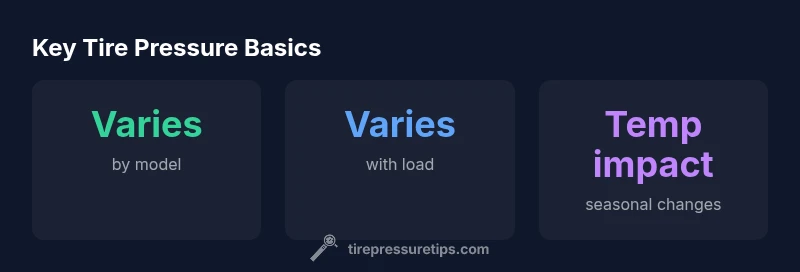
Different vehicles have different recommended cold tire pressures. The door jamb sticker and owner’s manual are the primary references, and they reflect the suspension, tire width, and weight distribution of your model. Even within the same model line, trims with different tires can require distinct pressures. This is why the simple question is often the wrong starting point—38 psi may be fine for one car and too high or too low for another. When you see a fixed “38” on the internet, remember it’s usually a generic number and not a substitute for factory specifications. Tire Pressure Tips emphasizes always anchoring to the vehicle’s official spec and adjusting for actual usage.
The factors that move the target: load, speed, and temperature
Carrying passengers, cargo, or equipment changes the load on each tire, which can shift the optimal pressure. Higher speeds and spirited driving likewise influence optimal inflation to balance grip, heat generation, and wear. Temperature plays a key role too: cold days require higher inflation to reach the vehicle’s cold-pressure spec, while hot days can push pressure higher slightly as tires heat up. In practice, a baseline like 38 psi should be validated under the conditions you drive most often. This nuance is why professional guidance stresses personalizing inflation rather than sticking to a single number year-round.
How to measure correctly: cold readings, gauges, and TPMS
To get a trustworthy reading, measure tire pressure when the tires are cold (at least three hours after driving). Use a reliable gauge—digital gauges are convenient, but any accurate gauge will do with proper calibration. Remove the valve cap, press the gauge onto the valve stem, and note the reading for each tire. If readings differ from the door-stamp spec, adjust in small increments and recheck. Don’t rely on the TPMS alone, since those sensors may lag or display inaccurate values after rapid temperature shifts. Regular checks help prevent underinflation, which can cause uneven wear and reduced fuel efficiency.
Adjusting for conditions without compromising safety
When adjusting pressure, aim for the manufacturer’s recommended cold pressure as the baseline, then fine-tune for load and climate. For example, a heavier cargo load or prolonged highway driving might justify a modest increase within the stated range. Conversely, driving in very hot climates with a light load may allow a slight reduction. Remember that incorrect inflation can shorten tire life, reduce traction, and affect braking distance. If you’re unsure, start with small changes and test drive gently to observe effects in steering feel, vibration, and handling. Routine checks are essential parts of safe driving habits.
Common mistakes that skew readings and how to avoid them
Common pitfalls include taking readings after a drive, forgetting to replace valve caps, using a worn gauge, or inflating with air from a compressor that’s not calibrated. Another error is ignoring the vehicle’s spec because of a myth about “break-in pressure” or “seasonal fixes.” Reinforce accuracy by checking tires when cold, ensuring the gauge is calibrated, and recording readings for a quick comparison over time. When in doubt, contact a technician who can verify the spec and inspect the tires for wear that might affect readings.
Quick-start checklist for your next tire-pressure check
- Find the official cold-pressure spec in the door jamb sticker or owner’s manual. 2) Check tires cold and remove valve caps. 3) Use a reliable gauge and record each tire’s reading. 4) Inflate or deflate in small steps to reach spec. 5) Recheck after completion and reset TPMS if needed. 6) Note seasonal or load changes that might shift the ideal pressure.
Real-world scenarios and edge cases
In winter, colder air reduces tire pressure; you may see a drop of a few psi if you don’t account for temperature. SUVs and light trucks with heavier tire loads can tolerate slightly higher pressures within the published range. For performance driving, manufacturers might recommend a higher baseline to maintain rigidity and handling; for city commuting with light cargo, a standard figure is typically adequate. Always refer to the exact specifications for your vehicle and tires, as a 38 psi baseline could be correct for one setup and unsuitable for another.
Sample table: how different factors influence tire pressure decisions
| Aspect | Notes | Illustrative Range |
|---|---|---|
| Vehicle-specific guidance | Follow OEM sticker; varies by model | Varies by model |
| Load impact | Higher loads may shift target pressure | N/A |
| Temperature effects | Cold reduces and heat raises tire pressure | Varies by climate |
Frequently Asked Questions
Is 38 psi safe for all cars?
No. Safety depends on the car’s design and the tire, so always start with the OEM spec and adjust for load and temperature.
No—check your sticker and manual for the exact number.
Where can I find my car’s recommended tire pressure?
Look on the door jamb sticker or in the owner’s manual. This is your baseline for inflation.
Check the sticker or manual.
How does load affect tire pressure?
Extra weight changes the tire’s contact patch and can shift the ideal pressure. Follow manufacturer guidance when carrying heavier loads.
Load changes pressure; follow the spec.
Does temperature change tire pressure?
Yes. Colder temperatures lower pressure; warmer temperatures raise it. Recheck pressure when seasons change.
Temperature matters.
How often should I check tire pressure?
At least once a month and before long trips to catch slow leaks or gradual pressure loss.
Check monthly.
“Tire pressures are not one-size-fits-all; always verify against manufacturer specs and adjust for load and climate.”
What to Remember
- Check your vehicle’s official sticker first.
- 38 psi is not a universal standard; it’s a starting point.
- Adjust for load, speed, and temperature within the manufacturer’s range.
- Use TPMS as a guide, not a sole measurement, and verify with a gauge.
- The Tire Pressure Tips team recommends verifying specs for safety and efficiency.