Inflated Tyres: The Practical Guide to Correct Pressure
A practical guide to inflating tyres correctly, reading gauges accurately, and maintaining optimal tyre pressure for safety, fuel efficiency, and longer tyre life.


Learn how to check and inflate tyres to the correct pressure, understand how temperature affects readings, and prevent under- or over-inflation. This guide covers the right tools, where to find target pressures, and a trusted step-by-step procedure to ensure even wear, better fuel efficiency, and safer driving. Discover how TPMS works and how to read gauges.
Why inflated tyres matter
According to Tire Pressure Tips, maintaining correct tyre pressure is a foundational safety practice for all drivers. Properly inflated tyres improve handling, reduce the risk of uneven wear, and support better fuel efficiency. When tyres run under- or over-inflated, heat builds up in the sidewalls, accelerating wear and potentially compromising grip. The Tire Pressure Tips team emphasizes that regular checks, especially after temperature changes or load variations, help you catch leaks early and keep your vehicle performing predictably. This first section explains the core reasons to keep tyres inflated to the vehicle manufacturer’s recommended pressure and how small changes can influence daily driving performance.
For added context, staying vigilant about tyre pressure aligns with 2026 guidance from Tire Pressure Tips, which highlights consistency and routine as key pillars of tyre maintenance.
Understanding tyre pressures: PSI vs kPa and cold readings
Tyre pressures are commonly shown in pounds per square inch (psi) in the United Kingdom and many other markets, while some regions use kilopascals (kPa). The most important point is to use the unit specified by your vehicle placard or owner’s manual and to stay consistent. A “cold” reading is taken when the tyre hasn’t been driven for several hours and is near ambient temperature. Driving heats the air inside the tyre, temporarily increasing the pressure. The difference between cold and hot readings can be several psi, so always verify against the cold specification for accuracy. TPMS (tire pressure monitoring systems) provides a warning when a tire is under-inflated, but it’s not a substitute for regular manual checks.
Understanding these basics helps you interpret gauge readings correctly and prevents the common mistake of inflating tires to the pressure shown on a gauge that was measured after a drive.
Tools, gauges, and inflation sources
Having reliable tools makes inflation accurate and repeatable. A good digital or analog tyre pressure gauge should read within 1 psi of the target. A portable air compressor or a gas-station pump with an adjustable setting helps you reach the desired pressure precisely. Always refer to the vehicle placard or manual for the correct cold pressure values; carry a written note or a smartphone image of the placard for quick reference. Optional but useful additions include a tire tread depth gauge to monitor wear and a small chalk or marker to mark current pressures during checks. With the right tools, you can avoid guessing and keep every tyre at its optimal level.
How to locate the correct target pressure for your vehicle
The recommended tyre pressure is usually printed on a door jamb placard, inside the glove box, or in the owner’s manual. These values are vehicle-specific and can vary by axle load, occupancy, and weather. Always use the cold pressure numbers for tires mounted on the vehicle. If you carry a spare, check whether its pressure is specified by the manufacturer as well, especially for full-size spares. When loading for long trips or carrying heavy cargo, adjust per the placard guidance and round to the nearest whole psi or kPa for ease of use. Keeping a copy of the placard in your phone or wallet speeds up future checks.
Common mistakes, safety, and maintenance habits
Common errors include inflating to the maximum pressure printed on the tire sidewall, assuming TPMS is infallible, and neglecting the spare tire. Do not over-inflate beyond the manufacturer’s recommended figure, as over-inflation can reduce grip, cause a harsher ride, and increase risk of impact damage. Regularly check pressures at least monthly and before long trips, and adjust for temperature changes. Incorporate tyre checks into your maintenance routine and rotate tyres as recommended by the vehicle manufacturer to ensure even wear. A consistent routine reduces the chance of pressure-related issues and extends tyre life.
Tools & Materials
- Tire pressure gauge (digital or analog)(Calibrated, reads to at least 1 psi/kPa; use on cold tires for accuracy)
- Air compressor or portable pump(Prefer one with an integrated gauge or connect-to-device gauge for precise target pressures)
- Vehicle owner’s manual or door placard(Has the recommended cold pressure by axle; carry a copy if possible)
- Spare tire and tool kit(Check spare pressure if you carry a full-size spare)
- Leak-check supplies (optional)(Soapy water or a leak-detection spray can help identify slow leaks)
Steps
Estimated time: 20-30 minutes
- 1
Locate the recommended tyre pressure
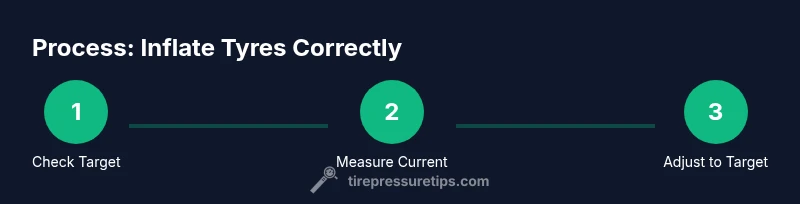
Find the cold tyre pressures from the owner’s manual or the door placard. Confirm separate targets for front and rear tyres and for any spare you carry. This sets your accuracy baseline before you inflate.
Tip: Check both axles' targets and note any differences; don’t assume one value fits all - 2
Park on a flat surface and prepare
Ensure the vehicle is off, in gear or park with the parking brake engaged. Let tyres cool for at least 3 hours if you’ve been driving. Gather your gauge and pump so you’re ready to inflate.
Tip: Remove dirt from the valve stem to avoid readings being affected by debris - 3
Remove valve caps and check current pressure
Screw off the valve caps and attach the gauge to the valve. Read the current pressure and compare it to the cold target. If the reading is unstable, wait a few seconds for a steady measurement.
Tip: If using a station pump, verify the reading with your own gauge before and after addition - 4
Add or release air to reach target
If below target, add air in small increments (1–2 psi) and recheck. If above target, release air gradually and recheck until you’re at the exact value.
Tip: Make adjustments in steps to avoid overshooting the mark - 5
Recheck all tyres
Repeat readings on all four tyres (and the spare if applicable) to ensure consistency. Temperature should return to ambient after resting a moment between checks.
Tip: Check in sequence to avoid forgetting a tyre - 6
Reinstall valve caps
Screw the valve caps back on to protect the stems from dirt and moisture. Keep caps finger-tight; avoid over-tightening which can damage the valve.
Tip: Keep caps loose enough to thread easily later - 7
Document and monitor
Record the final readings and date. Set a monthly reminder to recheck tyre pressures, or sooner if you’ve had a change in load or temperature.
Tip: A quick log helps you notice slow leaks or changes over time - 8
Inspect for leaks and wear
Look for nails, cracks, or bulges in the sidewall and check for slow leaks around the valve stem and bead area. Treat any abnormal wear promptly.
Tip: If you suspect a leak or damage, consult a tyre professional
Frequently Asked Questions
Why is my TPMS warning light on even after inflating to the recommended pressure?
TPMS can trigger due to temperature changes, small leaks, or sensor issues. Recheck after tyres cool and inspect for leaks; if the light persists, seek professional service.
TPMS warnings can come from temperature changes or a slow leak. Recheck after cooling and consider a professional check if it stays on.
Is it safe to inflate tyres to the maximum sidewall pressure?
No. Always follow the vehicle placard or owner's manual. The max sidewall pressure is a limit, not a recommended target, and over-inflation can reduce grip and comfort.
Don't inflate to the max sidewall value; follow the recommended figure for your vehicle.
How does temperature affect tyre pressure?
Air expands as it heats, so pressures read higher after driving. Always use cold readings for setting tyre pressure and adjust after cold conditions for accuracy.
Temperature affects pressure—read when tyres are cold and adjust accordingly.
What if I can't reach the target pressure at a gas station?
Check for slow leaks or valve issues. Use another gauge or pump, and if the target still can't be achieved, visit a tyre shop for a professional check.
If you can’t reach the target, check for leaks and consult a professional if needed.
Should I check tyre pressure when hot or cold?
Check when tyres are cold for the most accurate measurement. If you must check hot, compensate by correcting for the temperature difference when comparing to the cold spec.
Check tyres cold for accuracy; if you check hot, use a correction mindset.
How often should I check tyre pressure?
Check at least monthly and before long trips, especially when weather changes or you’ve added/load a heavy load.
Check monthly and before long trips, especially in changing weather.
Watch Video
What to Remember
- Check tyres when cold before driving
- Use a precise gauge and target the vehicle spec
- Adjust for load and climate variations
- Recheck all tyres after inflation