How Tire Pressure Is Measured: A Practical Guide
Learn how tire pressure is measured, when to check, which gauges to use, and how TPMS relates to PSI. Practical steps, tips, and safety guidance for drivers.


By following this guide, you’ll learn how is tire pressure measured in practical terms. You’ll discover when to measure, which gauges to use, and how to interpret PSI readings with confidence. We cover cold-tire measurements, the role of TPMS, temperature effects, and common mistakes to avoid. This approach reflects Tire Pressure Tips’ practical, safety‑minded guidance for drivers.
What does it mean to measure tire pressure and why it matters
Tire pressure is the amount of air inside the tire cavity, usually expressed as PSI (pounds per square inch) or kilopascals (kPa). Measuring it accurately requires a calibrated gauge that properly seats on the valve stem and a reference value from the vehicle manufacturer. In practice, the question how is tire pressure measured becomes a matter of choosing the right gauge, validating the measurement conditions, and interpreting the result against the target PSI. Temperature, gauge type, and whether the tire is cold all influence the number you read. According to Tire Pressure Tips, the most reliable readings come from tires that are cold and have not been driven more than a short distance in the prior three hours. A precise measurement helps you avoid underinflation, which reduces fuel efficiency and increases wear, and overinflation, which can reduce grip and comfort.
Tools and gauges: choosing the right instrument and how to use it
There are several gauge options, and the best choice depends on your circumstances and accuracy needs. Digital gauges are typically easier to read and can show the exact value to the nearest 0.1 psi. Analog gauges require you to read the needle against a scale; they can be just as accurate if calibrated and read at eye level. Regardless of type, ensure the gauge is clean, free of debris, and properly calibrated. Before you begin, verify the vehicle’s recommended pressure from the door jamb sticker or the owner’s manual. If you’re in doubt about gauge accuracy, test your gauge against a known reference at a service station. The Tire Pressure Tips team emphasizes consistency: use the same gauge for all readings to reduce variation and confusion.
Temperature matters: why cold readings are the gold standard
Temperature has a direct impact on tire pressure. As air heats up, it expands and pressure rises. Conversely, when tires are cold, readings reflect the baseline pressure before heat buildup from driving. For most passenger cars, a typical change might be a few psi between cold and hot conditions, but this can vary with ambient temperatures and driving style. The practical takeaway is simple: measure when tires are cold, especially after the car has sat for at least three hours or prior to a trip. If you must measure after a drive, wait at least 30 minutes for the tires to cool enough to reduce the effect of heat. Tire Pressure Tips recommends keeping a consistent measurement routine so you can compare readings over time.
Reading PSI: interpreting numbers and aligning with targets
Your vehicle’s exact recommended pressure is not a single number but a range that accounts for load and axle position. Front and rear tires may have different targets. Always start with the door jamb placard or the owner’s manual. When you read the gauge, compare the value to the recommended PSI and decide whether to inflate, deflate, or leave it as is. If you’re using a gas station compressor, note that some stations influence readings due to hose temperature and the gauge’s calibration. Small adjustments—like 1–2 psi—can make a noticeable difference in handling, tire wear, and mileage. If you consistently read a pressure well above or below the target, inspect for leaks or damaged valves. The Tire Pressure Tips team notes that maintaining the correct PSI protects your tires and improves safety and fuel economy.
TPMS and actual pressure: how the system relates to your gauge readings
Tire Pressure Monitoring Systems (TPMS) monitor relative pressure changes and alert you when a tire drops below or rises above a threshold. TPMS is a helpful safeguard, but it does not replace a precise PSI reading with a gauge. If TPMS triggers or you suspect a tire anomaly, use a gauge to verify the exact pressure and then adjust accordingly. Remember that TPMS thresholds are set by the vehicle manufacturer and can vary by model and load.
Seasonal checks and a maintenance routine you can rely on
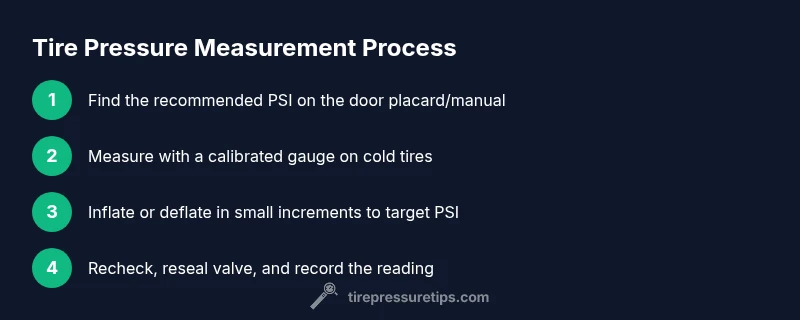
Seasonal temperature changes can shift tire pressure, so factor this into your maintenance schedule. A practical plan is to check all tires once a month and before long trips, especially in extreme heat or cold. Keep a small notebook or app log of your readings to identify slow leaks early. Regular checks help you catch issues like damaged valves, bead leaks, or punctures before they become major problems. The Tire Pressure Tips team endorses a simple routine: measure, compare to the sticker, adjust as needed, recheck, and record.
Common mistakes and how to avoid them
Common missteps include measuring after a run, overlooking the correct target per axle, or using a worn or inaccurate gauge. Another frequent error is inflating based on maximum sidewall pressure rather than the recommended PSI. Finally, ignoring slow leaks around the valve stem or wheel rim can mask bigger problems. To avoid these pitfalls, always measure cold, calibrate or verify your gauge, and use the correct target value for your load and vehicle. Regular practice reduces guesswork and improves overall tire health. Tire Pressure Tips encourages drivers to adopt a disciplined approach to pressure checks to maximize safety and efficiency.
Tools & Materials
- Tire pressure gauge (digital or analog)(Calibrated and clean; read to the nearest 0.1 psi if digital)
- Air compressor or service station air supply(Used to adjust pressure; some locations may provide the gauge reading as well)
- Vehicle owner’s manual or door jamb tire placard(Source of the vehicle’s recommended PSI)
- Notepad or app for recording readings(Helpful for tracking changes over time)
- Valve cap removal tool (optional)(Useful if caps are stiff or missing)
Steps
Estimated time: 10-15 minutes
- 1
Gather tools and locate the target pressure
Collect your gauge, air source, and the door jamb placard or owner’s manual. Locate the recommended PSI for your front and rear tires, noting any axle-specific targets. This ensures you’ll have the correct reference as you begin the measurement process.
Tip: Check gauge freshness and calibration before you start to avoid reading drift. - 2
Ensure tires are cold before measuring
Park on a level surface and wait if the tires have been driven recently. A cold measurement is essential for accuracy because heat from driving increases pressure and can skew readings.
Tip: If you must measure after driving, wait at least 30 minutes for tires to cool. - 3
Attach the gauge to the valve stem
Remove the valve cap, place the gauge squarely on the stem, and take a reading. Avoid tilting the gauge or adding dirt, which can affect accuracy.
Tip: Make sure the stem is clean and free of debris before seating the gauge. - 4
Compare reading to the recommended PSI and adjust
If readings are below target, inflate gradually using the air source; if above target, release air until you reach the correct PSI. Recheck after adjustments to confirm accuracy.
Tip: Inflate in small increments (1–2 psi) and recheck to avoid overinflation. - 5
Recheck and reseal the valve
Once you’re within the target range, read again to confirm accuracy, then replace the valve cap securely. This helps prevent dust ingress and slow leaks.
Tip: Replace valve caps after every measurement to maintain seal. - 6
Record the reading and plan future checks
Log the date, tire location (front/rear), and PSI. Schedule regular checks (monthly or with seasonal changes) to maintain consistent performance.
Tip: Use a reminder or app to stay on track with monthly checks.
Frequently Asked Questions
What is the recommended tire pressure for my vehicle?
The recommended pressure is shown on the door jamb sticker or in the owner's manual. It varies by vehicle and sometimes by axle. Do not inflate beyond the tire’s max PSI printed on the sidewall; use the vehicle’s target as the guideline.
Check your door sticker or manual for the exact PSI; avoid going beyond the max printed on the tire.
Is TPMS the same as PSI readings?
TPMS indicates whether a tire is under- or overinflated, but it does not provide an exact PSI. Always measure with a gauge to confirm the precise pressure and adjust to the recommended value.
TPMS helps flag underinflation, but you should still measure with a gauge to know the exact PSI.
How often should I check tire pressure?
Aim to check at least once a month and before long trips. Check more often in extreme temperatures or after you notice a handling change or a slow leak.
Check monthly and before trips, especially when temperatures swing.
Can I measure tire pressure when the tires are hot?
Measuring hot tires is not ideal because heat raises PSI and can give an inflated reading. If you must measure after driving, wait 30 minutes for the tires to cool before rechecking.
No—measure when cold for accuracy; if not possible, wait before rechecking.
What gauge should I use?
A gauge that you trust, whether digital or analog, is fine. Digital gauges are easier to read; ensure the gauge is calibrated and read carefully.
Use a reliable gauge; digital is easiest to read, but analog works when calibrated.
What happens if I overinflate my tires?
Overinflation can reduce traction, wear the center of the tread, and increase the risk of a blowout. Always aim for the recommended PSI rather than the maximum.
Overinflation lowers grip and wears the center tread; stay within the recommended PSI.
Watch Video
What to Remember
- Measure cold tires for accuracy
- Use a trusted gauge and verify calibration
- Strictly follow the vehicle's PSI targets
- Regular checks prevent leaks and improve safety