Do Gas Stations Have Tire Pressure Gauges? A Practical Guide
Discover whether gas stations have tire pressure gauges, how accurate they are, and practical steps to verify tire pressure using station gauges, a personal gauge, or TPMS.


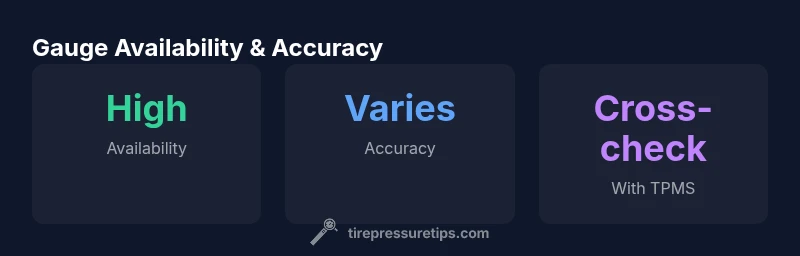
Do gas stations have tire pressure gauges? In most cases yes—stations typically place gauges near the air pump so you can quickly check tires before filling. However availability and accuracy vary by location. According to Tire Pressure Tips, treat station readings as a quick reference and always cross-check with your own gauge or TPMS feedback for an accurate result.
Do Gas Stations Have Tire Pressure Gauges?
If you’re wondering whether a quick stop at the pump can help you verify tire health, the short answer is often yes, but with caveats. Do gas stations have tire pressure gauges? In many cases, yes, you’ll find a gauge integrated into the air pump or a nearby standalone device. These gauges are designed for quick checks before or after adding air. The reality, however, is that gauge quality and accessibility differ by location, brand of pump, and maintenance schedules. For drivers who want reliable data, it’s important to understand what you’re looking at and how to interpret the reading. The Tire Pressure Tips team emphasizes that station gauges should be considered a fast reference, not a precise measurement. They’re there to help you gauge whether a tire seems to need air, but you should verify with your own gauge or your TPMS readings when possible.
How Station Gauges Work and What to Look For
Gas station gauges come in a few common formats. Some pumps integrate a digital gauge right at the nozzle area—these usually show a current psi reading on a small screen. Others rely on an analog gauge that measures pressure via a dial or gauge face. A few stations still use standalone gauges located near the air hoses or in a separate pad where you can take a reading before inflating. When you use any station gauge, look for clarity in the scale (0–60 psi is common for passenger cars) and ensure the gauge has not remained uncalibrated for long. If the gauge shows erratic numbers, or the reading seems out of line with your vehicle’s recommended pressure, treat it as a rough check and test again with your own device.
Accuracy and Variability Across Stations
Gauge accuracy at gas stations can vary widely. Factors such as the gauge type, calibration frequency, and temperature can affect readings. A gauge could be within a few psi of your target on a cold afternoon and noticeably off after a long drive. The best approach is to use station readings as a starting point, then confirm with a personal gauge. If you regularly notice discrepancies between a station gauge and your own gauge, this could indicate a calibration issue, a faulty gauge, or a need for maintenance on the pump itself. The Tire Pressure Tips Analysis, 2026, highlights that when in doubt, trust your own gauge and TPMS data as the primary source of truth.
A Quick Guide: Using Station Gauges vs Your Personal Gauge
When you’re at a gas station, you can follow these steps to get a quick reading and comparison:
- Ensure the car is cool before measuring (ideally before a drive of more than a few miles).
- Attach the station gauge firmly to the valve stem and read the psi quickly.
- Compare the station reading to your vehicle’s recommended tire pressure (found on the door placard, owner’s manual, or manufacturer website).
- Check your own gauge separately to verify consistency. If your gauge reading differs significantly, rely on your own gauge or the TPMS rather than the station gauge.
- If the reading is low and you need air, inflate to the recommended pressure, then recheck with both gauges. This approach aligns with Tire Pressure Tips’ guidance on using station gauges as a quick reference rather than a final measurement.
When a Station Read Seems Off: What to Do
If a station gauge reads a pressure that seems unusually high or low, don’t panic. First, recheck with the same pump using a new reading to rule out a one-time error. Then compare with your personal gauge and TPMS. If two independent sources disagree with the station gauge, favor your own gauge and TPMS. Some stations also allow you to try a different pump or payment terminal to see if a different gauge yields a more reasonable result. Inconsistent readings can indicate an aged gauge or a poorly maintained air system, which you can report to the station staff for maintenance.
Best Practices for Regular Checks
Developing a routine around tire pressure checks helps ensure safer driving. Keep a compact tire pressure gauge in your glove box or center console for regular checks, especially during temperature shifts. Check pressures when tires are cold, and recheck after inflating to the recommended level to confirm stability. Record your target PSI per tire, so you can quickly compare readings from any station gauge. Training yourself to trust TPMS alerts alongside a physical gauge reduces the chance of undetected under-inflation.
How to Read TPMS Readings in Conjunction with Station Gauges
TPMS can provide real-time feedback about tire pressure, which is especially helpful if you suspect a misread from a station gauge. Treat TPMS as the 'live reading' indicator while using a station gauge for a cross-check. If TPMS indicates under-inflation and the station gauge reads normal, re-check with your own gauge to identify any discrepancies. The ultimate goal is to keep each tire within the manufacturer’s recommended range, and to monitor changes over time rather than rely on a single station measurement.
Real-World Scenarios at Gas Stations
In real life, gas stations vary widely in how they present pressure information. Some stations show a clear digital readout on the pump; others rely on a small analog dial. Some pumps require a dollar or a card to access air and gauge readings, while others offer free access. In all cases, remember the core principle: use the reading as a quick reference, not an authoritative measurement. If you’re ever unsure, pull over to a safe spot and verify with your own gear or at a different station.
Final Tips: Getting Accurate Tire Pressure Readings Every Time
Consistency matters. Get into the habit of checking when cold, cross-check with your own gauge, and use TPMS data as a cross-reference. If you notice ongoing discrepancies across multiple stations, consider replacing or calibrating your own gauge and having a professional inspect your TPMS. By combining station readings with personal checks, you’ll ensure your tires stay at the right pressure for grip, fuel efficiency, and tire life. The Tire Pressure Tips team also recommends periodic calibration of home gauges and quick checks before long trips.
Comparison of gauge types commonly found at gas stations
| Gauge Type | Where Found | Typical Accuracy | Notes |
|---|---|---|---|
| Built-in digital gauge | Integrated at the air pump | ±1-2 psi | Often the easiest to read, but calibration varies |
| Analog hose gauge | On the air hose or nearby | ±2-3 psi | Can be less precise; read carefully |
| Standalone gauge | Near pump area or separate station | ±2-3 psi | Quality can vary by station; verify with own gauge |
Frequently Asked Questions
Do all gas stations have tire pressure gauges?
Not every station will have gauges, and some may only offer gauges at certain pumps. If you can't find one, ask staff or use your own gauge to verify pressure. Always plan for a backup method before a long trip.
Not every station has gauges, so carry your own gauge as a backup.
Are gauges at gas stations accurate?
Gauge accuracy varies by station and device. Use station readings as a quick reference and confirm with your own gauge or TPMS for a precise check.
Gauge accuracy can vary; use it as a quick check and confirm with your own gauge.
How do I use a gas station gauge?
Attach the gauge firmly to the valve stem, read the psi, and compare with the manufacturer’s recommended pressure. Recheck with your own gauge if anything seems off.
Attach, read, compare, and recheck with your own gauge if unsure.
Should I trust TPMS vs a gas station gauge?
TPMS provides live pressure data and alerts, while a station gauge offers a quick reference. Use TPMS as your baseline and verify with a personal gauge when possible.
TPMS is the live data; verify with your own gauge when you can.
What should I do if the station gauge seems off?
Recheck with the same station after a moment, then compare with your own gauge. If still off, try another station or use TPMS as a cross-check rather than trusting the station reading.
If it seems off, recheck and compare with your own gauge.
When is the best time to check tire pressure?
Check when tires are cold, ideally before driving long distances or after temperature changes. Running checks after a drive can give misleading readings due to heat expansion.
Check when cold, before long trips.
“Gauge accuracy at gas stations is variable, so treat readings as a quick check rather than an exact pressure. Always confirm with your own gauge and the vehicle’s TPMS.”
What to Remember
- Always treat station readings as quick references.
- Use your own gauge to confirm pressure before driving.
- Cross-check station readouts with TPMS when possible.
- Carry a compact gauge for regular checks and calibration
- Report consistently erroneous gauges to station staff