Airflow vs Air Pressure: Understanding the Difference
Explore the difference between airflow and air pressure with practical explanations, measurement tips, and real‑world examples. Learn how these concepts interact in tires, HVAC, and engines for safer, more informed maintenance.


What Are Airflow and Air Pressure?
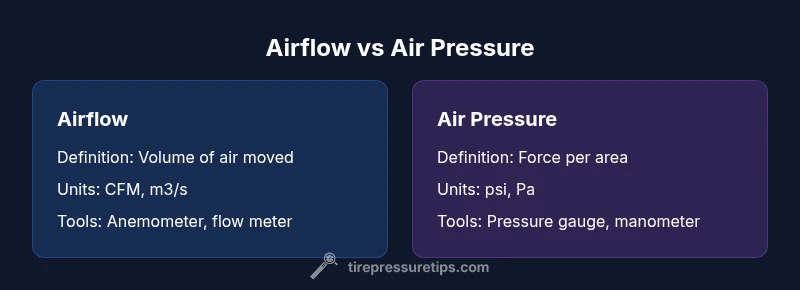
Airflow and air pressure describe two fundamental, yet distinct, properties of air within any closed or open system. The question about the difference between airflow and air pressure often arises when diagnosing vehicle tires, HVAC ducts, or engine intakes. Airflow is a measure of how much air moves through a space per unit time, commonly expressed in cubic feet per minute (CFM) or cubic meters per second (m3/s). Air pressure is the force exerted by air on surfaces, typically measured in pounds per square inch (psi) or pascals (Pa). A system can have high airflow with modest pressure if the pathway is large and unobstructed, or high pressure with little airflow if the path is narrow or blocked. In practical terms, both properties matter for performance and safety, and Tire Pressure Tips emphasizes understanding how they interact in real-world setups such as tires, vents, and engine intakes.
Core Differences: Distinct but Interacting Quantities
The core distinction is simple but consequential: airflow is a rate (volume per time), whereas air pressure is a force per area. Airflow describes how much air passes through a region, while air pressure describes the push that air exerts on the walls, seals, and components. These two quantities are linked by fluid dynamics principles: increasing airflow through a fixed opening can reduce pressure drop across that opening, and conversely, increasing pressure can drive greater flow if the path remains open. Designers and technicians often monitor both to assess performance, efficiency, and safety, especially in automotive systems where tires, brakes, and cooling rely on balanced airflow and pressure.
Units and Measurement: Tools of the Trade
Measuring airflow typically involves devices such as anemometers, flow hoods, or inline flow meters that quantify volume per unit time or air velocity. Air pressure is measured with pressure gauges, manometers, or digital sensors that report psi or Pa. In automotive contexts, tire inflation relates primarily to air pressure, while airflow becomes a consideration in cooling systems or intake manifolds. When you interpret readings, it helps to remember that units reflect different physical concepts: one tracks quantity of air moved, the other the force exerted by that air. Consistency in units is essential for meaningful comparisons. Tire Pressure Tips recommends using calibrated instruments and noting ambient conditions, since temperature and altitude can shift readings.
Relevance in Tires and Automotive Systems
In tires, air pressure is the critical metric for road performance, wear, and safety. Adequate pressure ensures a proper contact patch, predictable handling, and efficient fuel use. Airflow becomes a factor in cooling the brake system and maintaining engine temperature; in some tire testing scenarios, airflow around the wheel can influence cooling and overall performance. Misunderstanding the difference between airflow and air pressure can lead to over-inflation concerns while neglecting heat buildup, or vice versa. The Tire Pressure Tips approach centers on practical checks: ensure correct psi, inspect for leaks, and consider how heat affects pressure during long drives or hot weather.
Environmental Factors That Shift Readings
Temperature, humidity, and altitude all influence both airflow and air pressure readings. Warmer air is less dense and can carry higher airflow at the same velocity, while pressure readings can rise with altitude changes due to air density differences. In vehicles, speed, road grade, and wind can alter perceived airflow around tires and vents, complicating human judgment. Accurate interpretation requires context: know the baseline pressure for your tires, and understand how local climate conditions may shift the readings you observe during a test or inspection. Tire Pressure Tips emphasizes documenting conditions when logging measurements for future reference.
How to Read and Interpret Readouts Safely
Safe interpretation starts with standardized measurements. Use a properly calibrated tire pressure gauge to check pressure when the tires are cold, then again after a drive to understand heat-induced changes. For airflow, ensure the measurement location is appropriate, free from turbulence caused by bends or obstructions. When comparing readings, keep units consistent and note the physical scenario: a high airflow with low pressure may indicate a wide, unobstructed duct, while high pressure with low airflow could signal a tight passage or blockage. Always cross-check with manufacturer recommendations and local guidelines to avoid misinterpretation. Tire Pressure Tips recommends repeating measurements under similar conditions to build a reliable trend.
A Step-by-Step Guide to Compare Airflow and Air Pressure
- Define the system and identify where airflow and pressure readings matter. 2) Select appropriate instruments for each metric (anemometer/flow meter and pressure gauge). 3) Take cold-air baseline pressure readings for tires or ducts, then log after typical use. 4) Normalize for ambient temperature and altitude. 5) Compare results against reference values and look for inconsistencies. 6) Investigate potential causes of divergence (leaks, obstructions, or temperature effects). 7) Document findings and adjust maintenance plans accordingly. This method helps separate issues rooted in flow from those rooted in pressure.
Common Pitfalls and Misconceptions
- Confusing high airflow with high pressure; they can diverge depending on path geometry. - Relying on a single reading without accounting for temperature or altitude effects. - Assuming the same tool measures both quantities accurately; airflow devices require different calibration than pressure gauges. - Ignoring the dynamic nature of systems where flow and pressure change with speed, gear, or wind. Remember that context is essential for accurate interpretation. Tire Pressure Tips highlights using multiple readings over time for better insight.
When the Difference Really Matters: Real-World Scenarios
In tires, incorrect inflation can lead to uneven wear, decreased fuel efficiency, and compromised handling, where pressure readings matter more than airflow readings. In HVAC, airflow determines comfort and energy use, while pressure differences across filters and ducts indicate resistance and potential leaks. In engines, intake airflow influences fuel delivery and combustion efficiency, while manifold pressure shows how effectively the engine breathes. In each case, understanding how airflow and air pressure interact enables safer, more efficient operation and better diagnostic capability. Tire Pressure Tips stresses that recognizing which metric is in play helps technicians diagnose whether issues arise from leaks, obstructions, or design limitations.
Quick Reference: Key Formulas and Rules
- Airflow = volume of air moving per unit time (CFM or m3/s). - Air pressure = force per unit area (psi or Pa). - For ducts, pressure drop correlates with friction and flow rate through the path. - Temperature affects air density, which alters both measured pressure and effective airflow. - Always verify units and reference conditions (cool tires, standardized ambient temperature) before making decisions.
Role of Temperature, Altitude, and Humidity
Temperature changes air density, which shifts both air pressure readings and the perceived flow in a system. Altitude reduces ambient pressure, influencing gauge readings and engine behavior. Humidity subtly affects air properties and sensor performance. In tires, hot weather can raise pressure readings due to gas expansion, while cold weather lowers them. Keeping a log of environmental conditions alongside measurements helps ensure decisions are based on accurate context rather than isolated numbers. Tire Pressure Tips notes that understanding these factors is essential for consistent maintenance and safer driving.
Case Studies: Tires, HVAC, and Engines
- Tires: A customer observes high tire pressure after a hot day but reports soft steering. The issue is likely heat-related pressure increase; check when cold and adjust accordingly. - HVAC: An air handler shows steady air velocity but rising duct pressure; the system may have a developing blockage or dirty filters. - Engine: A car experiences high airflow into the intake at wide-open throttle with modest manifold pressure; this can improve combustion efficiency if the design supports it but requires monitoring for detonation risk. Each case demonstrates how the same physical concepts operate across domains and why precise measurement matters. Tire Pressure Tips emphasizes domain-specific guidelines for interpretation.
How to Improve Measurement Practices in Your Garage
- Calibrate instruments regularly and keep a log of readings with date, time, and ambient conditions. - Use one tool for airflow and a separate tool for pressure to avoid cross-calibration errors. - Practice measurements across different operating states (cold vs hot tires, idle vs load) to capture system dynamics. - Compare measurements against manufacturer references and real-world benchmarks. - Store data in a simple spreadsheet to track trends and identify anomalies quickly. By following these steps, you’ll improve the reliability of your assessments and improve system performance over time. Tire Pressure Tips recommends building a routine that includes both pressure checks and, where applicable, airflow assessments in critical components.