Is Air Pressure the Same as Air Resistance? A Clear Comparison
Explore the difference between air pressure and air resistance, with definitions, measurements, and practical implications for driving, aerodynamics, and tire maintenance, according to Tire Pressure Tips.


Air pressure and air resistance are related but distinct concepts. Static air pressure is the force exerted by air on surfaces, while air resistance (drag) is the resistive force that opposes motion through air. The two should not be conflated when diagnosing vehicle performance or weather effects. This comparison highlights definitions, measurements, and practical implications.
Is air pressure the same as air resistance? An introductory distinction
Air pressure and air resistance are two fundamental ideas in fluid dynamics, but they describe different physical phenomena. In everyday language, people sometimes confuse the two, especially when discussing car tires, wind, or aerodynamics. For clarity, is air pressure the same as air resistance? The quick answer is no: air pressure is the force per unit area from the air acting on surfaces, while air resistance, or drag, is a resistive force that opposes motion through air. This article, from Tire Pressure Tips, explains the differences, how each is measured, and why confusion happens in practical contexts such as driving and vehicle maintenance. According to Tire Pressure Tips, the guidance here helps drivers optimize safety, comfort, and efficiency without conflating the two ideas. The distinction becomes particularly important when you consider how weather, vehicle speed, and surface textures influence both static and dynamic air forces. Throughout this article you will see practical examples, measurement tips, and clear definitions that you can apply when checking tire pressure, evaluating aerodynamics, or planning maintenance routines.
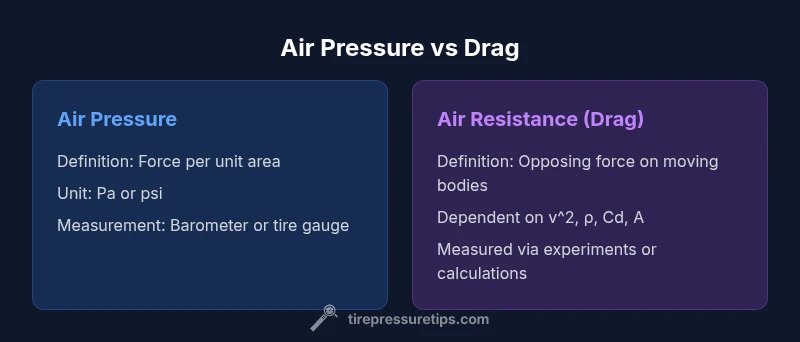
Definitions: air pressure vs. air resistance
Air pressure is a scalar (or vector, when you specify direction) quantity describing the force exerted by air on a surface per unit area. In atmospheric science, we speak of ambient atmospheric pressure, often measured in pascals (Pa) or kilopascals (kPa). In the tire world, “air pressure” usually means gauge pressure inside a tire, which affects the contact patch and rolling resistance. Air resistance, also known as drag, is a resistive force that opposes the motion of a body moving through air. Drag depends on the shape, cross-sectional area, air density, velocity, and the drag coefficient Cd. It is typically expressed as Fd = 0.5 ρ v^2 Cd A, which makes drag sensitive to speed and geometry rather than a fixed pressure value alone. Understanding both concepts helps avoid common misinterpretations when evaluating performance, safety, or fuel economy.
How air pressure is measured and what it does in practice
Air pressure can be measured with different instruments depending on the context. Weather stations use barometers to gauge ambient atmospheric pressure, while tire pressures are checked with gauge-style devices that read gauge pressure relative to ambient. In everyday driving, maintaining recommended tire pressures ensures optimal contact patch geometry, predictable handling, and reasonable rolling resistance. It is important to note: is air pressure the same as air resistance? Not at all. While both originate from the same surrounding air, pressure relates to how much force the air column exerts on a surface, whereas drag describes how that air resists the motion of a moving object. Weather changes, altitude, and temperature shifts can alter ambient pressure and, to a lesser extent, the way air interacts with a moving vehicle.
How air resistance operates in different regimes
Drag arises from the interaction between a moving body and air. It increases with velocity due to the v^2 term in the drag equation, and it also depends on air density ρ, the cross-sectional area A, and the drag coefficient Cd, which captures shape and flow characteristics. At low speeds, laminar flow dominates and Cd is relatively stable; at higher speeds, flow becomes turbulent, Cd can change with Reynolds number, and drag rises steeply. The distinction from air pressure is critical: while pressure is a static property of the air, drag is a dynamic force that grows with speed and depends on how the body presents itself to the airstream. For vehicles, this means aerodynamic shaping reduces Cd and smooths airflow to minimize drag, while proper tire pressure reduces rolling resistance but does not directly change aerodynamic drag.
Everyday implications: vehicles, cycling, and wind effects
In daily life, most people encounter air pressure in weather forecasts, tire maintenance, and safety checks. Is air pressure the same as air resistance? No—the two influence performance in different ways. For drivers, proper tire pressure improves grip and reduces rolling resistance, potentially improving fuel economy. Drag, however, governs how the vehicle interacts with wind and determines high-speed performance and wind noise. Cyclists feel drag profoundly as speeds rise, especially in headwinds or drafts. In terms of safety and comfort, understanding these forces helps you interpret weather reports, select appropriate tire pressures for different seasons, and anticipate how wind conditions affect handling and efficiency. The Tire Pressure Tips framework emphasizes distinguishing these factors to guide everyday maintenance and performance decisions.
Common misconceptions and clarifications
Many beginners assume increasing tire pressure directly reduces aerodynamic drag. While higher tire pressure can reduce rolling resistance, it does not inherently lower drag, which is driven by shape, velocity, and air density. Conversely, thinking that air pressure inside a tire pushes the vehicle forward neglects the real role of drag in resisting motion at speed. A practical takeaway is to treat air pressure and drag as separate design and operating factors. When diagnosing performance issues, ask: Is the observed effect likely due to static air pressure influencing the contact patch, or is it due to aerodynamic drag from airflow around the body? Clarifying this helps you pick the right maintenance actions and design choices.
Interactions: when air pressure affects drag and vice versa
Although pressure and drag are distinct, they interact in meaningful ways. Air density, driven by weather and altitude, affects both ambient pressure and drag magnitude. A higher density medium increases drag for a given speed and may alter the perceived effect of tire inflation on handling due to changes in aerodynamics and tire footprint. Conversely, a tire at very low pressure can alter the vehicle’s geometry and cross-sectional exposure to air, affecting drag indirectly through changes in ride height and body shape. In engineering practice, models separate static pressure effects from dynamic drag to produce more accurate predictions of performance, safety margins, and fuel efficiency.
Practical experiments you can run to visualize the concepts
Try these simple tests to visualize the difference between air pressure and drag:
- Balloon and wind: Inflate a balloon to a fixed pressure and observe how it remains stable in still air but encounters friction when pushed through air. Compare with a similarly shaped object moving at the same speed to feel drag.
- Fan and paper strip: Hold a lightweight card edge-first in a steady airflow. Notice how drag increases with speed; alter the air density by changing humidity or temperature and observe changes in drag behavior.
- Tire pressure and rolling resistance: Inflate a tire to two different pressures and compare the effort required to push a cart across a controlled surface at a constant speed. The effort reflects rolling resistance (related to pressure) rather than pure air drag.
These activities reinforce the separation between static air pressure and dynamic drag while illustrating how both forces shape everyday performance.
Quick reference: key distinctions at a glance
- Air pressure is the force per unit area from air on surfaces; drag is the resistive force against motion through air.
- Pressure uses pa/psi; drag is described via Fd = 0.5 ρ v^2 Cd A and depends strongly on speed.
- Static pressure influences surface contact and safety; drag governs aerodynamic efficiency and performance at speed.
- Weather, altitude, and temperature affect ambient pressure and air density, thereby influencing both quantities in different ways.
- In vehicle maintenance, keep tires inflated to recommended levels to manage rolling resistance; aerodynamics design handles drag through shaping and surface treatment.
Comparison
| Feature | Air Pressure | Air Resistance (Drag) |
|---|---|---|
| Definition | Force per unit area exerted by air on surfaces (ambient or gauge) | Resistive force opposing motion through air (fluid friction, CdA) |
| Measurement | Barometer, tire gauges; pressure in Pa or psi | Calculated from velocity, density, area, and Cd; sometimes inferred from experiments |
| Primary effect | Affects surface forces, weather readings, tire inflation guidance | Affects motion through air, vehicle efficiency, top speed, and noise |
| Dependence on velocity | Weak or negligible dependence in static contexts | Strong dependence due to v^2 term |
| Key variables | Ambient density, surface area, pressure difference | Air density, velocity, cross-sectional area, Cd |
| Control levers | Altitude, weather, and gauge calibration | Shape, smoothness, speed, and airflow management |
| Common contexts | Weather reporting, tire maintenance, HVAC systems | Automotive aerodynamics, aviation, sports equipment design |
Strengths
- Clarifies how different forces affect performance
- Improves diagnostic thinking for maintenance and design
- Supports targeted improvements (pressure vs. aerodynamics)
Drawbacks
- Can overwhelm beginners with abstract concepts
- Requires consistent context to avoid confusion
- Drag is environment and speed dependent, making inference tricky
Air pressure and air resistance are distinct but interrelated concepts.
Treat static pressure as a surface force and drag as a motion-side resistance. Use separate measurements and models for accurate diagnostics and optimization in driving, cycling, and vehicle engineering.
Frequently Asked Questions
Is air pressure the same as air resistance?
No. Air pressure is the force per area from air on surfaces, while air resistance (drag) is the resistive force opposing motion through air. They are related through the same medium but represent different physical quantities.
No, they’re different: pressure is a static force per area, while drag is a dynamic resistance to motion.
How do you measure air pressure versus drag?
Air pressure is measured with barometers or tire gauges (Pa or psi). Drag is typically inferred from velocity, air density, cross-sectional area, and Cd, or measured with specialized wind tunnel equipment.
Pressure is read with a gauge; drag is estimated from speed, shape, and air properties.
Can increasing tire pressure affect air resistance?
Increasing tire pressure mainly reduces rolling resistance and can change contact patch. It does not directly reduce aerodynamic drag, which is governed by shape, speed, and air density.
Higher tire pressure mainly affects rolling resistance, not aerodynamic drag.
Why does drag rise with speed?
Drag increases roughly with the square of speed (v^2) because dynamic pressure grows with velocity. Faster motion interacts with more air resistance, amplifying energy losses.
Drag grows quickly with speed due to the v^2 relationship.
What role does air density play in drag?
Drag is proportional to air density. Higher density (e.g., at sea level) increases drag for a given speed and body area, while lower density reduces it.
More dense air means more drag at the same speed.
How do TPMS and tire pressure relate to drag and performance?
TPMS helps maintain correct tire pressure, which optimizes rolling resistance and stability. Drag is influenced by aerodynamics and speed, not TPMS readings, though proper pressure supports overall efficiency.
TPMS helps keep tires at the right pressure; drag depends mainly on aero factors, but good tire pressure supports efficiency.
What to Remember
- Define each term before applying it in practice
- Measure pressure with a gauge; estimate drag from speed and geometry
- Elevate understanding through real-world experiments
- Apply separate fixes for pressure and drag factors
- Revisit designs for aerodynamics and tire maintenance as needed