Difference Between Air Pressure and Air Volume: A Practical Guide
Explore the difference between air pressure and air volume with practical explanations, real-world examples, and how these concepts apply to tires, inflatables, and everyday measurement.


Air pressure and air volume describe different aspects of gas behavior: pressure measures force per unit area, while volume is the space the gas occupies. In many situations they relate through the ideal gas law PV=nRT, and temperature can shift both. Understanding this distinction helps when diagnosing tires, balloons, or sealed systems, and guides safe, effective measurements.
What the terms mean in plain language
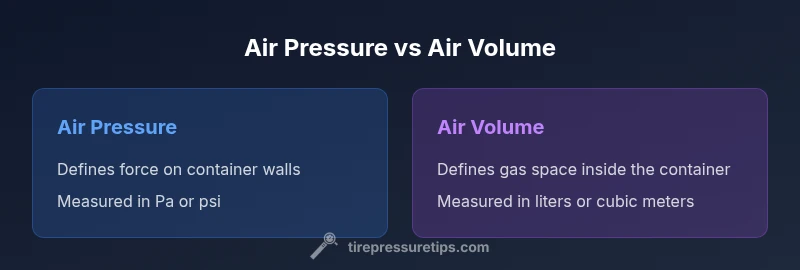
According to Tire Pressure Tips, air pressure and air volume are not interchangeable ideas; they describe different aspects of a gas’s state. Air pressure is the force exerted by gas molecules on container walls per unit area. Air volume is the space the gas occupies inside that container. The distinction matters most when the container size changes or temperature shifts cause gas behavior to change. In tires, for example, a small increase in load can momentarily affect volume and pressure differently. To avoid confusion, remember that pressure measures a force, while volume measures how much space is filled. This framing also aligns with common laboratory and automotive measurements—pascals, liters, and the PV=nRT equation help you reason across contexts.
Key takeaways
- Pressure is a force per area; volume is space occupied.
- Temperature links both through gas behavior.
- Use PV=nRT as a guiding framework in most practical cases.
Comparison
| Feature | Air Pressure | Air Volume |
|---|---|---|
| Definition | Force per unit area exerted on container walls | Space occupied by gas inside the container |
| Typical units | Pascals/psi/bar | Liters/cubic meters |
| Key relationship | Inversely related at fixed n and T (Boyle’s Law) | Depends on P and T via PV=nRT; changing V alters P for fixed n and T |
| Measurement approach | Use a pressure gauge or sensor | Estimate volume from container geometry or displacement methods |
| Best for | Diagnosing leaks, TPMS behavior, safety margins | Understanding gas storage, sealed systems, and inflation dynamics |
Strengths
- Clarifies how pressure and volume influence each other
- Helps diagnose tire or gas-system issues
- Supports safer engineering limits and design decisions
- Improves measurement accuracy when combined with temperature data
Drawbacks
- Can be conceptually challenging for beginners
- Real-world gases show non-ideal behavior
- Temperature effects can complicate direct intuition
Understanding both concepts is essential for safe and efficient gas-related systems.
Use the ideal gas framework as a starting point, but always account for temperature and material constraints. In tires and inflatables, pressure control is often the practical priority, while volume considerations matter for capacity and safety.
Frequently Asked Questions
What is the difference between air pressure and air volume?
Air pressure measures the force of gas molecules on container walls per unit area, while air volume is the space the gas occupies. They are connected through gas laws, especially when temperature changes. Knowing the distinction helps you predict how a change in one affects the other in practical scenarios like tires and inflatables.
Pressure is the force per area; volume is the space gas fills. Temperature can tweak both, so watch how changes in one parameter shift the other.
How does temperature affect air pressure in a fixed-volume container?
In a fixed-volume container, raising the temperature generally increases air pressure because gas molecules move faster and collide with the container walls more often. This is described by Gay-Lussac's law and the ideal gas relation PV=nRT. If you cool the gas, pressure tends to drop accordingly.
Heat makes pressure rise in a sealed space; cooling lowers it. This is why hot tires feel different and why temperature should be considered in inflation decisions.
Can air pressure change without changing volume?
Yes. Pressure can change if temperature changes or the amount of gas (moles) in the container changes. In a fixed-volume system, pressure varies with temperature (and amount of gas) according to PV=nRT. Non-ideal behaviors can complicate the relationship at very high densities or low temperatures.
Pressure can go up or down if you heat or vent gas, even if the space size stays the same.
Why is TPMS relevant to air pressure?
Tire Pressure Monitoring Systems (TPMS) track whether a tire’s pressure deviates from the recommended level. TPMS helps maintain safe air pressure within a tire, which indirectly relates to volume and load, since underinflation can reduce tire volume efficiency and increase heat buildup.
TPMS keeps you informed about pressure levels so you can adjust before issues arise.
How do you measure air volume in a sealed system?
Measuring volume typically requires geometry of the container or indirect methods like displacement. In complex systems, volume changes can be inferred from changes in pressure and temperature using PV=nRT under known conditions. For most consumer contexts, estimating volume from container size is sufficient.
You usually estimate volume from the container’s shape or use indirect methods based on pressure changes and temperature.
What is Boyle's law and when does it apply?
Boyle's law states that for a fixed amount of gas at constant temperature, pressure and volume are inversely related. It applies best to isothermal (constant temperature) processes in idealized conditions. Real gases deviate at high pressures or extreme temperatures, but the principle still guides intuition.
Pressure goes up when volume goes down, if temperature stays the same. Real life adds temperature and non-ideal effects.
What to Remember
- Grasp the core definitions to avoid mixing up terms
- Remember pressure is force per area; volume is space occupied
- Link them via PV=nRT and temperature effects
- Use pressure measurements for safety and control in tires
- Apply the concepts with real-world examples like tires and balloons