Difference Between Air Pressure and Air Density
Explore the difference between air pressure and air density, how temperature and altitude affect each, and what it means for tire behavior, performance, and safety on the road.


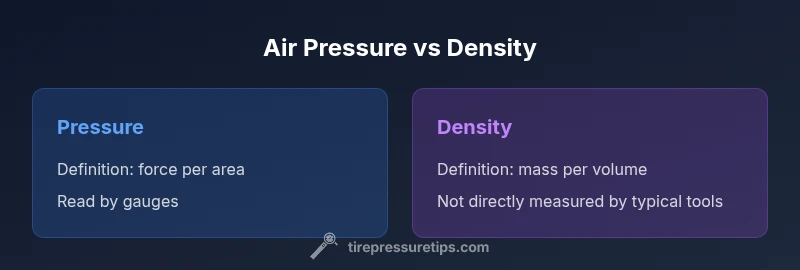
According to Tire Pressure Tips, the difference between air pressure and air density is fundamental to understanding how air behaves in tires and engines. Pressure is the force per area; density is mass per volume. Temperature and altitude alter density more noticeably than gauge readings in everyday driving. This quick distinction helps you interpret TPMS data and manage tires more effectively.
The difference between air pressure and air density
The distinction between air pressure and air density is a foundational concept in both physics and practical vehicle maintenance. Pressure measures how much force the air exerts on a surface per unit area, while density measures how much air mass occupies a given volume. In many real-world situations, these two properties move together, but they respond differently to changes in temperature and altitude. The Tire Pressure Tips team emphasizes that recognizing this separation helps drivers interpret gauge readings, weather effects, and engine performance more accurately. By keeping this distinction in mind, you can better understand why a tire’s inflation reading might not tell the whole story about how the air inside behaves under different conditions.
How pressure and density relate to basic gas behavior
Air is a mixture of molecules that exerts force when confined. Pressure is what you feel as a force on the tire’s inner wall or a tire gauge. Density is how compactly those air molecules are packed in a given space. When temperature rises, molecules move faster and tend to occupy more space, which can lower density if the volume is fixed. Conversely, when temperature falls, density increases as molecules pack more tightly if volume remains the same. These relationships are central to understanding both mechanical systems and atmospheric physics in everyday driving.
Units, measurements, and what gauges tell you
Pressure is commonly measured in units like psi or pascals, indicating force per area. Density is measured as mass per volume, often represented in kilograms per cubic meter in scientific contexts. A tire gauge gives you a pressure reading, but it does not directly measure density inside the tire. The density inside a sealed tire depends on the gas inside and the temperature of that gas. This practical distinction explains why a tire can show a consistent pressure while the density inside shifts with heat or cold.
Temperature as a dominant driver for density changes
Temperature changes have a pronounced effect on density because the air molecules gain or lose kinetic energy, altering how closely they pack together within a fixed volume. In many situations, the density variation due to temperature is more noticeable than the change in pressure you might read on a gauge. The ideal gas insight—though simplified—helps you predict how density shifts with heat and how that relates to performance factors like rolling resistance and grip.
Altitude and ambient air influence on pressure versus density
Altitude alters the ambient air you encounter every time you start a trip. As you ascend, the surrounding air becomes thinner, reducing ambient density and the pressure exerted on surfaces. Inside a tire, however, the density response depends on the internal pressure and temperature of the gas. Understanding these dynamics helps explain why inflating tires to a cold-weather specification matters and how temperature can partially compensate for altitude-induced pressure changes.
Practical implications for tires and driving performance
For daily maintenance, remember that the gauge reading you rely on is a measure of pressure, not density. Temperature fluctuations during a drive can change density and, to a lesser extent, the gauge pressure you observe when you stop for a reading. This distinction matters for safety and efficiency: underinflation can compromise grip and wear, while density shifts during hot days can alter tire behavior. The takeaway is to monitor pressure, consider ambient temperature, and inflate tires according to cold-weather guidelines when appropriate.
Common misconceptions about pressure and density
A frequent misunderstanding is to equate pressure with density or to assume they change in lockstep under all conditions. While they are related through gas laws, pressure readings do not directly reveal density inside a tire. Likewise, density is not something most drivers measure with typical maintenance tools. The practical focus should be on accurate pressure readings, correct inflation targets, and awareness of how temperature and altitude influence density indirectly through the gas in your tires.
Integrating the concepts for everyday diagnostics
When diagnosing tire behavior, use pressure readings as your primary metric, but keep the density concept in mind for contexts like temperature extremes or high-altitude driving. In normal driving, keeping tires inflated to the recommended cold pressure remains the best practice to balance safety, fuel efficiency, and tire wear. If you notice unusual performance changes, consider both pressure and the potential density-related effects of heat or cold on the gas inside the tire.
Comparison
| Feature | Air Pressure | Air Density |
|---|---|---|
| Definition | Force per unit area exerted by air | Mass per unit volume of air |
| Primary units | psi / kPa (gauge or absolute) | kg/m³ (density) |
| Direct measurement | Measured with gauges (TPMS, handheld) | Not directly measured by common tools |
| Temperature effect | Rises with heating, but gauge reads external force | Density changes strongly with temperature |
| Altitude effect | Ambient pressure drops with altitude | Ambient density also decreases, but behavior depends on temperature |
| Impact on tires | Inflation readings guide maintenance | Density influences how gas occupies space and reacts to heat |
| Practical focus | Inflation targets and safety checks | Understanding density helps interpret performance under temperature changes |
Strengths
- Pressure readings are straightforward and actionable for maintenance
- Density concepts explain gas behavior under temperature changes
- Understanding both helps prevent misinterpretation of readings
- Supports better intuition for tire safety and performance
Drawbacks
- Density is abstract for daily tire maintenance
- Density inside a tire is not routinely measurable with common tools
- Relying on density alone can mislead if temperature is ignored
- TPMS does not directly measure gas density
Pressure and density are complementary concepts; use both for accurate diagnostics
Pressure tells you how hard air pushes on the tire walls, while density explains how much air mass is packed in a given volume. Temperature and altitude shift density more noticeably, which indirectly affects pressure readings. Combine both ideas for safer inflations and better tire performance.
Frequently Asked Questions
What exactly is the difference between air pressure and air density?
Air pressure measures the force air molecules exert on a surface per unit area, while air density measures how much air mass occupies a given volume. They are related by gas laws, but they are not the same quantity. This distinction helps explain why temperature and altitude affect density differently from what a tire gauge reads.
Pressure is how hard air pushes on surfaces; density is how much air mass is in a space. They’re connected but not identical.
Why do temperature and altitude affect density more than pressure readings?
Temperature directly changes molecular motion, which changes how closely air molecules pack in a fixed volume, altering density. Altitude changes ambient air properties, reducing the amount of air mass in a given space outside the tire. Pressure gauges reflect external force, not the internal density dynamics as strongly.
Temperature changes density more noticeably; altitude also shifts density, while gauges mainly read pressure.
How does TPMS relate to density if it doesn’t measure density directly?
TPMS provides a reading of tire pressure. While it doesn’t measure density, changes in temperature and air mass inside the tire influence density and thereby affect pressure readings over time. Understanding this helps interpret why a tire’s pressure reading might vary with weather and driving conditions.
TPMS reads pressure; density is inferred through how temperature and mass interact inside the tire.
Can I measure air density at home with common tools?
In general, air density is not measured with typical home tools. It requires controlled conditions or specialized equipment. For practical purposes, focusing on accurate pressure inflation and temperature awareness yields reliable tire performance and safety.
Density isn’t something you usually measure at home; focus on proper inflation and temperature awareness instead.
Does ambient density affect my tires during a drive?
Ambient density impacts air behavior outside the tire. Inside the tire, temperature and pressure dynamics are the primary factors that influence how the gas inside behaves. In hot weather, density inside the gas can decrease with expansion, impacting pressure readings and performance indirectly.
Ambient density affects the external environment; inside the tire, pressure and temperature drive density-like effects.
What should I do to maintain safe tire pressure across weather changes?
Check tire pressure when the tires are cold and inflate to the manufacturer’s recommended cold pressure. Remember that hot days can raise both pressure readings and inner gas temperature, so adjustments may be needed after driving. Temperature-aware maintenance helps maintain performance and safety.
Check cold pressure, follow the vehicle’s specs, and adjust for weather changes.
What to Remember
- Know the difference: pressure is force per area, density is mass per volume
- Use cold-pressure checks to minimize temperature-induced errors
- TPMS measures pressure, not density; interpret density concepts during heat or altitude changes
- Temperature and altitude drive density changes more than gauge readings
- Apply the ideal gas intuition to predict how air inside tires behaves