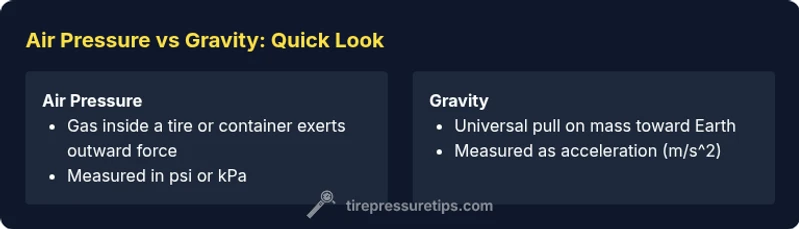
Difference Between Air Pressure and Gravity: A Tire Technician’s Guide
Learn how air pressure and gravity differ and what that means for tire readings, TPMS, and maintenance. Get practical inflation tips and understand how temperature, altitude, and weight affect readings on the road.


TL;DR: The difference between air pressure and gravity lies in scope and function. Air pressure is the internal force exerted by gas inside a container or atmosphere, measurable in psi or kPa. Gravity is a universal force attracting masses toward Earth. In tires, air pressure changes with temperature and volume, while gravity sets weight and load.
Core Concepts: Air Pressure vs Gravity
Understanding the difference between air pressure and gravity helps drivers interpret tire readings accurately. Air pressure refers to the force that gas molecules exert on the walls of their container, such as a tire cavity. Gravity is a universal force that acts on mass, pulling it toward the center of the Earth. In everyday terms, air pressure is about how tightly the gas is squeezed inside a space; gravity is about how mass is pulled downward. Both forces operate in the same physical world, but their roles, measurement, and implications differ widely. For tire maintenance, recognizing that air pressure responds to temperature, volume, and altitude, while gravity determines vehicle weight and load, is essential for reliable inflation strategies and safety.
Definitions: What is Air Pressure?
Air pressure is the force exerted by gas molecules as they collide with surfaces. In tires, it is the pressure inside the tire cavity, balancing the external atmosphere. It is commonly measured in psi or kilopascals (kPa). Changes in temperature can increase or decrease gas density, altering pressure even when the tire volume stays the same. Proper inflation depends on understanding this pressure as a dynamic quantity that reacts to environmental conditions and driving load.
Gravity Explained: The Invisible Force
Gravity is a fundamental force that attracts masses toward each other, with Earth providing the strongest, most observable pull for everyday life. Its effect on tires is indirect but real: gravity sets the weight the tires must bear, influencing tire deformation, contact patch, and load distribution. While gravity is spatially uniform on a local scale, ambient conditions and altitude can modify the air’s density around the tire, which interacts with the pressure reading you see on a gauge.
Measurement and Units: How We Quantify Each Force
Air pressure is quantified in units like psi or kPa and is measured by gauges that press against the tire’s interior air. Gravity is quantified as acceleration due to gravity (m/s^2) and is effectively constant on Earth, with small variations due to altitude and rotation. The key distinction is that pressure is a property of a gas within a volume, while gravity is a force acting on mass. This difference informs how we interpret data from sensors and gauges in automotive maintenance.
Environmental Factors: Temperature, Elevation, and Reading Variability
Temperature and elevation complicate air-pressure readings. Warmer air increases pressure in a sealed system, while cooler air lowers it. At higher elevations, air density changes, subtly affecting tire pressure readings. Gravity itself remains largely constant, but its interaction with atmospheric pressure means the same tire can read differently at sea level versus high altitude. For drivers, this means you should routinely check pressure in similar conditions or use a gauge that compensates for temperature and altitude when possible.
Gravity's Role in Vehicle Weight and Tire Load
Gravity defines the weight your vehicle carries. Heavier loads increase the tire’s deformation and the frictional grip needed to propel and stop the car. This weight translates into higher contact pressure on the tire’s footprint. While you cannot change gravity, you can manage how weight distribution and load affect tire wear. This underscores why inflating to the manufacturer-recommended pressure is essential for both safety and efficiency, particularly when carrying passengers or cargo.
The Interplay in Tire Inflation: Practical Implications
Understanding the interplay between air pressure and gravity helps explain why inflation targets are not static. The same pressure reading can imply different things under different loads. When a car is heavily loaded, the contact patch enlarges, and the pressure required to maintain the same tire shape changes slightly. Temperature shifts the air inside the tire, and gravity determines how much weight the tire supports. The practical takeaway is to inflate to the spec for typical loads and adjust using temperature-compensated gauges or guidelines provided by manufacturers.
Real-World Scenarios: Altitude, Temperature, and TPMS
In real-world driving, altitude and temperature shifts can produce tricky readings. A tire gauge reading in a hot climate may show higher pressure after a highway run than a cooler, shaded stop. TPMS provides alerts when pressures fall below a threshold, but drivers should also understand that gravity-related weight changes affect how those thresholds translate to safe performance. When troubleshooting, compare readings against recent trips and load conditions, not a single snapshot.
How to Interpret Readings: Distinguishing Pressure from Temporary Variations
To separate genuine pressure issues from temporary fluctuations, measure after the tires have rested for several hours in a stable environment, or use a tire gauge in the shade after a drive. Record readings under consistent temperatures and loads. Remember that air pressure is a function of gas behavior within a volume, while gravity reflects mass effects on the vehicle. This distinction helps prevent unnecessary top-ups or misinterpretations when diagnosing tire problems.
Analogies and Visual Aids to Grasp the Difference
A simple analogy: air pressure is like the tension in a balloon’s wall, while gravity is the weight that balloon must carry on a string. A second analogy compares pressure to a gas “pushing” outward, akin to the force you feel when inflating a tire, and gravity to the downward pull that keeps the car anchored to the road. Visual aids, diagrams, and measurements can help translate these concepts into practical habits for maintenance and safety.
Safety, Maintenance, and Best Practices
Prioritize regular, scheduled air-pressure checks, particularly before long trips or when carrying heavy loads. Use temperature-compensated guidelines if available, and always refer to the vehicle manufacturer’s recommended tire pressure. Understanding the difference between air pressure and gravity supports safer driving by ensuring tires are properly inflated, loaded correctly, and monitored under varying environmental conditions.
Comparison
| Feature | Air Pressure | Gravity |
|---|---|---|
| Core concept | Pressure exerted by gas on container walls (e.g., tire cavity) | A universal force that attracts masses toward Earth |
| Measurement units | psi / kPa (gauge-based) | m/s^2 (acceleration due to gravity) |
| Dependencies | Temperature, volume, altitude affect readings | Relatively constant on Earth with minor atmospheric interactions |
| Practical uses | Tire inflation accuracy, TPMS signals | Weight, inertia, and g-forces in motion |
| Best for | Inflation control and safety | Analyzing loads and motion dynamics |
Strengths
- Clarifies fundamental physics concepts for practical use
- Improves interpretation of tire readings and TPMS alerts
- Helps explain why readings vary with temperature and load
- Supports safer, more informed maintenance decisions
Drawbacks
- Abstract concepts can be challenging for beginners
- Requires careful context to avoid misapplying ideas
- May seem theoretical without concrete tire-related examples
Air pressure and gravity are distinct forces with different roles in tires; understanding both improves inflation accuracy and safety.
Recognizing that air pressure responds to gas behavior and environmental factors, while gravity governs weight and load, helps drivers diagnose tire issues more reliably. Use manufacturer specs and temperature-adjusted guidance to maintain optimal inflation.
Frequently Asked Questions
What is the core difference between air pressure and gravity?
Air pressure is the force of gas inside a space on its surfaces. Gravity is the pull that mass experiences toward Earth. In tires, air pressure reflects gas behavior, while gravity relates to weight and load on the tire.
Air pressure is about gas pushing on the tire walls, gravity is the pull on mass. In tires, pressure matters for inflation; gravity affects weight and load.
How does temperature affect tire pressure readings?
Temperature changes cause air to expand or contract, altering pressure readings. A hot day can raise readings; a cold day can lower them. Always check pressure under similar temperature conditions.
Temperature makes air expand or contract, so pressure numbers move with the weather. Check when it’s reasonably stable.
Does gravity directly change tire pressure?
Gravity does not directly alter the air pressure in a tire. It influences the load the tire must carry, which can affect how the tire deforms and, indirectly, the pressure reading.
Gravity doesn’t push on the tire to change pressure, but it changes the weight the tire carries.
Why should I care about the difference for TPMS?
TPMS alerts help you detect under- or over-inflation, but interpreting readings correctly requires understanding that pressure varies with temperature and load, not just gravity.
TPMS tells you when pressure is off, but knowing the why helps you fix it right.
What is a practical way to check tire pressure?
Check after the car has rested and in the same ambient conditions. Use a reputable gauge, compare against the vehicle’s recommended pressure, and adjust for load and temperature as needed.
Let the tires sit, use a good gauge, and compare to the recommended pressure for your load and temperature.
How does gravity relate to tire wear and performance?
Gravity influences load distribution and the contact patch, which affects wear patterns and performance. Proper inflation helps even wear and safer handling.
Gravity sets the load, which changes how the tire wears and handles.
What to Remember
- Inflation targets depend on gas behavior, not gravity alone
- Temperature and altitude affect tire pressure readings
- Gravity shapes weight and load, influencing tire contact
- Use consistent conditions when checking tire pressure
- TPMS is helpful but requires awareness of environmental factors