Difference Between Air Pressure and Atmospheric Pressure
Explore the difference between air pressure and atmospheric pressure, why they differ, and how this matters for weather, science, and tire maintenance guidance from Tire Pressure Tips.


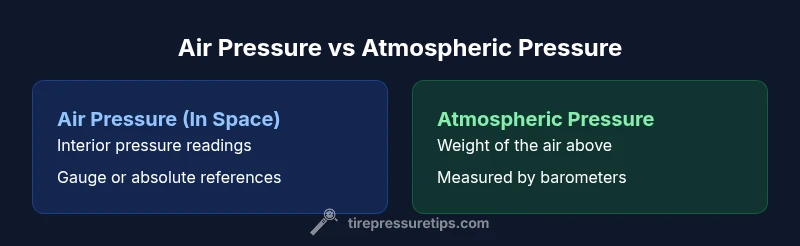
The difference between air pressure and atmospheric pressure is a foundational concept in physics and meteorology. In practice, atmospheric pressure is the force exerted by the weight of the air above a location, measured relative to a vacuum, while air pressure refers to the pressure within a specific space or system, such as a tire, chamber, or instrument. Understanding this distinction helps interpret readings accurately and informs both weather analysis and practical maintenance decisions.
Defining the Terms
The difference between air pressure and atmospheric pressure shapes how scientists describe the atmosphere and how we interpret readings from gauges and barometers. In practical terms, air pressure can refer to the pressure within any enclosed space or the ambient pressure of the surrounding air, while atmospheric pressure refers specifically to the weight of the air column above a location, measured relative to a hypothetical vacuum. For weather and science, atmospheric pressure is the reference frame used to describe changes in the air column. Inside a tire, outdoor environment, or engineered chamber, you may measure air pressure that is a local value, but it exists against the backdrop of atmospheric pressure. According to Tire Pressure Tips, recognizing this distinction helps motorists interpret gauge readings accurately and avoids conflating two related yet different quantities. In physics terms, atmospheric pressure is sometimes called P_atm and is a function of altitude, temperature, and atmospheric mass; air pressure in a space is often discussed as gauge pressure (P_gauge) or absolute pressure (P_abs) depending on whether the reference is vacuum or ambient air. The vocabulary matters because it affects how instruments are calibrated, how charts are read, and how one communicates readings in both everyday and professional contexts. Throughout this article, we will unpack definitions, measurement methods, and practical implications so the difference between air pressure and atmospheric pressure becomes clearer in both theory and practice.
Historical Context and Measurement
Understanding how these pressures are measured historically helps readers grasp why the terminology matters today. Atmospheric pressure has been measured with barometers for centuries, beginning with mercury-filled devices that respond to the weight of the entire air column. Modern barometers include aneroid models and electronic sensors that translate pressure into readable units such as hectopascals (hPa) or millibars (mb). Air pressure inside a space is typically measured with gauges or sensors that respond to the pressure relative to a chosen reference. In many practical contexts, those devices report gauge pressure or absolute pressure, depending on calibration and reference frame. The distinction between a locating reference point and an external ambient condition influences both instrument design and data interpretation. For drivers and technicians, the practical upshot is that a reading inside a tire or a sealed chamber must be interpreted with knowledge of the surrounding atmospheric pressure to determine the true state of the system.
Conceptual Distinctions: Absolute vs. Relative Pressure
Two core concepts underpin the difference between air pressure and atmospheric pressure: absolute pressure and relative (gauge) pressure. Absolute pressure is measured relative to a perfect vacuum, while gauge pressure is measured relative to ambient atmospheric pressure. Atmospheric pressure itself represents the load exerted by the air above a location, and it varies with altitude, weather systems, and temperature. When you read a tire gauge that shows 32 psi, that value is gauge pressure relative to the current atmospheric pressure. If you add the local atmospheric pressure to the gauge reading, you obtain the absolute pressure inside the tire. This distinction matters for calibration, scientific modeling, and interpreting weather charts, especially at high elevations where atmospheric pressure is lower. The relationship among P_abs, P_gauge, and P_atm forms the backbone of how engineers design pressurized systems and how meteorologists describe atmospheric state variables.
How Meteorology Uses These Pressures
Meteorology treats atmospheric pressure as a primary parameter for weather prediction. High-pressure systems typically correspond to sinking air and clearer skies, while low-pressure systems are associated with rising air and cloud formation. The measurement reference is crucial: near-sea-level atmospheric pressure is commonly discussed in hPa or mb and is used to construct weather maps. In practice, barometric pressure readings inform forecasts, while local air pressure within devices or vehicles requires conversion to gauge or absolute terms for meaningful interpretation. While sea-level pressure provides a reference, actual readings vary with altitude, temperature, and humidity. For weather enthusiasts and professionals, distinguishing P_atm from P_gauge clarifies why a weather station reading or a tire gauge might look different under the same ambient conditions at different locations. This nuance helps avoid misinterpretations when evaluating maps, forecasts, or diagnostic readings.
Conceptual Distinctions: Absolute vs. Relative Pressure (Continued)
The core takeaway is that pressure numbers owe their meaning to the reference frame. Absolute pressure combines the vacuum reference with all environmental contributions, whereas gauge pressure excludes ambient atmospheric load. When a person talks about pressure in a tire, the gauge reading is what matters for vehicle performance, but knowing the surrounding atmospheric pressure helps explain seasonal or altitude-related changes in readings. This distinction also clarifies why a device calibrated at sea level behaves differently at higher elevations. Professionals often specify the reference (P_abs or P_gauge) when reporting measurements to ensure accuracy and avoid ambiguities. For students, engineers, and technicians, internalizing this framework improves communication and reduces errors in educational or field settings.
Implications for Everyday Scenarios
Translating theory into daily life means recognizing how these pressures affect real-world tasks. For drivers, the most immediate relevance is tire maintenance. A gauge reading inside a tire reflects gauge pressure, which must be interpreted against atmospheric pressure to determine whether the tire is under- or over-inflated relative to standard or recommended values. Weather considerations follow a parallel logic: atmospheric pressure governs air movement, weather maps, and storm tracks, while the pressure inside sealed compartments (aircraft cabins, submarine hulls, or tire tubes) follows different reference frames. Altitude amplifies the difference, since atmospheric pressure decreases with height, yet an enclosed air volume maintains its own internal pressure unless vented or adjusted. In educational contexts, teachers often emphasize the relationship between P_atm and P_abs to illustrate how physics scales with location, temperature, and environmental mass. For readers of Tire Pressure Tips, this means practical interpretation of readings and the ability to explain why two devices in the same room can report different numbers depending on their reference frames.
Comparison
| Feature | Air Pressure in a Space | Atmospheric Pressure at a Location |
|---|---|---|
| Definition | Pressure inside a space or system (air pressure) | Weight of the air column above the location (atmospheric pressure) |
| Units | Pa or psi (varies by device) | Pa / hPa / mb (often used in weather) |
| Measurement Tools | Gauges or sensors inside the space | Barometer or ambient-air sensors exposed to air |
| Reference Frame | Local environment within the space | Global reference relative to vacuum at sea level |
| Practical Implications | Affects tire readings and chamber pressures | Affects weather analysis and altitude changes |
| Best Use Case | Tire maintenance and enclosed systems | Weather forecasting and atmospheric studies |
Strengths
- Clarifies readings by separating local conditions from ambient load
- Improves accuracy in calibration and diagnostics
- Enhances communication across engineering and meteorology
- Supports better decision-making in maintenance and weather interpretation
Drawbacks
- Can be confusing for beginners without clear definitions
- Requires careful attention to reference frames in reports
- Miscommunication can occur if gauge vs absolute terms are not specified
Distinguish air pressure from atmospheric pressure for accurate readings and interpretation.
Understanding the distinction helps both practical tasks—like tire maintenance—and scientific weather analysis. Use the reference frame consistently when reporting pressures to avoid misinterpretation.
Frequently Asked Questions
What is atmospheric pressure in simple terms?
Atmospheric pressure is the weight of the air above a location, acting on everything at that point. It is a global reference used in weather science and varies with altitude and weather conditions.
Atmospheric pressure is the weight of the air above us, used as a reference in weather science.
How does air pressure differ from atmospheric pressure?
Air pressure can refer to the pressure inside a space or the ambient air pressure. Atmospheric pressure specifically refers to the weight of the air column overhead. The two are related but measured with different references.
Air pressure is pressure inside a space or the surrounding air, while atmospheric pressure is the weight of air above the location.
What instruments measure air pressure and atmospheric pressure?
Air pressure inside a space is measured with gauges, while atmospheric pressure is measured with a barometer. Some devices report absolute pressure, others report gauge pressure relative to ambient air.
Gauges measure air pressure inside spaces; barometers measure atmospheric pressure.
Does altitude affect atmospheric pressure?
Yes. Atmospheric pressure decreases with altitude because the air column above is thinner. This change influences weather patterns and air density.
Altitude lowers atmospheric pressure because there is less air above you.
How is this difference relevant to tire pressure?
Tire gauges measure gauge pressure, which is the pressure inside the tire relative to the surrounding air. To evaluate the tire's absolute state, you can consider atmospheric pressure as a reference.
Tire gauges show gauge pressure; relate it to atmospheric pressure to assess true conditions.
Are standard atmospheric pressures constant?
Atmospheric pressure is not constant; it changes with weather systems and altitude. Weather forecasts use sea-level references to compare readings, but actual values vary by location.
Atmospheric pressure changes with weather and altitude.
What to Remember
- Define the terms clearly before use
- Always note the reference frame (gauge vs absolute)
- Gauge pressure equals the local pressure minus atmospheric pressure
- Atmospheric pressure varies with altitude and weather
- Use correct units and references when interpreting readings