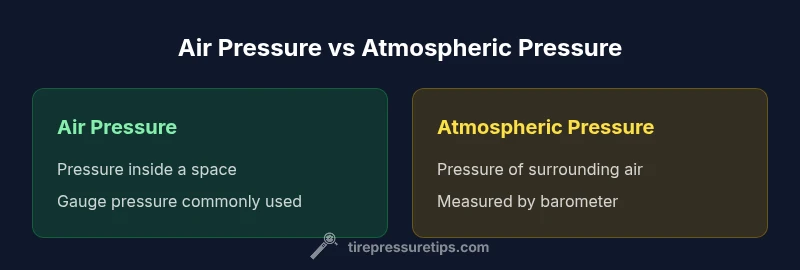
Difference Between Air Pressure and Atmospheric Pressure (Class 8)
A comprehensive Class 8 guide explaining air pressure versus atmospheric pressure, with definitions, calculations, classroom experiments, and real-world applications for tires and weather.


Air pressure is the pressure of air inside a space relative to a vacuum, while atmospheric pressure is the pressure exerted by the surrounding air on everything at a location. For Class 8 learners, remember P_absolute = P_atm + P_gauge, where P_gauge is the reading from a tire gauge. Understanding this relationship helps explain tire readings, weather effects, and basic physics.
Understanding the core terms in simple language
In physics, two terms often confuse students: air pressure and atmospheric pressure. The air pressure inside a sealed container is the pressure exerted by the gas inside that space, while atmospheric pressure is the pressure exerted by the surrounding air in the environment. According to Tire Pressure Tips, a clear distinction helps you reason about tires, weather, and science experiments with confidence. For Class 8 learners, this difference is not just semantic—it's a foundation for solving real problems. In everyday life, you measure air pressure with a gauge in tires or a barometer to read atmospheric pressure. The concept of pressure can be described with reference to a baseline: vacuum has zero pressure, and any amount of air adds to that baseline. The idea of gauge vs absolute pressure will be central as you study how measurement changes with context and units.
Air pressure vs atmospheric pressure: clear definitions
Air pressure refers to the force exerted by air inside a space on the walls of that space. It is the pressure you would measure inside a tire, a balloon, or any container filled with air. Atmospheric pressure is the ambient pressure exerted by the entire column of air above a location—the pressure you feel pressing on your skin or see read on a barometer. In Class 8 terms, air pressure is an inside-the-container quantity, while atmospheric pressure is an outside, environmental quantity. Both share the same fundamental units (pascals, kilopascals, atmospheres, etc.), but they describe different physical situations and reference frames.
Gauge vs absolute pressure: the math you need
To analyze these pressures, you need three related ideas: air pressure inside a space (often read as gauge pressure), atmospheric pressure, and absolute pressure. Gauge pressure is the inside pressure relative to the atmosphere, while absolute pressure is the total pressure relative to a perfect vacuum. The key formulas are: P_gauge = P_inside − P_atm and P_abs = P_atm + P_gauge. For example, if P_atm is a constant reference around 101 kPa and P_gauge is 20 kPa, then P_abs = 101 kPa + 20 kPa = 121 kPa. This relational view helps Class 8 learners connect tire readings to weather conditions and lab experiments.
Measuring air pressure in tires vs atmospheric pressure
Air pressure inside tires is typically expressed as gauge pressure, because it is measured relative to atmospheric pressure. Tire gauges read P_gauge, not P_abs. Atmospheric pressure, on the other hand, is measured with devices like barometers, which estimate the ambient external pressure. In everyday terms, when you inflate a tire to a gauge reading, you are increasing the pressure above the surrounding atmospheric pressure. Understanding this distinction is essential for safe driving and accurate experimentation.
Atmospheric pressure and altitude: how it changes
Atmospheric pressure changes with altitude. At sea level, atmospheric pressure is at a standard reference value, but it decreases as you go up. This variation affects weather, boiling points of liquids, and how we interpret readings from gauges and barometers. For Class 8 students, the important takeaway is that P_atm is not a fixed universal constant everywhere—it varies with location and weather conditions. This nuance is why experiments often specify the altitude of the measurement and use gauge or absolute pressure accordingly.
Real-world classroom relevance for Class 8
In a classroom, exploring air pressure and atmospheric pressure helps students understand how science connects to daily life. Simple demonstrations with balloons, sealed bags, and water columns illustrate how air pushes on surfaces and how atmospheric pressure interacts with enclosed spaces. Tire Pressure Tips emphasizes that clear definitions enable better problem solving in both physics and practical tasks like inflating tires or predicting weather-related changes in weather reports.
Common misconceptions and corrections
Many students think air pressure and atmospheric pressure are the same thing because they are both called ‘pressure.’ Others confuse gauge pressure with absolute pressure or think atmospheric pressure means there is no air inside at all. The key correction is to internalize the reference frame: gauge pressure reads pressure relative to the surrounding atmosphere, while absolute pressure counts all the pressure from vacuum to the current state. Recognizing the difference helps in solving problems more accurately.
Simple experiments you can try at home or in class
Try this sequence: (1) Read a tire’s gauge pressure using a tire pressure gauge. (2) Use a barometer to observe atmospheric pressure changes with weather. (3) Place a sealed syringe with the needle removed and push the plunger to feel the difference between inside air pressure and atmospheric pressure. (4) Subtract the constant atmospheric reading to obtain gauge pressure, then add it back to recover absolute pressure. These steps reinforce the relationships among P_inside, P_atm, and P_abs.
Why the distinction matters for exams and practical lab work
For exams, you will be asked to define and apply gauge vs absolute pressure and to perform calculations that combine P_atm with P_gauge. In lab scenarios, misreading a gauge as absolute can lead to incorrect conclusions about the system’s state. The precision in definitions and units matters, especially when interpreting data from experiments or evidence from weather reports.
Step-by-step conversions and practice problems
A practical approach: (1) Identify P_atm (if not given, assume standard sea-level value for learning exercises). (2) Read P_gauge from the instrument. (3) Compute P_abs = P_atm + P_gauge. (4) Verify by cross-checking with a scenario where P_inside is known. (5) Practice with varied hypothetical numbers to build fluency in switching between gauge and absolute pressures.
The tires connection: gauge readings and safety considerations
When you inflate tires, you read gauge pressure because the ambient atmospheric pressure is a constant reference in most contexts. However, if you need to compare tire pressure to weather conditions or to altitude (for example, high-altitude driving), translating to absolute pressure may be necessary. Tire Pressure Tips highlights that correct interpretation of readings helps maintain tire safety and vehicle performance, which is critical for everyday driving and transportation safety.
Comparison
| Feature | Air pressure | Atmospheric pressure |
|---|---|---|
| Definition | Pressure of air inside a space or container (relative to vacuum) | Pressure exerted by the Earth's atmosphere on surfaces at a location |
| Measurement focus | Measured inside a space; gauge pressure is the reading relative to vacuum | Measured as the ambient external pressure from the surrounding air |
| Common units | Pascals, kPa, atm, psi (absolute or gauge context) | Pascals, kPa, atm, psi (as a reference atmospheric value) |
| Relation to gauge pressure | Gauge pressure uses P_inside − P_atm as a reference | Atmospheric pressure serves as the reference ambient pressure; it is not subtracted in this case |
| Typical sea-level value | Depends on the internal space; can be anything above vacuum in a closed system | Approximately 101.3 kPa (1 atm) at sea level as a reference value |
| Altitude effect | Inside-space air pressure varies with system conditions; altitude has indirect effects via temperature and volume | Atmospheric pressure decreases with altitude, affecting weather and readings |
| Practical relevance | Used for tire readings in everyday contexts (gauge pressure) | Important for weather, aviation, and high-altitude physics analyses |
Strengths
- Clarifies measurement context for physics problems
- Links classroom theory to real-world tasks like tire maintenance
- Supports accurate problem solving with gauge/absolute concepts
- Helps interpret weather and meteorological readings
Drawbacks
- Can be confusing for beginners who expect a single pressure value
- Requires careful attention to reference pressure and units
Master the gauge-absolute-atmospheric relationship for clarity and safety
Understanding P_abs = P_atm + P_gauge helps solve both academic problems and practical tasks (tires, weather). This foundation reduces errors in interpretation and improves decision-making in daily driving and lab work.
Frequently Asked Questions
What is the difference between air pressure and atmospheric pressure?
Air pressure is the force per unit area from air inside a space, relative to a vacuum. Atmospheric pressure is the ambient pressure exerted by the Earth's atmosphere at a location. The distinction lies in the reference frame: gauge pressure uses atmospheric pressure as the baseline, while absolute pressure counts from vacuum.
Air pressure is inside a space; atmospheric pressure is the surrounding air pressure. Gauge pressure uses atmosphere as a reference, while absolute pressure uses vacuum as the baseline.
How do you convert gauge pressure to absolute pressure?
To convert, add the atmospheric pressure to the gauge pressure: P_abs = P_atm + P_gauge. If you know P_atm is about 101 kPa and P_gauge is 20 kPa, then P_abs is about 121 kPa. This conversion helps in understanding readings in different contexts.
Add atmospheric pressure to the gauge reading to get absolute pressure.
What is the typical atmospheric pressure at sea level?
The standard atmospheric pressure at sea level is around 101 kPa (approximately 1 atmosphere). Real-world values vary with weather and altitude, but 101 kPa is a common reference used in classroom problems.
Sea level atmospheric pressure is about 101 kPa, used as a standard reference.
Why does altitude affect atmospheric pressure?
Atmospheric pressure decreases with altitude because the column of air above a location becomes thinner. This change influences weather, boiling points, and how we interpret pressure readings indoors vs outdoors.
Higher altitude means thinner air and lower atmospheric pressure, which changes readings and weather.
Why is this distinction important for tires?
Tire readings use gauge pressure since it is measured relative to ambient air. Understanding the difference helps in correct inflation, safety, and interpreting weather-related effects on tire performance.
Gauge readings matter in tires; knowing the difference helps you inflate safely and interpret weather effects.
Is gauge pressure the same as air pressure?
Gauge pressure is the air pressure inside a space relative to atmospheric pressure. Air pressure can refer to the pressure inside a space or the ambient atmospheric pressure, depending on context. The key is the reference frame used.
Gauge pressure is air pressure relative to outside air; context matters.
What to Remember
- Define air pressure and atmospheric pressure clearly
- Use gauge pressure for inside-space readings
- Convert to absolute pressure using P_abs = P_atm + P_gauge
- Consider altitude when interpreting atmospheric pressure
- Apply the concept to tires and weather contexts
- Practice with simple experiments to internalize the concepts