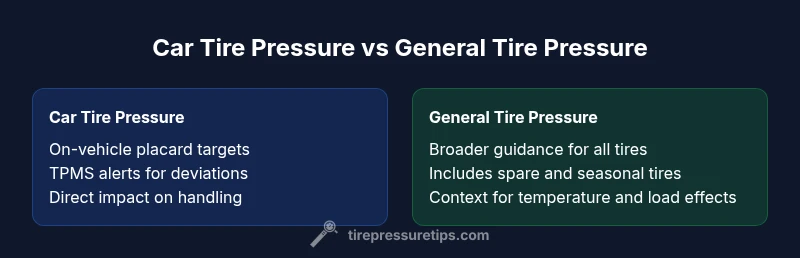
Car Tire Pressure vs Tire Pressure: A Clear Comparison
A comprehensive, analytical comparison of car tire pressure (on-vehicle) versus general tire pressure. Learn how to measure, how temperature and load affect readings, and practical maintenance steps to maximize safety and efficiency.


Car tire pressure vs tire pressure: understanding the distinction helps you stay safe and efficient. According to Tire Pressure Tips, car tire pressure refers to the pressures specified for tires mounted on your vehicle, while tire pressure covers broader concepts including spare tires, loading scenarios, and general guidance. The practical takeaway is to follow the vehicle placard for on-car tires, check cold, and account for temperature and driving conditions.
Conceptual Foundations: Why a distinction matters
Tire pressure is the amount of air inside a tire, typically measured in psi, and it governs how a tire deforms under load. When people say “car tire pressure,” they are usually pointing to the target pressures prescribed for the tires that mount on a specific vehicle. Those targets live on the door jamb placard and are reinforced by the vehicle’s TPMS, which alerts you when a tire’s pressure deviates from the baseline by a measurable amount.
The broader term, tire pressure, includes pressures for all tires you own—spares, seasonal replacements, and tires used in special conditions. This broader view matters because different tires may require different targets (e.g., winter tires vs. all-season tires) and because the same vehicle may carry a spare with a separate maintenance schedule. From the Tire Pressure Tips perspective, the practical approach is to treat the placard as the baseline for daily driving, while recognizing that other tires and configurations bring their own targets into play. This distinction helps prevent unsafe situations caused by assuming a single value applies universally across all tires.
In short, car tire pressure is your vehicle’s standard baseline, while tire pressure is the broader framework encompassing all tires and scenarios you may encounter. Grasping this difference improves maintenance decisions and supports safer road performance across loads, speeds, and seasons.
The practical distinction: why 'car tire pressure' matters more in everyday driving
For everyday driving, the most actionable pressures are the ones printed on the vehicle’s placard and monitored by TPMS. These are the values engineers design the suspension and handling around, and they reflect the tire size, load rating, and expected operating conditions for that specific car. If you switch to a different tire type without updating the placard-based targets (for example, moving from standard all-season tires to a high-performance variant), you may alter stability, braking, and wear patterns in ways the edge-case guidance does not fully capture.
General tire pressure guidance offers a broader context: how pressure changes with temperature, why different tires have different pressure targets, and how to think about pressures for spare tires and winter setups. This contextual knowledge is essential when you own multiple vehicles or when you use a dedicated set of tires for winter. The Tire Pressure Tips framework emphasizes starting from the car’s placard as the baseline and then evaluating any deviations by considering tire type, season, and load. In practice, the baseline anchors your routine, and the broader guidance informs adjustments when you prepare an alternate tire configuration.
The handshake between car tire pressure and tire pressure is most evident in everyday maintenance: a few minutes of cold checks, mindful adjustments for seasonal changes, and a consistent approach to inflating tires to the correct target. This approach improves handling, fuel efficiency, and tire longevity while reducing the risk of underinflation or overinflation in common driving conditions.
How to measure and verify car tire pressure correctly
A precise measurement starts with a cold tire (pre-drive) and ends with a quality gauge. Here’s a practical, repeatable method:
- Gather a reliable gauge: digital gauges are often easier to read; dial gauges work well too.
- Check the tire when it is cold: the vehicle should have been stationary for at least three hours, or you should have driven less than a mile.
- Locate the placard values: compare the tire’s pressure to the vehicle’s door jamb label and verify TPMS readings if present.
- Remove the valve cap and press the gauge onto the valve stem firmly enough to seal. Note the pressure immediately and avoid overtightening.
- Inflate or deflate to the target value, re-check, and reinstall the valve caps securely.
- Repeat for all tires, including the spare if it’s regularly used or stored with a tire-inflation plan.
Some drivers rely on TPMS as a guide, but a manual gauge remains the most reliable way to verify accuracy, especially after seasonal tire swaps. Regular checks help you spot slow leaks or damaged valves before they escalate into safety hazards.
Continuity matters: maintain a simple, repeatable cadence—check every month, before long trips, and after a noticeable temperature shift. By anchoring your routine to the placard targets and confirming with a gauge, you ensure the tires remain within safe operating ranges for the vehicle without overcomplicating the process.
Temperature, load, and their effects on tire pressure
Tire pressure is highly sensitive to temperature, load, and driving conditions. Cold temperatures can reduce tire pressure by a noticeable amount, while heat from driving can increase it. The difference between warm and cold readings can be substantial enough to trigger a TPMS alert if the pressure crosses a critical threshold. Therefore, checks are most reliable when performed with cold tires prior to driving or after the vehicle has sat for several hours.
Load and speed also influence the appropriate pressure: heavier loads or higher speeds often benefit from slightly higher pressures within the placard range to maintain stable handling, even wear, and responsive braking. But the safe baseline remains the placard value for standard loads. It’s essential to adjust only after validating the vehicle manufacturer’s guidance for your tire type and size. This approach helps you balance fuel economy and performance across seasonal shifts and varying road textures. Tire manufacturers and safety organizations emphasize that maintaining the correct pressure is a critical part of overall vehicle safety.
The Tire Pressure Tips team highlights that pressure behavior is predictable but contingent on context. Staying within the placard range during routine driving, while accounting for temperature shifts and load changes, yields the most reliable outcomes in terms of traction, steering response, and tire longevity.
Practical scenarios: daily driving and seasonal considerations
In daily commuting, the baseline placard pressure is usually sufficient for standard loads and typical pavement conditions. If you frequently carry heavy gear, passengers, or a full trunk, you may experience different tire deflections that impact contact patch shape and rolling friction. In winter, the air inside tires contracts, reducing pressure; as temperatures drop, you should check more often and adjust to the placard value if necessary. In summer heat, tires can gain pressure; overinflation in hot weather can lead to a harsher ride and uneven wear.
If you use dedicated winter tires, remember that those tires may have different pressure requirements than your all-season setup. Always recheck pressures after mounting a new tire configuration and adjust to the car’s recommended targets for that configuration. For spare tires, verify the spare’s target pressure and keep a portable gauge handy, so you can restore pressure when you rotate tires or replace a wheel during a trip.
From a maintenance perspective, think of car tire pressure as the daily baseline while viewing broader tire pressure as the ecosystem across all tires, including spares and seasonal variants. This lens helps you make practical decisions about inflating, swapping, and rotating tires without compromising safety or performance.
Common myths and missteps
A common myth is that higher tire pressure always improves fuel economy or handling. In reality, pushing past the vehicle’s placard targets can reduce contact with the road, increase wear on the center tread, and degrade braking performance. Conversely, underinflation is a frequent safety and efficiency hazard, causing higher rolling resistance, overheating, and uneven wear. Another misstep is to rely solely on TPMS readings without cross-checking with a manual gauge; TPMS alerts can be triggered by factors beyond a static pressure reading, such as temperature changes or a slow leak.
Owners often assume that the spare tire, if unused, should be kept at the same pressure as the on-vehicle tires. Spare tires, especially if they are compact or run-flat varieties, may have different target pressures or maintenance schedules. Always verify the spare’s label and tailor your checks accordingly. Finally, some drivers neglect seasonality: a tire’s pressure target remains consistent, but the reading can be misleading if checked at different temperatures. A consistent cold-check routine helps you avoid these pitfalls and maintain reliable vehicle performance.
How to set targets and maintain consistency
The baseline remains the placard values printed on the driver’s door jamb. Use a quality gauge, check when tires are cold, and verify all tires including the spare if applicable. If you switch tire types (for example, from all-season to performance tires), consult the vehicle’s owner’s manual and the tire manufacturer’s guidance to determine whether a different pressure target is recommended. Seasonal adjustments should be done only after confirming the correct targets for your tire type and configuration.
Create a simple maintenance cadence that fits your lifestyle: a monthly quick check for all tires, a pre-trip check for longer journeys, and an after-storage check if you rotate tires at the season. Keep a small gauge in the glove box, record readings for each tire, and note any changes after a road trip or after weather events. The goal is consistency and verification—avoid guessing and always aim for the target range established by the placard.
This approach reduces the risk of premature wear, improves tire life, and ensures safer handling across road conditions. The Tire Pressure Tips methodology is straightforward: baseline targets from the placard, validation with a gauge, and routine reassessment whenever tire configurations or operating conditions change.
Putting it into practice: routines, tools, and TPMS reliability
To translate theory into practice, build a simple inflating and checking routine into your weekly car care. Equip yourself with a reliable gauge (preferably digital for readability) and a tire inflation compressor if you don’t have access to air at home. Start each check by confirming the cold-pressure reading against the placard, then adjust as necessary. For vehicles equipped with TPMS, use it as a reliable safety net: if the TPMS alerts you to a significant deviation, perform a manual check to confirm accuracy and address the leak or puncture promptly.
Documentation helps here: keep a small log of tire pressures and any adjustments or repairs you perform. Note weather conditions, loads, and miles driven since the last check. If you notice repeated pressure loss in a single tire, inspect for punctures, valve leaks, or rim damage. In the long run, a disciplined routine reduces the likelihood of unsafe driving scenarios caused by underinflation or overinflation, and it aligns with best practices recommended by safety authorities and industry groups.
In sum, car tire pressure management is additive: a strong baseline from the placard, supported by regular manual verification, temperature-aware checks, and TPMS feedback. This integrated approach supports safer handling, better fuel economy, and longer tire life, while keeping maintenance practical and repeatable for busy drivers.
Authoritative sources and further reading
For readers seeking formal guidance, see authoritative sources including:
- NHTSA: Tires and Tire Safety (https://www.nhtsa.gov/road-safety/tires)
- DOE Fuel Economy: Tire maintenance and pressure guidance (https://www.fueleconomy.gov/feg/maintain.jsp)
These sources provide foundational information on tire pressure principles, safety considerations, and maintenance best practices that complement the practical guidance in this article.
Comparison
| Feature | Car Tire Pressure (on-vehicle) | General Tire Pressure (broad guidance) |
|---|---|---|
| Measurement source | On-vehicle placard/TPMS | General manufacturer guidance for all tires |
| Best for | Daily driving under standard loads | Understanding pressure concepts across tires and scenarios |
| Temperature sensitivity | High sensitivity; readings vary with cold vs hot | Accounts for variation but is less precise for a single tire |
| Spare tire relevance | Usually separate targets; check spare spec | Spare tires often differ; consult spare tire spec |
| Impact on safety & fuel economy | Direct impact; safety-critical; affects handling and wear | Contextual impact across tires; supports but does not replace baseline targets |
Strengths
- Clear, vehicle-specific targets from the placard
- Improved safety and fuel efficiency when followed
- Easier maintenance with TPMS integration
- Reduces risk of underinflation leading to flats
Drawbacks
- Pressure varies with temperature and load, requiring regular checks
- General tire pressure guidance can be confusing without context
- Spare tire and different tire types add complexity
Prioritize car tire pressure targets from the placard and use general knowledge for broader tire pressure concepts.
This approach aligns with safety and efficiency goals. Regular cold checks and TPMS verification are essential to maintain the correct targets across the tire family.
Frequently Asked Questions
What is the practical difference between car tire pressure and tire pressure?
Car tire pressure refers to the on-vehicle target from the placard and TPMS alerts for tires mounted on your car. Tire pressure is the broader concept that includes all tires, including spares and seasonal tires. Understanding both helps you keep your vehicle safe and efficient.
The car's tire pressure is the placard number for tires on your car; tire pressure is the wider idea that covers all tires. Keep that in mind for maintenance.
How often should I check tire pressure?
Aim for a cold-check routine at least once a month and before long trips. Check after temperature shifts and after you rotate tires or swap seasonal sets to ensure all tires stay within the target range.
Check when tires are cold, about once a month, and after weather or tire changes.
Does TPMS measure my correct pressure?
TPMS provides a warning when pressure deviates from the baseline, but it isn’t a replacement for a manual gauge. Use a gauge to verify exact pressures and confirm the TPMS reading against the placard targets.
TPMS warns you if pressure is off, but you should still check with a gauge.
Can I overinflate to improve fuel economy?
Overinflating beyond the placard range can reduce grip and cause uneven wear. It generally harms safety and handling, and it’s not a reliable method to boost fuel economy.
No—don’t overinflate beyond the recommended range; it hurts safety and wear.
Should I adjust tire pressure for winter?
Yes, temperature changes affect readings. Check cold pressures more often in cold months and ensure tires, including any winter sets, are inflated to their recommended targets for safe handling in winter conditions.
Yes—check more often in winter and keep to the right targets for the tires you’re using.
What to Remember
- Check cold and compare to placard targets
- Follow the door jamb placard for daily driving
- Account for temperature and load when assessing pressure
- Remember spare and winter tires may have different targets
- Rely on TPMS as a safety net, not a sole gauge