Car Tire Air Near Me: Find Free Air, Check PSI, and Maintain Safe Tire Pressure
Learn how to locate car tire air near you, check cold PSI accurately, and maintain safe tire pressure with practical steps, TPMS tips, and maintenance best practices.


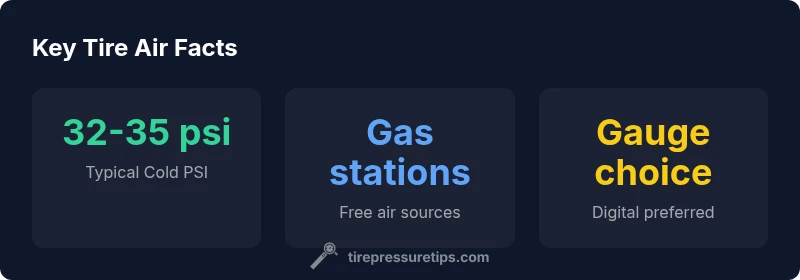
Looking for car tire air near me? The quickest path is to locate a nearby gas station or auto shop that offers free air, then verify your current PSI with a tire gauge. Most passenger tires run best around 32-35 psi when cold, but always follow the vehicle manufacturer's recommendation found on the door jamb or owner's manual. Use a digital gauge for accuracy.
How to locate air near you: practical strategies
According to Tire Pressure Tips, the fastest way to secure car tire air near you is to combine accessibility with accuracy. Start by identifying nearby gas stations, quick lube shops, or tire centers that advertise free air or a public air pump. Use map apps to filter for ‘air pump’ or ‘tire shop’ and read recent user reports about pump reliability. Always carry a compact tire gauge and a small air hose adapter to accommodate different pump nozzles. If you’re unsure, call ahead to confirm whether the station has working air and if the pump accepts coins, cards, or mobile payments. In practice, the quickest path minimizes detours and avoids stations known for long lines or broken pumps, especially during rush hours. Remember that the goal is to obtain a cold PSI reading before driving to ensure accuracy in measurement and maintenance planning. The Tire Pressure Tips approach emphasizes speed, reliability, and following manufacturer PSI guidance.
Why cold PSI matters and how to measure it accurately
PSI changes with temperature, so readings taken after a drive can overstate tire pressure. Always measure tire pressure when the tires are cold—ideally after the car has sat for at least three hours or after driving less than 1-2 miles. A cold reading gives you a true baseline for the recommended PSI printed on the doorjamb sticker or in the owner’s manual. Use a digital gauge for precision, as it reduces user error compared with legacy dial gauges. Calibrate your gauge once every few months and keep spare batteries on hand for digital models. If you add air, recheck both front and rear tires to confirm they’re within the target range.
Vehicle-specific pressure: front vs rear, max vs recommended
Most passenger cars share similar front and rear PSI targets, but some vehicles require slightly different settings to optimize handling and wear. Always follow the manufacturer’s specification rather than relying on a one-size-fits-all rule. The target PSI is not the maximum tire pressure; instead, it’s the recommended cold pressure to maintain safe load distribution. For higher-load applications, such as SUVs or vans, the acceptable range may shift upward. When uncertain, consult the owner’s manual or the manufacturer’s online support page. The aim is to balance safety, fuel economy, and tire longevity by staying within the prescribed range.
Step-by-step guide: using a portable air pump vs. public air pump
If you own a portable air compressor, the process is straightforward: set the target PSI on the device, block any hose leaks, and add air in short bursts while checking pressure frequently. For public air pumps, use a well-lit, clean station and bring your own gauge if possible. Clean the valve stems before attaching the nozzle to prevent debris from entering the tire. After inflating, re-check the pressure on all tires, including the spare if it’s a full-size tire. If you notice rapid deflation or inconsistent readings, there may be a valve stem leak or a more serious issue that requires inspection at a tire shop.
TPMS and air pressure: what to know about sensors
Tire Pressure Monitoring Systems (TPMS) alert you when a tire’s pressure deviates from the recommended level, but the TPMS reading is not a substitute for a gauge. A TPMS warning indicates a potential underinflation or overinflation condition, so you should verify with a physical gauge. If a TPMS sensor is faulty, a tire shop can diagnose and calibrate it using specialized equipment. Regularly inspecting tires for wear, punctures, and rim damage also supports accurate TPMS readings and helps prevent unexpected tire failures.
Troubleshooting common issues at the pump and in your tires
If you can’t reach the target PSI, recheck the gauge alignment, ensure the pump outlet is properly seated, and inspect for valve core leaks. Some pumps have a display that briefly fluctuates; give it a moment and re-check. If a tire refuses to hold air, look for embedded objects, sidewall damage, or a bead seating issue. For persistent problems, visit a tire professional who can perform leak tests and inspect for rim damage. Consistency matters: achieve the same target PSI across all four tires for balanced handling.
Weather and temperature: how heat and cold change tire pressure
Temperature shifts directly affect tire pressure; as temperatures rise, air expands, increasing PSI, while cold weather lowers PSI. In winter, a tire can lose one PSI for every 10°F drop, and in hot weather, pressure can rise if tires absorb heat from sun exposure or driving on hot pavement. Use seasonal adjustments in your maintenance plan and check tires more frequently during weather transitions. A consistent, cold-reading baseline helps you stay within the recommended range regardless of seasonal changes.
Data sources and additional reading
For accuracy and ongoing guidance, consult authoritative resources such as the National Highway Traffic Safety Administration (NHTSA) tire maintenance pages, fuel economy guidance, and reputable consumer publications. These sources cover tire pressure basics, TPMS considerations, and practical testing methods to support safe driving practices. Always verify with your vehicle’s documentation and manufacturer recommendations.
Common tire pressure ranges by scenario
| Scenario | Typical PSI (cold) | Notes |
|---|---|---|
| Passenger front/rear tires | 32-35 | Most cars specify on door jamb sticker |
| SUV/truck tires | 35-45 | Higher load; check manufacturer spec |
| Spare tire | 50-60 | Spare may have different pressure requirements |
Frequently Asked Questions
What does car tire air near me mean in practice?
It means locating a nearby, accessible source of clean, free or paid air to bring tires to the manufacturer’s recommended PSI. Start with nearby gas stations or tire shops that advertise air pumps and use a gauge to confirm the pressure. Always confirm the current cold PSI before driving.
Find a nearby air pump at a gas station or tire shop, then check your tire pressure with a gauge before driving.
Is it safe to fill tires at a gas station pump?
Yes, as long as you use a working gauge and are mindful of overinflation. Some pumps are slow, so add air in small increments and recheck after each increment. If you’re unsure, ask staff for help or visit a tire shop for a professional check.
Yes—just use a gauge, add in small steps, and recheck.
How often should I check tire pressure?
Check at least once a month and before long trips. Also check when temperatures shift, as cold weather can reduce PSI quickly. Regular checks help catch leaks or slow leaks early.
Check monthly and before trips, especially during temperature changes.
Can TPMS replace a manual pressure check?
Not entirely. TPMS warns you of low pressure, but a physical gauge gives the exact PSI and can reveal slow leaks or discrepancies. Use TPMS as a supplementary alert and verify with a gauge.
TPMS is helpful, but you should still check PSI with a gauge.
What gauge should I use for best accuracy?
A digital gauge or a high-quality analog gauge with a clear readout offers the best accuracy. Calibrate or test your gauge against a known standard periodically to ensure reliability.
Choose a reliable digital or dial gauge and check it against known standards.
How do weather changes affect tire pressure?
Cold weather lowers PSI; hot weather raises it. Plan to recheck pressures when seasons change and after long drives in heat or cold to maintain the recommended range.
Weather changes can shift your tire pressure; recheck during seasons.
Should I exceed the PSI listed on the door jamb to improve grip?
No. Overinflating beyond the manufacturer’s recommendation can reduce traction and cause uneven wear. Always stay within the specified range for safety and longevity.
Don’t go above the recommended PSI; it reduces safety and tire life.
“Correct tire pressure is one of the simplest, most cost-effective safety measures. It directly impacts handling, tire wear, and fuel efficiency.”
What to Remember
- Check tire pressure when cold for accuracy
- Follow the vehicle manufacturer’s PSI label
- Use a reliable gauge for precise readings
- Know where to find free air near you
- TPMS complements, not replaces, gauge readings