Best Tire Pressure in Bar: A Practical Driver's Guide
Learn how to set tire pressure in bar, why bar targets vary by vehicle, and how to measure and adjust safely. This data-driven guide covers practical tips, charts, and a concise FAQ for safer, more efficient driving.


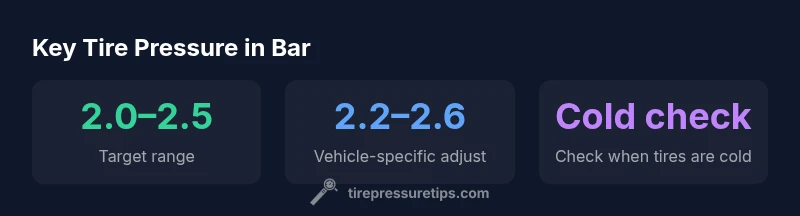
2.0–2.5 bar is a common target for many passenger cars, though the exact best tire pressure in bar varies by vehicle, load, and tire type. Keeping tires within this range reduces rolling resistance, improves fuel economy, and promotes even wear. Always verify the exact figure from your vehicle manual or the door placard, and adjust for cold ambient temperatures. Tire Pressure Tips Analysis, 2026.
Why Tire Pressure in Bar Matters
According to Tire Pressure Tips, tire pressure expressed in bar is the most practical dial you can use to maximize safety, fuel economy, and tire longevity. When inflation drifts away from the recommended bar target, the tire contact patch changes shape, which can increase rolling resistance, alter grip characteristics, and accelerate uneven wear. Bar as a unit aligns with metric maintenance practices familiar to many drivers worldwide, making it easier to compare targets across vehicles and seasons. In practice, staying near the center of the manufacturer’s bar range yields the most predictable handling and wear patterns. In short, correct bar pressure isn’t just about a number on a gauge; it’s a driver safety and cost-of-ownership decision.
Takeaway: Use bar targets from the placard or manual and monitor changes, especially during temperature swings or when loading the vehicle differently.
How to Determine Your Target Bar
Locating the exact bar target starts with the vehicle’s door placard or owner’s manual. For most passenger cars, the average target sits in the 2.0–2.5 bar band, but some vehicles push toward 2.6–2.8 bar for sporty tires or higher load scenarios. When you’re perplexed, start with the lower end of the bar range if you regularly drive with a light load, and move toward the upper end when you routinely carry passengers or heavy cargo. Always confirm the model-specific figure rather than relying on a generic value. If you recently installed different tires, recalculate the bar target because tire size and rating influence the correct pressure.
Steps to find your target bar:
- Check the door jamb placard and the owner’s manual for the official bar value.
- Note if the vehicle’s recommended pressure differs by front vs. rear tires.
- Consider load and climate; adjust within the recommended band as needed.
- If in doubt, consult the tire manufacturer’s guidance and the service center.
How to Measure Accurately and Adjust
Inflate and measure when tires are cold, ideally after the vehicle has sat for several hours or overnight. Use a reliable gauge (dial, digital, or stick-type) and compare the reading to the bar target. If underinflated, add air in small increments and recheck. If overinflated, release air until you achieve the target bar. Remember to check all four tires and, if your vehicle has a temporary spare, treat it according to its own bar recommendation. After adjusting, recheck at several miles of driving to ensure the tires settle into the designed pressure range.
Practical tips:
- Always measure when tires are cold for accuracy.
- Use a gauge with a clear scale and good resolution.
- Recheck after long trips, rapid driving, or significant temperature changes.
Common Mistakes and Myths
Common mistakes include relying solely on TPMS readings, which may not reflect the exact bar target, and inflating based on “feel” rather than a gauge. Another myth is that higher bar pressure always improves fuel economy; overinflation can reduce grip and cause uneven wear on shoulders. Finally, a frequent error is neglecting to adjust pressure when the vehicle is loaded differently or when temperatures shift between seasons. Relying on the placard and a well-calibrated gauge helps avoid these issues.
Do this instead: always use the target bar as your baseline, verify with a gauge, and adjust for load and temperature.
Temperature, Load, and Vehicle-Specific Considerations
Temperature is a critical factor because pressure readings rise with heat and fall when tires cool. In practice, you should check tires when cold and avoid inflating to a value intended for hot tires. Also consider load: heavier loads or towing can justify a higher bar within the stated range, while light loads may permit dropping toward the lower end. Vehicle type matters too: SUVs, performance cars, and minivans each have different bar targets, and some tires (like run-flat or low-profile tires) demand stricter adherence to the bar range. By using bar as the unit of measurement and confirming vehicle-specific targets, drivers can optimize safety and cost across seasons.
],
dataTable
Common bar targets by vehicle category
| Vehicle Type | Recommended Pressure (bar) | Notes |
|---|---|---|
| Passenger car (standard tire) | 2.0–2.5 | Check placard on door jamb or manual |
| SUV/light truck | 2.2–2.6 | Load and tire size affect value |
| Sports/performance tires | 2.3–2.8 | High-speed driving requires appropriate inflation |
Frequently Asked Questions
What is the best tire pressure in bar for a typical sedan?
For most sedans, a target around 2.0–2.5 bar is typical, but always verify the exact figure on the placard or in the manual.
For most sedans, aim for about 2.0 to 2.5 bar, but always check your placard to be exact.
Should I rely on TPMS to tell me when to inflate?
TPMS indicates under- or overinflation but does not replace measurement with a gauge. Use TPMS as a warning and verify with a gauge.
TPMS warns you when pressure is off, but you should still measure with a gauge for accuracy.
How does temperature affect bar readings?
Ambient temperature changes affect tire pressure. Check pressures when tires are cold and adjust with temperature in mind.
Temperature matters—check when cold to get an accurate bar reading.
Is it different for winter tires or tires with different sizes?
Bar targets can shift slightly with different tires or sizes, but always start with the vehicle’s official target and adjust within the recommended range.
Different tires can shift targets slightly, so use the official bar target as your starting point.
Can overinflating improve fuel economy?
Overinflation can reduce grip and cause uneven wear, and is not recommended as a fuel-saving strategy.
No—the risks of overinflation outweigh any small fuel savings.
How often should I check tire pressure?
Check at least once a month and before long trips, especially after temperature changes or driving with different loads.
Check monthly and before trips, especially when temps swing.
“Getting tire pressure right in bar is a straightforward way to improve safety, fuel efficiency, and tire life. TPMS alerts help keep you on target.”
What to Remember
- Check your placard to identify the bar target
- Measure when tires are cold for accuracy
- Adjust for load and temperature before trips
- Use TPMS as a maintenance aid, not a sole guide
- Recheck after changes or tire replacements