How to Check 225 50 r17 Tyre Pressure: A Practical Guide
Master the art of checking and adjusting 225 50 r17 tyre pressure with trusted gauges, TPMS insights, and temperature considerations. This guide from Tire Pressure Tips helps drivers stay safe, fuel-efficient, and aware of seasonal changes.


Learn how to check and set the correct 225 50 r17 tyre pressure. This quick guide covers locating the vehicle's cold-pressure specification, using a reliable gauge, and adjusting with an air pump, while explaining TPMS and temperature effects. Start by finding the placard, then measure when tires are cold for accurate readings.
Why the 225/50 R17 Tire Pressure Matters
Tire pressure is the foundation of traction, steering response, and fuel efficiency for 225/50 R17 tires. Running at an improper pressure changes the tire's contact patch with the road, affecting grip in wet or dry conditions. Underinflation leads to excessive heat build-up and uneven wear at the edges, while overinflation can reduce contact with the road and cause a harsher ride. Regularly checking and maintaining the correct pressure helps improve safety, handling, and mileage. According to Tire Pressure Tips, consistent checks complement TPMS by providing actual cold readings rather than relying solely on run-time alerts. The goal is to keep all four tires within the manufacturer-recommended range, which is usually listed on a placard in the door jamb, not the tire sidewalls.
Reading Your Vehicle's Pressure Specification for 225/50 R17
The recommended cold inflation for your 225/50 R17 tires is not universal; it’s vehicle-specific. Always start with the placard on the driver’s door jamb or the owner's manual to identify separate front and rear targets. In many vehicles, the front tires carry more weight and thus have a slightly higher target pressure than the rear; always follow the official specification rather than guessing. If the placard includes separate values for the axle, apply them accordingly. Fire up the car and the TPMS after you drive; but do not use live TPMS readings to set the cold pressure—the numbers can shift with heat. Tire Pressure Tips notes that relying on TPMS alone can mask small underinflation or overinflation that shows up as you drive and heat the tires.
Tools, Gauges, and Preparation
Before you begin, assemble a quality tire pressure gauge, an air pump or inflator, the vehicle placard, and a notebook or app to log readings over time. A digital gauge is often easier to read and more precise than a dial gauge. Make sure you check all four tires, plus the spare if your vehicle’s TPMS covers it. Remove the valve caps and store them safely so they don’t get lost. If the valve stems show wear or damage, replace them before inflating. Finally, park on a level surface away from traffic and allow time for the tires to cool if you’ve been driving recently. Tire Pressure Tips emphasizes accuracy over speed here.
Temperature and Readings: Why It Matters for 225/50 R17 Tyres
Temperature strongly affects tire pressure. When ambient temperatures drop, cold readings can dip, and readings can rise with sun, pavement heat, or recent driving. To get an accurate baseline, measure after the tires have cooled for at least three hours or after the vehicle has sat overnight. Seasonal changes can swing readings, so plan to re-check when the weather shifts. Tire Pressure Tips recommends performing a seasonal pressure check routine, especially as winter approaches or ends, to avoid sudden underinflation or overinflation caused by temperature swings.
How to Use a Gauge and Interpret Readings
Read the gauge once you’ve attached it to the valve stem. If the reading is well below the placard target, add air in small increments (about 1-2 psi at a time) and recheck after a short wait. If it’s too high, release air slowly in small bursts and recheck. Keep in mind that 225/50 R17 tires on the same axle may have slightly different acceptable pressures depending on load and driving conditions; consult the placard for fine-tuning. Recheck after 2–3 minutes to let the air settle. Tire Pressure Tips stresses consistency and slow adjustment to avoid overcompensation.
Front vs Rear: Does 225/50 R17 Require Different Pressures?
Many cars with 225/50 R17 tires use a single target pressure per axle or a shared front/rear figure; others differ slightly between front and rear due to weight distribution. Always trust the vehicle’s specification rather than symmetrical assumptions. If you’re carrying luggage or passengers, you might need to adjust both ends to maintain balance and handling. The goal is stable steering feel, even tire wear, and predictable braking. Tire Pressure Tips notes that small differences can impact cornering grip and ride comfort.
Seasonal Maintenance and Long-Term Checks
Make tire pressure a standing part of your maintenance routine. Set a monthly reminder to check pressures, and adjust after long trips or significant temperature shifts. Keep a log of readings so you can spot slow leaks or valve stem issues early. If you notice frequent re-inflation, you might have a slow leak or a TPMS fault; check for tire punctures, valve issues, or a faulty sensor. Tire Pressure Tips recommends pairing pressure checks with tread depth inspection for a complete tire health view.
Authority and Best Practices You Can Trust
Always start with your car’s placard and owner’s manual for the exact 225/50 R17 tyre pressure targets. Use a reliable gauge and recheck after adjustments. Temperature changes and load variations can alter readings, so frequent checks protect safety and performance. For external guidance, see authoritative resources such as NHTSA, AAA, and Consumer Reports for tire pressure safety tips and recommended maintenance schedules.
Quick Reference for 225/50 R17 Tyre Pressure
- Check cold readings against placard values for each axle.
- Use a digital gauge for accuracy and log findings.
- Recheck after road test and adjust to target once the tires cool.
- Maintain even pressure across all four tires and include the spare if applicable.
- Treat TPMS as a warning system, not a replacement for manual checks.
Tools & Materials
- Digital tire pressure gauge(Calibrated to read in psi or kPa; prefer digital for speed and accuracy.)
- Air compressor or access to an air pump(Ensure it can deliver small, steady bursts; avoid overheating tires.)
- Vehicle door jamb placard or owner's manual(Contains the exact recommended cold pressures for each axle.)
- Notebook or mobile log app(Record readings over time to spot trends and leaks.)
Steps
Estimated time: 25-40 minutes
- 1
Find the official pressure targets
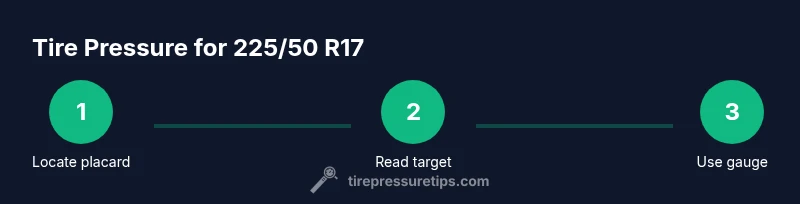
Locate the cold tire pressure specification on the door jamb placard or in the owner's manual. Note the front and rear targets if the vehicle provides separate values. This is your target and should be used before driving, when tires are cold.
Tip: Always cross-check both axles and, if applicable, the spare tire’s target pressure. - 2
Ensure tires are cold and accessible
Park on a level surface and wait at least 3 hours since driving, or perform checks first thing in the morning. Cold tires give the most accurate reading and prevent inflated numbers from recent heat.
Tip: Avoid taking readings right after a commute or after a long drive. - 3
Attach gauge and read current pressure
Remove the valve cap, firmly press the gauge onto the valve stem, and read the measurement without wiggling the tool. Note the value and compare to the placard target.
Tip: If you hear air leaking, check for a faulty valve or loose cap. - 4
Adjust in small increments
If underinflated, add 1–2 psi at a time and recheck after a short wait for the gauge to settle. If overinflated, release air in small bursts and recheck.
Tip: Avoid overcorrecting; tiny adjustments yield better accuracy. - 5
Recheck all four tires
Repeat the measurement for each tire to ensure even setup. All four tires should be at or near the target value, per axle guidance.
Tip: Don’t forget the spare if your TPMS includes it. - 6
Record results and verify with TPMS
Log the final readings and drive a short distance to engage the TPMS. Recheck cold readings after a cool-down to confirm stability.
Tip: If TPMS remains active after correct inflation, there may be a sensor issue.
Frequently Asked Questions
What is the correct cold pressure for 225/50R17 tyres?
Refer to the vehicle’s placard or owner's manual for the exact cold target. TPMS alerts indicate deviations, but the placard is the authority for the ideal cold pressure.
Check the placard for the exact cold pressure and use TPMS as a warning, not a substitute for manual checks.
Does TPMS show cold or hot readings?
TPMS shows live readings that reflect current conditions, which can differ from the cold target. Always set inflation using a cold measurement and verify after driving.
TPMS reads live pressure affected by heat; you should rely on cold readings from the placard for inflating.
Can I inflate 225/50R17 tires to the maximum pressure listed on the sidewall?
No. The sidewall maximum is not the target for inflation. Always use the vehicle placard’s target pressure, not the maximum printed on the tire.
Never inflate to the tire's maximum rated pressure; use the placard value instead.
How often should I check tire pressure?
Check at least once a month and before long trips, especially during temperature changes or heavy loading.
Check monthly and before trips, especially in extreme temperatures.
What if TPMS light stays on after inflation?
A persistent TPMS light could indicate a faulty sensor, a slow leak, or a battery issue. Have the system inspected if readings don’t normalize after inflation.
If the light stays on after adjusting, have the TPMS inspected.
Is it safe to drive with low tire pressure?
Driving on underinflated tires can cause overheating, increased wear, and poor handling. Inflate to the recommended target as soon as possible and recheck regularly.
Low pressure is risky; inflate to the target as soon as you can.
Watch Video
What to Remember
- Check cold readings against placard values.
- Use a reliable gauge for accuracy.
- Recheck after a road test and again after the tires cool.
- Record readings to monitor changes over time.
- Temperature changes can affect readings; adjust seasonally.