Is 25 Tire Pressure Bad? A Practical Guide to Tire Pressure
Discover whether 25 psi is bad for your tires, how to read your vehicle's recommended pressure, and practical steps to maintain proper tire inflation for safety and efficiency.


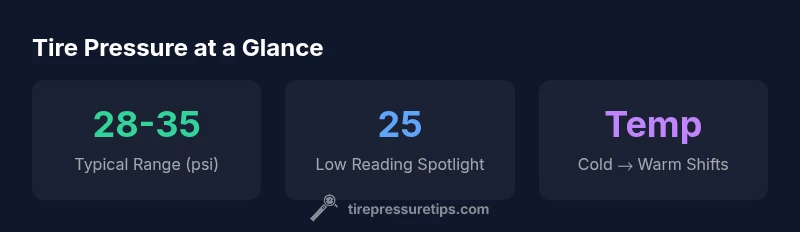
Short answer: yes, 25 psi is typically below the recommended range for most passenger cars. Vehicle manufacturers usually specify a higher pressure—often in the high 20s to mid-30s psi. Repeatedly running at 25 psi can affect handling, tire wear, and fuel economy, and may trigger TPMS warnings if your car uses a fixed threshold.
Is 25 tire pressure bad?
Is 25 tire pressure bad? This phrasing is common among drivers who notice a low reading on a cold morning or after a long trip. According to Tire Pressure Tips, is 25 tire pressure bad for most passenger cars? Yes, in most cases it falls below the vehicle’s recommended range. The exact spec is model-dependent, but a jump from 25 psi toward the mid-30s psi is often wise for safety, handling, and tire wear. Your car’s official spec comes from the placard on the door jamb or the owner’s manual, not a single gauge reading. Regular checks help prevent the slow creep of underinflation into a bigger safety risk.
How to find your vehicle’s official tire-pressure spec
Every vehicle has a recommended tire-pressure range. To locate it, check the driver-side door jamb placard, the fuel-filler cap label, or the owner’s manual. For many modern vehicles, the recommended pressure is listed per tire and may differ when the vehicle is loaded versus unloaded. If you’re unsure, start with the standard front/rear range printed on the placard and adjust only after confirming load and driving conditions. Tire Pressure Tips emphasizes verifying your spec across all four tires—the aim is not a single number but a range appropriate for your car’s weight, tires, and use. Regular calibration using a reliable gauge helps translate the placard value into real-world readings.
The safety and wear implications of underinflation around 25 psi
Underinflation increases the tire’s contact patch, heat buildup, and rolling resistance, all of which can impact braking and handling. Prolonged underinflation can cause uneven wear (often on the edges), reduced grip in wet conditions, and slower steering response. While a single low reading isn’t catastrophic, consistently driving at 25 psi can erode tire life and performance. The risk compounds in cold weather, where air pressure drops naturally. If you frequently see 25 psi, recheck with a cold tire test and compare against the manufacturer spec. Tire Pressure Tips recommends aiming for the vehicle’s stated range rather than a fixed number.
Special cases: when 25 psi might be reasonable
There are scenarios where 25 psi might be temporarily acceptable, such as when a tire has a known soft spot and the vehicle is operating under light load. Some performance or vintage vehicles may list a lower baseline for specific tire types, but this is unusual for daily drivers. In any case, do not rely on a single reading. If 25 psi appears after a puncture repair or a tire has been replaced with a non-standard tire, consult the owner’s manual or a tire professional to confirm the correct cold pressure. Tire Pressure Tips stresses aligning readings with the official spec for that tire and vehicle combination.
Temperature, load, and how readings shift with time
Tire pressure is dynamic. Colder temperatures lower readings, while warm driving raises them. A tire that reads 25 psi in the morning could rise to mid-range after a few miles, or fall again with a cold snap. Loading the vehicle—carrying heavy cargo or passengers—also shifts the ideal pressure upward. Keep a log of your readings at different temperatures and loads to identify a stable baseline. Remember that the placard reflects the recommended range for normal conditions, not every possible scenario.
Step-by-step actions if you see 25 psi
If you observe 25 psi, start with a cold measurement from a known, accurate gauge. Compare against the vehicle’s recommended range. If you’re below the lower end, add air in 2–3 psi increments and recheck after the tire cools. Don’t top off above the upper limit unless the load or temperature justifies it. If the reading remains stubbornly low after cold checks, inspect for leaks or a damaged valve. Consider professional inspection if you suspect a slow leak or a compromised tire.
Myths and best practices for tire pressure
Myth: High pressure means stronger tires. Reality: Overinflation reduces the contact patch and can degrade ride comfort and traction. Best practice: Aim for the vehicle’s stated range and adjust for load and temperature. Myth: You should only check pressure when the tire looks flat. Reality: Tire pressure changes gradually and can be invisible visually; use a gauge. Best practice: Check cold, and use a reliable gauge, ideally one that reads to at least 1 psi increments. Tire Pressure Tips suggests making pressure checks a regular habit.
Tools and habits to stay properly inflated
Invest in a quality, digital gauge for ease of use. Keep a small air compressor or access to a gas station with a quality gauge, and check tires monthly and before long trips. Label your tires if you have different front/rear pressures, and consider TPMS alerts as a supplementary guide, but never rely on them alone. A small notebook or app reminder helps you track changes over time and maintain consistent, safe inflation.
Tire pressure ranges by vehicle category
| Category | Typical psi range | Notes |
|---|---|---|
| Passenger cars | 28-35 psi | Actual spec varies by model and tires, check placard |
| SUVs/minivans | 32-35 psi | Higher load capacity often requires higher pressure |
| Winter tires | 30-35 psi | Temperature effects apply; confirm with OEM guidance |
Frequently Asked Questions
Is 25 psi safe for winter tires?
Winter tires can have different pressure needs, and some manufacturers specify slightly different baselines under cold conditions. Always defer to the tire and vehicle placards and consult a professional if you’re unsure.
Winter tires may have different baselines; check the placard and consult the manual.
How often should I check tire pressure?
Check tire pressure at least once a month and before long trips. Always measure when tires are cold for accuracy and adjust to the vehicle’s recommended range.
Check monthly and before trips, when tires are cold.
Will 25 psi trigger TPMS?
TPMS activation thresholds vary by vehicle and may not align with a fixed number like 25 psi. If TPMS warns, verify against the manufacturer spec and adjust accordingly.
TPMS varies by model; check the spec and fix any low readings.
What happens if I ignore a low reading?
Ignoring low readings can lead to faster wear, reduced fuel efficiency, and poorer handling. Regular checks help maintain safety and performance.
Don’t ignore it; regular checks keep you safe and save fuel.
Can I mix tires with different pressures?
Mixing tires with different pressures is not advised as it can affect steering, braking, and traction. Keep each tire inflated to its own recommended spec.
Avoid mixing; keep each tire at its proper spec.
Does altitude or temperature affect tire pressure?
Yes. Colder temperatures lower readings; higher speeds and heat increase readings. Account for seasonal changes by adjusting pressure as needed and verifying with cold measurements.
Yes, temperature changes affect readings; check regularly with cold measurements.
“Underinflation is a safety and efficiency risk. Always compare actual pressure to the vehicle’s recommended spec and adjust accordingly.”
What to Remember
- Check your vehicle placard for the exact spec
- 25 psi is generally below the recommended range for most cars
- Always measure tire pressure cold for accuracy
- Temperature and load change recommended pressures
- Use a reliable gauge and check monthly
- TPMS is a helpful safety net but not a replacement for manual checks