How Low of Tire Pressure Can You Drive On: A Practical Guide
Understand the safe minimum tire pressure, risks of underinflation, and how to check and restore proper inflation. Practical guidance from Tire Pressure Tips to keep you safe on the road.


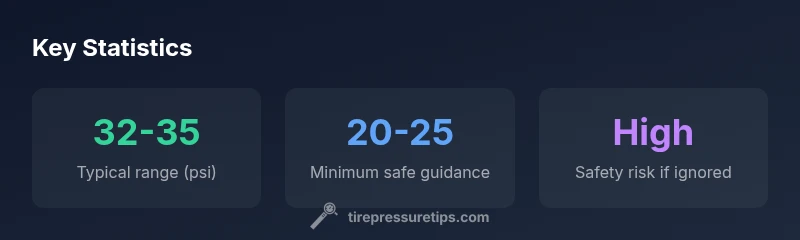
When it comes to the question of how low of tire pressure can you drive on, there is no universal safe threshold. Most passenger cars have a recommended cold-inflation range shown on the door placard, typically around 32-35 psi, but the minimum safe pressure varies by tire and vehicle. Driving significantly below the spec increases the risk of heat buildup, tread damage, and sudden failure, so do not rely on a fixed number; prioritize maintaining the manufacturer’s recommended range and seek air promptly if you notice a TPMS warning.
Why Tire Pressure Thresholds Matter
Understanding how low of tire pressure can you drive on is essential for safety. Underinflated tires alter handling, increase heat generation, and shorten tire life. While many tires are designed to run within a typical cold-inflation range (often around 32-35 psi for passenger cars), the minimum safe pressure is not universal. It depends on tire type, load, speed, ambient temperature, and even wheel construction. You might be able to move a vehicle with a tire reading in the mid-20s psi, but the risk of sidewall damage or a blowout rises quickly as you drop further. Therefore, use the vehicle’s placard as your compass and treat low PSI as a warning sign rather than a fixed number. The Tire Pressure Tips team emphasizes that the best practice is to maintain tires within the manufacturer’s recommended range when cold and inflate promptly if the TPMS alerts you. In short, the answer to how low you can drive on is not a one-size-fits-all number, but a safety-oriented spectrum that favors staying near the recommended range.
How Underinflation Affects Safety and Efficiency
Underinflated tires change physics on the road. Handling becomes less predictable, braking distances lengthen, and cornering grip deteriorates, especially in wet or snowy conditions. Heat builds up in the sidewalls as the tire flexes more than intended, accelerating wear and risk of failure. Fuel economy also drops because the tire creates more rolling resistance when it’s not at the correct pressure. Even modest underinflation can erode performance over time, so maintaining the spec is not merely about comfort—it’s about consistent safety margins and efficiency.
Vehicle-Specific Minimums and TPMS
There is no universal “minimum” psi that applies to every car. Every vehicle has a recommended cold-inflation range published on the door placard and sometimes in the owner’s manual. Some tires and rims tolerate deeper deflation than others, but most modern vehicles rely on TPMS to alert drivers when the pressure falls significantly below the recommended level. A TPMS warning typically signals underinflation before damage occurs, but it does not replace the need to check pressures with a gauge. Always cross-check the placard for your exact model and consider seasonal changes (temperature lowers pressure in winter, raising risk if you don’t compensate).
Practical thresholds and scenarios
If you drive with low pressure, consider your driving scenario. City commuting at lower speeds and shorter distances may allow temporary, minor reductions without immediate danger, but long highway trips, heavy loads, or hot weather amplify risk. In most cases, aiming to stay within the vehicle’s recommended cold range is prudent, while allowing a small margin (e.g., within 2-3 psi of the recommendation) for minor fluctuations due to temperature or aging tires. If you’re close to the lower end of the range, plan a stop to inflate and inspect for tread wear, bulges, or wounds. Remember that a tire’s ability to support loads and maintain stable handling hinges on staying near the intended pressure.
How to Determine Your Minimum Safe Pressure
Begin with the placard on the driver's door jamb (or fuel filler door on some models) to find the correct cold-inflation target. Use a good-quality gauge and check when the tire is cold (before you drive or after the car has been parked for several hours). If a tire reads noticeably under the target, re-inflate to the recommended psi and recheck after a few miles of driving to ensure the pressure stabilizes. If you routinely load your vehicle heavily, you may have different requirements for front vs rear tires; adjust accordingly and recheck. Regular checks (monthly or before long trips) help you avoid dangerous low pressures and ensure consistent performance.
Roadside Reality: Handling Low Pressure on the Road
If you notice a drop in tire pressure while driving, slow gradually, avoid hard braking or sudden steering, and head for a safe place to inspect. Driving on a significantly underinflated tire increases the risk of blowouts and can cause the tire to overheat, potentially damaging the wheel rim. Do not rely on the tires to “make it” to a service station—pumping up to the recommended pressure as soon as you can is the safest approach. If you repeatedly encounter low-pressure readings in cold weather, there may be slow leaks or valve stem issues that require professional inspection.
Common Myths and Misconceptions
Myth: Low tire pressure improves fuel economy. Reality: Underinflation typically worsens rolling resistance and reduces efficiency. Myth: You can drive indefinitely with a flat tire. Reality: A flat significantly compromises safety and should be avoided. Myth: TPMS is always exact. Reality: TPMS serves as a warning, but you should verify with a gauge. The truth is that maintaining correct pressure protects tires, improves safety, and sustains fuel economy, making it worth the extra minutes to check pressure regularly.
Quick-reference guide to common tire pressure guidance
| Aspect | Guidance | Notes |
|---|---|---|
| Cold inflation range | 32-35 psi typical | Check placard for your model |
| Minimum safe threshold | 20-25 psi general | Depends on tire and load |
| TPMS role | Alerts for low pressure | Do not delay inflation after warning |
Frequently Asked Questions
What happens if you drive with underinflated tires for a long distance?
Prolonged underinflation increases heat buildup, wears tires unevenly, worsens steering response, and raises the risk of a blowout. It can also lower fuel efficiency and shorten tire life. If you notice persistent low readings, inflate to the recommended level as soon as possible.
Long drives on underinflated tires can be dangerous; inflate to the recommended level as soon as you can.
How do I know my minimum safe tire pressure?
Your vehicle’s door placard lists the cold-inflation target for each tire. Use a reliable gauge to measure when cold, then bring all tires to the target. If you load your car heavily, front and rear tires may have different targets.
Check the placard, measure when cold, and adjust all tires to those targets.
Does cold weather affect tire pressure safety?
Yes. Cold ambient temperatures lower tire pressure, so you may see drops of a few psi. Recheck pressures after temperature changes and adjust to the recommended level when cold.
Cold weather lowers tire pressure; recheck and adjust when cold.
Can I drive with a TPMS warning while I’m on the road?
Pushing past a TPMS warning is not advised. If you’re near a service station, stop to inflate toward the recommended range and inspect for any signs of damage or slow leaks.
If possible, pull over and inflate to the recommended level.
How often should I check tire pressure?
Check at least monthly and before long trips, or whenever you notice a temperature shift or a TPMS warning. Regular checks help prevent unsafe driving conditions.
Check your tires monthly and before long trips.
Does inflating tires beyond the recommended range improve performance?
Overinflation can lead to reduced traction, uneven wear, and a harsher ride. Always stay within the manufacturer’s specified range for optimal performance.
Stick to the manufacturer’s range; avoid overinflation.
“Consistent tire pressures are a simple, critical safety measure. Keep to the manufacturer’s spec and treat low readings as a warning, not a minor inconvenience.”
What to Remember
- Maintain tires within the manufacturer’s recommended cold range.
- Underinflation increases safety risks and reduces efficiency.
- TPMS is a warning system; verify pressures with a gauge.
- Check tires monthly and before long trips to prevent problems.