Why Is Tire Pressure Not Going Up? A Troubleshooting Guide
Learn why tire pressure won't rise and how to fix common causes quickly. From leaks and valve issues to TPMS faults and temperature effects, follow our practical steps for safe, accurate readings.


The most common reasons tire pressure won't rise are small leaks, slow leaks around the valve stem or bead, a faulty TPMS sensor, or temperature-related pressure changes that mislead a gauge. Start by checking for obvious leaks, inspect the valve stem cap, and verify you’re using a reliable gauge. If the reading stays stubborn, move to a controlled test and consider professional service.
Why tire pressure readings stay flat, and what Tire Pressure Tips recommends
In real-world driving, a tire that won’t inflate higher can be frustrating and alarming. The Tire Pressure Tips team has seen cases where a tire shows the same psi after multiple inflations. In most situations, the issue isn’t a single mysterious fault; it’s a combination of small leaks, valve health, temperature effects, and sensor behavior. Starting with a calm, methodical check helps you avoid unnecessary repairs and keeps you safe on the road. Remember: a correct, stable tire pressure is essential for handling, fuel efficiency, and tire life. According to Tire Pressure Tips, taking a structured approach reduces guesswork and speeds you toward a safe, proper inflation.
Quick home checks to perform before you rush to a shop
Begin with the basics: use a reliable gauge, double-check the tire while cold, and inspect the valve core and cap. A small leak can be invisible; soapy water is your friend for spotting bubbles at the bead, valve stem, or tread. If you spot a leak, mark the area and monitor it over a few days. If the tire seems otherwise sound but pressure stays low, move to more targeted checks like TPMS status and temperature effects. These steps align with Tire Pressure Tips’ practical guidance for drivers seeking quick, accurate results.
TPMS and sensor health: reading versus reality
TPMS sensors can misreport if they’re old, damaged, or not calibrated. A reading that never climbs might reflect a sensor warning rather than an actual tire pressure problem. Calibrate or replace the sensor if necessary, and confirm the tire pressure with a hand-held gauge away from the vehicle’s electronic noise. This section emphasizes using independent tools to verify readings, a core principle in Tire Pressure Tips’ troubleshooting framework.
Temperature effects and gauge interpretation
Air pressure changes with temperature: cold air contracts and warm air expands. A tire inflated in a heated garage may show a lower reading after cooling, even though the tire is properly inflated. To reduce confusion, measure tire pressure only after the tire has cooled for at least 3 hours or 2-3 miles of driving, depending on ambient conditions. Keeping a reference chart a few psi apart for hot vs cold days helps you interpret numbers correctly.
When to seek professional help and what to expect
If you still can’t raise the pressure after at least two controlled tests, it’s time to involve a professional. A tire shop can perform leak detection, valve core replacement, bead seating checks, and TPMS diagnostics with specialized equipment. Expect a brief inspection, a precise pressure reading, and a recommended intervention plan—ranging from a valve replacement to puncture repair or TPMS service.
Steps
Estimated time: 45-60 minutes
- 1
Check for obvious leaks
Begin with a cold tire and inspect the tread, bead, and valve area. Look for nails, cracks, or chalky residue that signals a slow leak. If you find any damage, address it before inflating further.
Tip: Use soapy water and a spray bottle to reveal tiny leaks quickly. - 2
Verify gauge accuracy
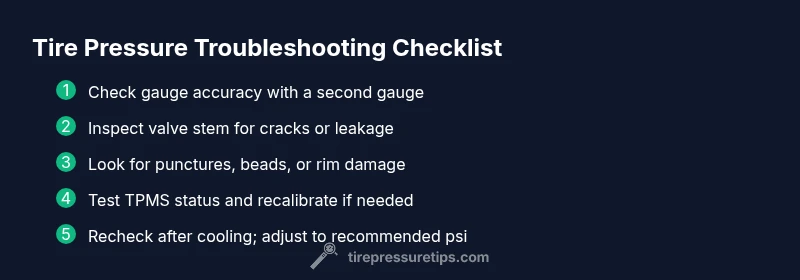
Use a reliable digital or dial gauge and compare readings with a second gauge to confirm accuracy. Record the measurement and compare it to the vehicle’s recommended tire pressure from the owner’s manual or door placard.
Tip: Calibrate or replace a failing gauge to avoid misleading results. - 3
Inspect valve stem and core
Remove the valve cap and inspect the stem for cracks or damage. If the core is loose or corroded, replace the core and reseat the cap firmly.
Tip: Do this with the tire cold to avoid heat affecting readings. - 4
Check TPMS status
If TPMS warns or digits seem abnormal, use a diagnostic tool to read sensor IDs and pressures. Recalibrate or replace sensors if needed.
Tip: Avoid driving long distances with a known TPMS fault. - 5
Test after temperature stabilization
Inflate to the correct pressure, then drive a short distance and recheck once the tire cools. Compare to the initial target and adjust if necessary.
Tip: Allow at least 10-15 minutes of cooling before rechecking. - 6
Consult a professional if unresolved
If the pressure still won’t rise, schedule a visit to a tire shop for a thorough leak test, bead seating, and TPMS evaluation.
Tip: Document symptoms and any measurements for the technician.
Diagnosis: Tire pressure won't rise after inflating
Possible Causes
- highVisible puncture or slow leak around tread/sidewall
- highFaulty or loose valve stem/core
- mediumTPMS sensor fault or miscalibration
- lowTemperature-related changes or gauge inaccuracy
Fixes
- easyInspect tire with soapy water to identify leaks; repair punctures or replace tire if necessary
- easyTighten or replace the valve core, inspect the valve stem for damage, reseal the valve
- mediumTest and calibrate or replace TPMS sensor using proper diagnostic tools
- easyInflate in a cool environment and recheck after stabilization to account for temperature effects
Frequently Asked Questions
Why won't my tire pressure go up after inflating?
Common causes include a slow leak, faulty valve core, TPMS sensor issues, or temperature effects. Start with a leak test and gauge check, then verify the sensor readings. If unresolved, seek professional help.
Most often a slow leak or valve issue keeps pressure from rising; check leaks and test with a gauge, then check TPMS if needed.
Can a bad TPMS cause wrong readings even when tires seem fine?
Yes. TPMS can read inaccurately if sensors are failing or not calibrated. Use an independent gauge to confirm tire pressure and have the TPMS checked by a technician if readings don’t match.
Yes, TPMS sensors can misread; verify with a gauge and consider recalibration or replacement.
How do temperature changes affect tire pressure?
Air expands with heat and contracts when cold. Check tire pressure when tires are cold and account for outdoor temperature using a reference chart to avoid misinterpretation.
Temperature changes can make tires seem under or overinflated; measure when cold for accuracy.
When should I call a professional for tire pressure issues?
Call a professional if you detect slow leaks, can't locate the source, or TPMS continues to misread after calibration. A technician can perform precise leak tests and TPMS service.
If leaks aren’t obvious or TPMS stays off after checks, seek a professional.
Is it safe to drive a car with a tire that won’t inflate properly?
If the tire pressure is significantly low or you suspect a leak, limit driving and seek assistance. Driving on underinflated tires can affect handling and tire life.
Drive slowly and seek help if the tire is underinflated; don’t push it long distances.
Watch Video
What to Remember
- Check for leaks first, then valve health
- Verify gauge accuracy with a second tool
- Consider TPMS status and temperature effects
- Seek professional help if the issue persists