Why Is My Tire Pressure Not Working? Quick Troubleshooting Guide
Urgent guide to diagnose why is my tire pressure not working, with quick checks, TPMS insights, and a safe step-by-step plan to restore accurate readings and prevent flats. Learn practical, technician-level tips from Tire Pressure Tips.


Most often, the problem is a faulty TPMS sensor, a slow leak, or an inaccurate gauge. Quick check: measure current pressures with a reliable gauge, compare to the vehicle’s placard, and inspect valve stems for leaks. If readings remain unstable or differ by more than 2 psi after inflation, recalibrate TPMS or seek professional diagnosis.
Understanding the Problem and Why It Matters
If you’ve ever asked yourself why is my tire pressure not working, you’re not alone. Accurate tire pressure is essential for safety, fuel efficiency, and tire wear. When readings seem inconsistent, or the TPMS warns with a light, you need a clear process to diagnose the root cause. According to Tire Pressure Tips, most issues fall into a few common categories: sensor faults, slow leaks, or measurement errors. In this guide, we break down the problem and provide practical steps you can take today to restore reliable readings and maintain proper inflation. The goal isn’t panic—it’s a repeatable, safe procedure that keeps you on the road with optimal tire performance. Before you inflate, verify the vehicle placard, check for visible damage, and prepare your tools. This early check helps you avoid over- or under-inflation and prepares you for the deeper checks that follow. As you read, keep in mind that precise tire pressure improves fuel economy, handling, and safety for every drive.
Common Causes of Inconsistent Tire Pressure Readings
There are several frequent culprits behind fluctuating tire pressures. A malfunctioning TPMS sensor can read inaccurately or fail entirely, especially after low-speed impacts or after tire changes. Slow leaks—often from nails, curb impacts, or bead seating issues—gradually reduce pressure and can trigger erratic readings as the air shifts. Instrument error matters too; gauges vary in accuracy, and inconsistent measurement techniques (reading after recent driving, not allowing the tire to cool, or using a damaged gauge) can skew results. Temperature shifts between morning and afternoon dramatically affect the numbers, as air expands and contracts inside the tire. Tire Pressure Tips analysis shows that the combination of sensor faults, leaks, gauge inaccuracies, and temperature effects explains most “not working” scenarios. Understanding these factors helps you prioritize checks and avoid guessing.
How TPMS Works and Why It Fails
Tire Pressure Monitoring Systems (TPMS) monitor pressure via sensors embedded in or on the wheel. They provide real-time alerts when a tire drops below a set threshold. However, TPMS can fail for several reasons: dead or weak battery in the sensor, improper relearn procedures after tire service, or software glitches in the vehicle’s central computer. In some cases, a sensor can be physically damaged during a curb strike or pothole, leading to inaccurate readings or a lit warning that won’t clear. Knowing how TPMS should behave helps distinguish a sensor problem from a simple gauge mismatch. If your TPMS light remains on after inflating to the placard and driving, you likely need a reset, calibration, or a sensor check from a professional.
Quick Home Checks You Can Do Now
Start with the simplest steps first to determine if the issue is just a measurement error. Use a reliable digital or analog gauge and take each tire reading when the tires are cold. Compare the readings to the manufacturer’s door placard on the driver’s side jamb, not the tire sidewall. Check that the gauge is not damaged and that you’re inflating to the correct target pressure. Inspect the valve stems for cracks or corrosion and look for obvious signs of leaks around the wheel bead and rim. If the readings jump around by more than 2 psi after a single inflation, document the numbers and try again with a different gauge. These quick checks often reveal the simplest root cause.
Leak Signs and Inspection: Valves, Beads, and Leaks
A slow leak is a common driver-side culprit behind changing pressures. Examine the valve stem core and cap for looseness or damage; a loose cap can let air escape slowly. Look for seal degradation at the bead where the tire meets the rim, which can occur after curb impact or potholes. Tire damage or foreign objects embedded in the tread may also contribute to poor air retention. A soapy water test around the valve stem and bead can reveal small leaks as bubbles. If you notice cracks, bulges, or persistent wet spots, do not drive on the tire until it’s inspected. Small leaks can become large quickly, especially during temperature swings.
The Role of Temperature and Driving in Readings
Temperature changes have a direct effect on tire pressure. Cold mornings can drop pressure, while driving warms air inside the tire and temporarily raises readings. A tire that seems fine after a short drive may appear underinflated once the tire cools. This is particularly relevant in seasons with wide temperature ranges. Always check pressures when tires are cold for an accurate baseline, and recheck after driving if you suspect a slow leak. Staying aware of temperature effects helps you interpret readings correctly and avoid chasing false alarms.
Calibration, Reset, and Gauge Techniques
When readings are inconsistent, recalibrating the gauge and TPMS can resolve issues. Start by validating gauge accuracy with a known reference or high-quality gauge. Inflate tires to the target pressure, then recheck with the same gauge after a few minutes of rest. If the vehicle uses TPMS, consult the owner’s manual for the relearn procedure—some cars require a specific sequence or a drive cycle to reset the system. For vehicles with a dedicated TPMS button, follow the exact steps in the manual. If you’re unsure, a professional can perform a precise relearn and confirm sensor integrity. Regular calibration of your measurement tools helps prevent misreads and unnecessary inflation adjustments.
When to Seek Professional Help and What to Expect
If you observe persistent fluctuations, frequent tire deflation, or a TPMS warning that won’t clear, it’s time to seek professional assistance. A technician can diagnose leaks with a professional-grade pressure tester, inspect TPMS sensors for battery or antenna problems, and verify that the valve cores are sealing properly. In some cases, valves, stems, or TPMS sensors must be replaced. Expect a diagnostic check, possible tire disassembly, and a relearn of the TPMS after any sensor work. Early professional input can prevent tire failure and save you money in the long run.
Prevention: Building a Tire Pressure Maintenance Routine
A proactive maintenance routine reduces the likelihood of recurring tire pressure issues. Check pressures weekly or at least monthly, especially during seasonal temperature changes. Use the same gauge for consistency and note down readings to track trends. Replace worn valve stems or caps, and seal the bead area if you notice slow leaks. Keep tires properly aligned and rotate them per manufacturer recommendations to ensure even wear and consistent pressure retention. Regular checks also help you stay in control and avoid sudden tire-related emergencies.
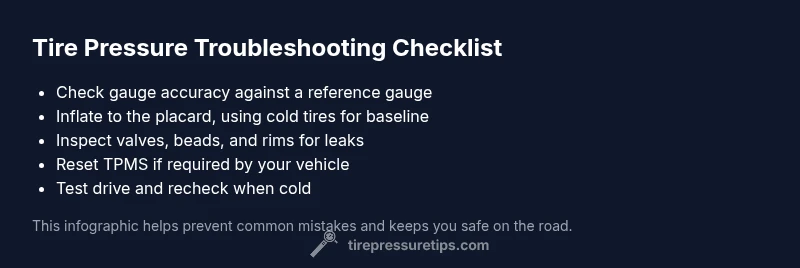
Steps
Estimated time: 30-45 minutes
- 1
Check gauge accuracy
Use a high-quality gauge and verify its accuracy against a known reference. Record the baseline reading for each tire when cold.
Tip: If your gauge is old or damaged, replace it to avoid false readings. - 2
Inflate to the placard value
Inflate each tire to the vehicle’s recommended pressure found on the door placard. Do not rely on the tire sidewall number.
Tip: Always inflate when tires are cold for an accurate baseline. - 3
Recheck after resting
Wait a few minutes and recheck each tire with the same gauge to confirm stable readings.
Tip: If readings vary by more than 2 psi, note the variance and proceed to inspect for leaks. - 4
Inspect for leaks and damage
Check valve stems, caps, beads, and rims for damage or leaks. Use soapy water to identify slow leaks.
Tip: A small bubble is a clear sign of a leak that needs repair. - 5
Reset or relearn TPMS
If you adjusted pressures, perform a TPMS relearn according to your manual or drive-cycle requirements.
Tip: Some vehicles require a specific sequence; never skip the relearn step. - 6
Road test and verify
Drive for 10-15 minutes and recheck pressures when cold to ensure stability.
Tip: A warm-up period helps reveal leaks or settling issues.
Diagnosis: Tire pressure readings bounce around or do not match gauge after inflation
Possible Causes
- highMalfunctioning TPMS sensor or relearn failure
- mediumSlow air leaks at valve stem, bead, or tire puncture
- highGauge inaccuracy or user error during measurement
- lowTemperature-related pressure changes
Fixes
- easyTest pressures with a known-good gauge and compare to placard; replace or recalibrate TPMS if needed
- easyInspect for leaks at valves, stems, and bead; apply sealant or replace damaged components as necessary
- mediumPerform TPMS relearn per manufacturer instructions or bring vehicle to a service shop
- mediumIf readings remain inconsistent, have a professional diagnose possible tire or wheel damage
Frequently Asked Questions
What causes tire pressure readings to be inconsistent?
Inconsistent readings are usually caused by a faulty TPMS sensor, slow leaks, gauge inaccuracy, or temperature shifts. A systematic check helps identify the specific issue and avoid unnecessary repairs.
Inconsistent tire readings are most often from a bad sensor, a slow leak, or measurement errors. A methodical check will reveal the exact cause.
Should I trust TPMS readings over a gauge?
TPMS is a helpful warning system, but it isn’t always precise. Use a trusted gauge to confirm actual pressure and then compare to the placard. If discrepancies persist, seek professional help.
TPMS is useful, but verify with a gauge to confirm true pressure before deciding on repairs.
How do I reset TPMS after inflating to the correct pressure?
Reset procedures vary by vehicle. Check the owner’s manual for the relearn procedure, or have a technician perform it during tire service. Driving for a specific distance may also trigger a relearn.
Resetting TPMS usually involves a specific menu option or a drive cycle; consult the manual for exact steps.
Can temperature changes affect tire pressure a lot?
Yes. Temperature changes can cause pressure to rise or fall by several psi. Always measure when tires are cold for a baseline and recheck after warming up in extreme conditions.
Temperature can swing tire pressure a lot; check when cold for accurate readings.
When should I seek professional help?
If you notice persistent pressure fluctuations, frequent deflation, or a TPMS warning that won’t clear, a professional diagnosis is warranted to rule out leaks, damaged sensors, or wheel damage.
If pressure keeps fluctuating or the TPMS won’t reset, see a professional.
What tools do I need to check tire pressure at home?
A reliable tire pressure gauge, access to the vehicle placard, and a way to clean valve stems are essential. Keep a small spray bottle for applying soapy water to check for leaks.
You’ll need a good gauge, the placard, and basic inspection tools.
Watch Video
What to Remember
- Check gauge accuracy first and use the placard as the target
- Inspect for leaks at valves, beads, and rims
- Calibrate TPMS after any sensor work or tire service
- Document readings and stay aware of temperature effects