Where to Check Tire Pressure for Free: A Practical Guide
Learn where to check tire pressure for free, how to measure accurately, and tips to save time and money. A practical guide with no-cost options, gear tips, and safety notes from Tire Pressure Tips.


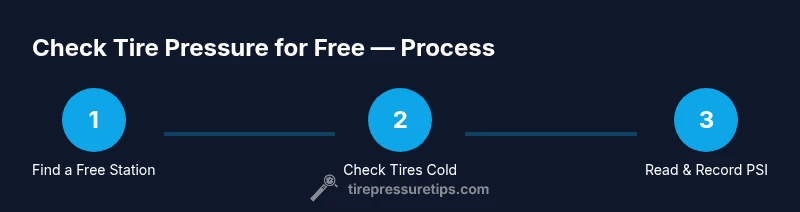
To check tire pressure for free, start with public, no-cost options: most gas stations offer free air or free-use gauges on tire valves; many tire shops and auto clubs provide complimentary checks during service days; municipal vehicle maintenance facilities sometimes allow free checks for residents. Always measure when tires are cold, use a reliable gauge, and compare to your vehicle’s recommended psi.
Why checking tire pressure for free matters
Regularly verifying tire pressure is one of the simplest, most cost-effective maintenance tasks. It helps with fuel economy, tire wear, and safety. The question of where to check tire pressure for free comes up often, especially for drivers on a budget or with an older vehicle. According to Tire Pressure Tips, there are more no-cost options than people realize, and knowing where to look can save you time and money. In practice, you can check free pressure readings at public stations, community workshops, and some auto service events. But remember: the gauge you use and whether the tires are cold strongly influence accuracy. In this guide we will map out where to check tire pressure for free, how to do it correctly, and how to avoid common mistakes. We’ll also discuss TPMS cues, seasonal changes, and how to keep a simple record of your readings, so you always know when a tire needs air, or when it’s time to visit a shop for a top-off.
Free, widely available options to check your tire pressure
There are several no-cost avenues you can rely on without paying a dime. Gas stations commonly provide free air and sometimes free-use gauges; many automotive clubs and community centers host free check events or partner with local shops for instructional days. Some municipal fleet services offer free checks for residents or during public safety campaigns. If you’re unsure whether a location offers free service, a quick phone call or online search saves time. Tire Pressure Tips's analysis shows that variety in access is common across regions, so make a quick plan before you head out. Always bring a reliable gauge and your vehicle’s PSI spec from the door jamb or owner’s manual. A consistent approach ensures you get a trustworthy reading, even when performed in a busy service area.
How to locate free tire pressure checks near you
Locating a free check starts with smart searching and a few local pointers. Start with your nearest gas stations; many provide free air and gauges, though hours vary. Check large auto parts stores that offer free diagnostic events, or community colleges and libraries that host vehicle maintenance clinics. Local government websites or DOT safety portals sometimes list free check events during road-safety awareness weeks. When you find a candidate, map the route, confirm hours, and note what equipment is available (gauge type, pressure unit). If you drive an unfamiliar area, pair your search with a simple template: “free tire pressure check near me” plus your city. Remember to be respectful of the staff and follow posted safety rules. These free checks are a practical way to stay safe on the road without spending money.
DIY checks at free stations: what to expect and how to prepare
If you plan to do the check yourself, you’ll typically use a handheld gauge and read the PSI at each tire. A few stations offer a self-serve air pump with a built-in gauge, which is convenient for topping off after you’ve read the values. Bring a copy of your vehicle’s recommended PSI from the door placard or owner’s manual, and jot down your results for each tire. For best results, perform checks when tires are cold (ideally after being parked for at least three hours). If you must drive to the station, wait until the tires cool before checking again when you reach your destination. The aim is to reduce variables that skew readings, such as heat buildup from recent driving or ambient temperature.
What to bring and how to prepare
Before you go, assemble a simple kit: a reliable tire pressure gauge, your vehicle’s PSI spec (door jamb label or manual), a notebook or notes app to log readings, and a pen or pencil. If you plan to top off, consider a small notepad for recording the before/after values. It’s helpful to know the unit of measure your gauge uses (PSI or
Common mistakes and how to avoid them
A frequent error is reading pressure in a warm tire, which can overstate the PSI by several pounds per square inch. Another pitfall is relying solely on TPMS without verifying with a gauge—TPMS indicates risk, not exact numbers. Some drivers forget to check the spare tire or neglect the inner side of the axle alignment when assessing front versus rear pressures. Always remove valve caps gently, install the gauge squarely on the valve stem, and read the pressure without rushing. If you detect a significant difference from the spec, recheck after a few minutes or at a cooler time of day. Per Tire Pressure Tips, consistency in technique is more important than chasing a perfect number on the first try.
Temperature effects and cold-start checks
Tire pressure is sensitive to temperature. Cold tires typically reflect a lower PSI than warm tires after driving. If you’ve driven recently, wait until the tires have cooled (about 3 hours if possible) and re-check for an accurate reading. This is especially important in extreme weather—hot days can raise pressure, while cold days can drop it. The recommended approach is to measure in the morning after the car has sat overnight, or after a long period of inactivity. Recording ambient temperature alongside your PSI reading helps you interpret changes accurately, reducing the likelihood of over- or under-inflation due to weather.
Safety considerations and quick maintenance tips
If a tire shows low pressure, top it off using a free air station or a home gauge, following the manufacturer’s recommended psi. Do not exceed the maximum tire pressure printed on the tire sidewall. If the tire has a side-dent, sidewall crack, or slow leak, stop and seek professional help. Always check the other tires after correcting one to ensure uniform inflation. Quick maintenance tips include checking pressure monthly, before long trips, and whenever you notice handling changes. The aim is to prevent uneven wear, improve fuel economy, and enhance overall safety.
How to record readings and track changes
Keeping a simple log of readings helps you notice slow leaks or gradual pressure loss. Create a compact table: date, tire position (LF, RF, LR, RR), measured PSI, ambient temperature, and any notes about the tire’s appearance. Review the log monthly to identify trends, and set reminders to recheck before highway trips or seasonal changes. Consistency matters as much as accuracy, and logging makes it easier to communicate with a tire professional if you suspect a leak.
What to do if you can’t find free checks nearby
If free options are scarce, consider paid checks as a last resort or use a home gauge to perform your own checks after acquiring a basic understanding of the correct PSI for your vehicle. Some employers or community groups offer occasional free inspection days; sign up for newsletters or community calendars to catch those events. You can also coordinate with a local auto club for member benefits that include free or discounted pressure checks. The key is to stay vigilant about pressure trends and keep a simple log to avoid surprises on the road.
Quick-start checklist for your next trip
- Locate a nearby free tire pressure check option (gas station, club, or public event).
- Bring a reliable gauge and your PSI spec.
- Check all four tires when cold; recheck after any top-off.
- Log the readings with date, tire position, PSI, and ambient temperature.
- Review your log monthly and ahead of long trips for safe driving.
Tools & Materials
- Tire pressure gauge (digital or analog)(Calibrated for accuracy; use the same unit (psi) throughout.)
- Vehicle PSI specification (door jamb sticker or owner’s manual)(Know the correct cold-psi for front and rear tires.)
- Access to a free air station (optional but helpful)(Many public stations offer free air; confirm hours and payment policy.)
- Notebook or digital log app(Record readings to track changes over time.)
- Smartphone or map app(Use it to locate nearby free checks and save addresses.)
Steps
Estimated time: 20-30 minutes
- 1
Prepare your check kit and locate a free station
Gather your gauge, PSI spec, and a notebook. Use a map app to find local free-air stations or community events and plan your route before you leave. This reduces stress and ensures you don’t miss the opportunity to check.
Tip: Call ahead or check online hours to avoid a wasted trip. - 2
Ensure tires are cold and accessible
Park in shade or wait at least 3 hours after driving to let tires cool. Remove the valve caps so you can attach the gauge easily and read the pressure without interference.
Tip: If you must drive to the station, recheck after tires cool down. - 3
Attach gauge and read PSI
Place the gauge squarely on the valve stem, press firmly, and read the pressure. Note which tire you measure (front left, front right, etc.) for a complete profile.
Tip: If readings vary widely, recheck to confirm accuracy. - 4
Compare with manufacturer specification
Compare each reading to your door jamb or manual values. Remember that front and rear tires may have different targets depending on load and axle.
Tip: If a tire is below spec, plan a safe top-off or service check. - 5
Top off or adjust as needed
Use the free air station or your own pump to top off to the recommended psi. Do not overinflate beyond the max psi printed on the tire sidewall.
Tip: Make small adjustments and recheck after stabilizing. - 6
Recheck all tires and record results
Recheck each tire after a few minutes to confirm stability. Log the final psi for each tire along with date and ambient temperature.
Tip: Keep your log accessible for future reference.
Frequently Asked Questions
Where can I get a free tire pressure check?
Common places include gas stations with air pumps, auto clubs, and some municipal fleets offering complimentary checks. Hours and availability vary, so a quick call or online search helps. Plan ahead to avoid dead ends.
Look for gas stations with air pumps or local auto clubs offering complimentary checks. Check hours before you go.
Should I check tire pressure when the tires are cold?
Yes. Measuring cold tires gives the most accurate PSI. Driving heats tires and raises pressure, skewing the reading.
Yes—check when cold for accuracy.
How do I know the correct PSI for my car?
Look at the door placard on the driver's side, or consult the owner’s manual. Psi values can differ by axle and load.
Check the door placard for the correct number.
Can I rely on TPMS readings instead of a gauge?
TPMS flags low or high pressure but does not provide exact PSI. Always verify with a gauge for precise measurements.
TPMS helps, but use a gauge for exact pressure.
Is it illegal to pay for air at a station?
Policies vary by location. Some stations offer free air; others charge. Look for free options or bring your own equipment when possible.
Policies vary; some places charge for air.
How often should I check tire pressure?
Check at least monthly and before long trips. Temperature changes and seasonal shifts can affect readings.
Monthly checks, especially before trips.
What to Remember
- Find nearby free checks with trusted sources
- Check cold tires for accurate readings
- Use a reliable gauge and log results
- Avoid overinflation when topping up at free stations
- Regular checks save fuel and extend tire life