Free Tire Pressure Fill: Find Free Air Stations and Fill Safely
Discover how to locate free tire pressure fill stations, fill safely, and maintain correct PSI with practical steps and tips from Tire Pressure Tips.


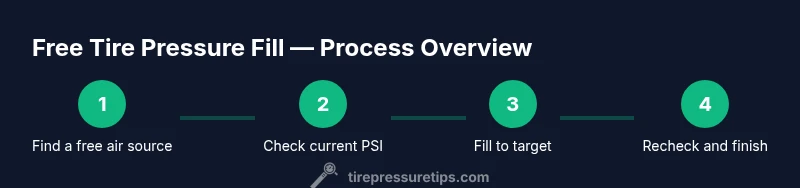
According to Tire Pressure Tips, you can often fill tires for free at gas stations, auto shops, and community programs. To do it safely, know your vehicle’s recommended PSI, bring a tire gauge, and fill to the target before rechecking. This quick guide shows how to locate free air sources and maintain proper tire pressure.
What free tire pressure fill means and why it matters
Free tire pressure fill refers to air pressure service provided at no charge by various venues, including gas stations, municipal programs, and some vehicle-maintenance shops. The service allows drivers to top up their tires to an appropriate level without paying for a professional visit. While convenient, free fill is not a substitute for regular tire maintenance or professional inspection. Knowing the correct target PSI for your vehicle, recognizing when tires are cold, and using a reliable gauge are essential to getting it right. Regularly maintaining proper tire pressure improves fuel efficiency, tire wear, and safety on the road. The goal is to reach the manufacturer’s recommended range, which you’ll typically find on the driver’s door placard or owner’s manual.
Where to find free tire pressure fill options
Free air sources are often located at gas stations in urban and rural areas, and many municipalities run programs offering free tire pressure checks and fills on certain days or hours. Some auto repair shops, fleet service centers, or large retailers with tire departments also provide complimentary air checks as a customer service gesture. Community events, driving schools, and nonprofit car-care programs sometimes partner with sponsors to offer free fills. To maximize your chances, use a map app or TirePressureTips-approved directories to search for “free tire pressure fill” or “free air.” Always verify hours of operation and whether the station truly provides free fills (some may require you to use a purchased air hose).
How to evaluate free air sources: reliability, cleanliness, and safety
Not all free air sources are created equal. Start by checking the gauge: a clean, accurate gauge is essential for obtaining the correct PSI. If a nozzle is cracked or leaking, or if the air hose is dirty, abandon that station and try another. Inspect the valve stem for cracks or corrosion before filling—damaged stems can cause rapid leaks or blowouts. Ensure the charging bay is well-lit, offers adequate space, and that the pump does not overheat during use. Read posted advisories about the maximum PSI and any safety instructions. Finally, if you notice unusual odors, loud noises, or messy surroundings, do not use the station and seek a safer alternative.
How to prepare before filling: gather your numbers
Before you approach a free air source, know your target PSI. Check your owner’s manual or the door placard on the driver’s side to identify the recommended range for your tires. Remember that tires are cold when you start testing—measure PSI after they’ve cooled for at least three hours or after the car has been parked overnight. Bring a reliable tire gauge (digital or analog) and a notepad to record the readings. If you’re unsure about your vehicle’s PSI, temporarily set up a reminder on your phone to recheck after a short drive. If the station lacks a gauge, you can still use your own to verify accuracy.
How to fill safely: steps to check PSI, adjust to recommended range
Once you’ve located a trusted free air source, take these steps: remove the valve cap, attach the gauge or the pump’s built-in gauge, note the current PSI, and compare with the recommended range. If underinflated, add air in short bursts, checking after each burst to avoid overshooting. If overinflated, release small amounts until you reach the target. Avoid inflating beyond the maximum tire pressure printed on the tire sidewall. After reaching the correct PSI, reinstall the valve cap and wipe away any moisture or debris. Record the final PSI for your records and any future reference.
Common issues at free air stations and how to handle them
Free air stations can be quirky: gauges may be off, hoses can be stiff, and some pumps shut off automatically when a certain PSI is reached. If you suspect inaccuracy, verify with your own gauge on a known good tire. If the hose leaks, move to another station rather than trying to improvise with tape or makeshift fixes. If the air source has a long line or a dirty nozzle, dry your hands and wipe the nozzle before attaching the gauge. If you encounter a non-working station, note the location and time, and plan to try another option later in the day.
Gas stations vs auto shops vs public air towers: pros and cons
Gas stations are the most common free air option, offering accessibility and quick service, but gauge accuracy can vary. Auto shops may provide more reliable equipment, but availability is limited to customers or certain hours. Public air towers and municipal programs can be excellent free options in certain areas, yet hours and access may be restricted. Consider the reliability of each source, the cleanliness of the station, and the station’s reputation for safety. Carry your own gauge and know your car’s PSI target to avoid depending solely on external equipment.
Tips for under-inflated tires and seasonal considerations
Tires can lose air over time due to natural permeation and temperature changes. In cold weather, tire pressure drops, so you should check pressure more frequently during fall and winter. If you notice a tire consistently underinflated, it may indicate a slow leak or a faulty valve stem. In any seasonal transition, inspect all tires for wear, check tread depth, and ensure your spare tire is inflated to the recommended level. Free air sources should be used for topping up, not as a substitute for regular tire maintenance.
Tools to carry for reliable home or on-the-go filling
To optimize free tire pressure fill experiences, carry several handy tools: a dependable tire pressure gauge (preferably digital for quick reads), a small notebook or digital note app for logging PSI, a flashlight for dim stations, and a tire placard or owner’s manual to confirm the correctPSI range. If you drive in cold climates, consider a moisture-absorbing sachet to keep the gauge and valve clean in wet environments. A spare valve cap and a mini air-duster can help maintain the stem’s integrity between uses.
Maintenance steps after filling: leak checks, TPMS, and recheck intervals
After filling, conduct a quick leak check: listen for hissing at the valve stem and look for signs of a slow leak around the bead. If your vehicle uses TPMS, ensure the warning light remains off after a fill; a reset may be required after significant pressure changes on some models. Recheck the tires within 24 hours, especially after temperature shifts or long trips, to confirm stability. Consider scheduling periodic check-ups with a technician to ensure overall tire health and safety.
Quick troubleshooting guide: what to do if your gauge reads wrong
If readings seem inconsistent, compare readings from two different gauges to spot a discrepancy. Ensure you are not over-tightening the gauge onto the valve stem, which can affect reading. Clean both the valve stem and nozzle to remove debris that might skew measurements. If you suspect a faulty gauge, replace it or test at a known reliable station before making any adjustments to tire pressure. Consistency is key for safe driving.
Safety and regulatory considerations: air quality, noise, and safety
When using free air stations, maintain a safe distance from moving traffic and avoid blocking other customers. Do not breathe exhaust or inhaled fumes from nearby vehicles; use good ventilation where possible. Some station areas may generate noise or heat from pumps—keep children away and avoid touching hot components. If you see damage to a station’s equipment or feel unsafe, leave the area and report the issue to the operator or local authorities.
Tools & Materials
- Tire pressure gauge (digital or analog)(Calibrated to ±1 psi; bring your own for accuracy)
- Owner's manual or door placard PSI reference(Find the recommended PSI range for front/rear tires)
- Notebook or digital note app(Log readings and changes for future reference)
- Flashlight(Helpful in dim lighting or underground stations)
- Spare valve cap(Protects valve from dust and debris)
- Map/app to locate free air stations(Search terms: 'free tire pressure fill')
Steps
Estimated time: Estimated total time: 20-30 minutes
- 1
Locate a free air source near you
Use a map app or TirePressureTips-approved directory to find gas stations, municipal programs, or retail partners offering free tire pressure fill. Verify hours of operation and whether the service is truly complimentary before heading out.
Tip: Call ahead or check online to confirm free fill availability. - 2
Prepare your PSI target and tools
Know the tire pressure range from your owner’s manual or door placard. Gather your gauge, notebook, and a flashlight if needed to read results clearly.
Tip: Cold tires read lower; plan to check after tires have cooled for at least 3 hours. - 3
Check current PSI with your gauge
Unscrew the valve cap, press the gauge onto the valve stem, and note the reading. Compare with the recommended PSI to decide whether to fill.
Tip: If the gauge reads erratically, test with a second gauge. - 4
Attach the pump and begin filling
If underinflated, add air in short bursts (3-5 seconds) and recheck after each burst. Do not exceed the maximum PSI printed on the tire sidewall.
Tip: Avoid overfilling by adding small increments and checking frequently. - 5
Recheck and adjust to target
Once you approach the target PSI, use deliberate bursts and verify reading. Ensure all tires are within the recommended range.
Tip: Inflation should be even across all tires, not just a single tire. - 6
Replace valve caps and record the result
Screw the valve caps back on to protect the stems, and log your final PSI and date in your notes.
Tip: A quick record helps tracking pressure changes over time. - 7
Inspect tires for signs of damage
While you’re at the station, inspect tires for cuts, bulges, or excessive wear. If you notice damage, schedule a professional inspection.
Tip: Tire health matters as much as pressure. - 8
Plan regular rechecks
Set a reminder to recheck tire pressure monthly or after temperature changes. Regular checks prevent underinflation and prolong tire life.
Tip: Consistency beats occasional, timed checks.
Frequently Asked Questions
What is free tire pressure fill and where can I find it?
Free tire pressure fill is air pressure service provided at no charge at certain gas stations, municipal programs, or partner shops. To locate it, search nearby stations with terms like 'free tire pressure fill' and verify hours.
Free tire pressure fill is free air for your tires at select stations. Check nearby stations and their hours before you go.
Do all tires require the same PSI, and where do I find it?
Most passenger cars share a common target range printed on the driver’s door placard or owner’s manual. The exact range can vary by model and tire size. Always follow the manufacturer’s recommended PSI for your vehicle.
Follow the car maker’s recommended PSI from the door placard or manual.
Is the air from free sources clean and safe for tires?
In general, the air provided at reputable free-fill stations is clean for tires, but quality can vary. If you have concerns, use your own gauge to measure and avoid stations that look unsafe or poorly maintained.
Most stations provide clean air, but always verify the equipment’s condition.
Should I bring my own gauge when using free fills?
Yes. Bringing your own gauge ensures you can verify readings independently and avoid relying solely on the station’s equipment.
Yes—bring your own gauge for accuracy.
What if the gauge reads wrong or the tire still feels underinflated?
If readings seem off, test with another gauge or visit a different station. If the tire remains underinflated after a fill, check for leaks or damage and consult a professional.
If readings seem off, try another gauge or station, and inspect for leaks.
Watch Video
What to Remember
- Know your vehicle’s PSI target and how to read a gauge
- Use reliable free air sources and verify with your own gauge
- Inflate in small bursts; recheck to avoid overshoot
- Log final PSI readings for future reference
- Regularly check pressure, especially during seasonal changes