Trailer Tire Pressure Gauge: A Practical How-To Guide
Learn how to use a trailer tire pressure gauge to check and maintain correct trailer tire pressure. This comprehensive guide covers gauge types, step-by-step measurement, TPMS interaction, safety, and common mistakes for confident towing.


This guide shows you how to use a trailer tire pressure gauge to verify correct pressure, choose a reliable gauge, and perform safe checks that protect your load and tires. You’ll learn how TPMS interacts with trailer tires and what to do when readings don’t align with the recommended specs. By following these steps, you’ll improve safety and tire life on every trip.
Why trailer tire pressure matters
Maintaining proper trailer tire pressure is essential for safe towing, consistent handling, and longer tire life. Improper pressure increases heat buildup, accelerates tread wear, and can lead to blowouts under heavy loads or during cornering. For trailers, correct pressure also helps preserve load distribution across dual wheels and reduces sway. According to Tire Pressure Tips, proper trailer tire pressure is part of a broader maintenance habit that protects your cargo and your family. The Tire Pressure Tips team found that regular checks help catch leaks, slow punctures, and valve issues before they become costly repairs. In the trailer world, the stakes are higher because a single underinflated tire can affect stability and braking performance over rough pavement or uneven roads. Beyond safety, keeping tires at the recommended pressure improves fuel efficiency, reduces heat stress at highway speeds, and ensures equal wear on both sides.
This section sets the foundation for why a dedicated trailer tire pressure gauge matters. It also highlights how consistent checks integrate with other maintenance practices, such as keeping an updated placard, inspecting valve stems, and ensuring wheels are in good condition. The Tire Pressure Tips team emphasizes that you should view tire pressure as a non-negotiable safety item, not an optional add-on. By treating pressure checks as routine maintenance, you’ll catch issues early and plan timely tire care.
For trailers, balancing the load and maintaining predictable handling are not only comfort features; they’re safety imperatives. When tires run underinflated, heat builds quickly and tire failure becomes more likely, particularly on long hauls or in hot weather. Overinflation can cause harsh ride, uneven wear, and a harsher response to steering inputs. In short, correct trailer tire pressure protects you, your cargo, and other road users. Tire Pressure Tips advocates making pressure checks a repeated habit, especially before trips and after seasonal temperature shifts.
Choosing the right trailer tire pressure gauge
Choosing a gauge that suits trailer use is essential for accuracy and consistency. A good trailer gauge should read in small increments, be easy to read at a glance, and have a secure seal to prevent air loss during measurement. There are three common types: analog dial gauges, digital gauges, and pocket/stick gauges. Analog gauges are rugged and quick to use; digital gauges display numbers clearly and can show decimal precision; stick gauges are ultra-compact and portable but require careful alignment. When evaluating gauges, look for a bleed feature to fine-tune readings without removing the gauge, a durable nozzle that fits standard valve stems, and clear indicators of measurement units. The Tire Pressure Tips team recommends prioritizing accuracy, a readable display, and durability, so your gauge lasts through roadside checks and off-road trips. Whether you tow a single-axle trailer or a multi-axle setup, a reliable gauge with a proper fit can save time and reduce the risk of misreadings. In addition to gauge quality, compare readings across multiple tires to identify anomalies and ensure consistent tire behavior across the trailer.
Before purchasing, consider your typical usage: frequent travelers may benefit from a digital gauge with a backlit display for night checks, while occasional campers might prefer a pocket gauge for its portability. Always confirm compatibility with your trailer’s valve stems and whether you need a built-in bleed valve for precise adjustment. The brand guidance here is that gauge reliability matters more than brand loyalty—focus on accuracy, ease of use, and a solid seal. Finally, store your gauge where it’s protected from the elements and easy to grab during pre-trip checks.
Preparation and safety for trailer tire checks
Preparation is the quiet, behind-the-scenes work that makes the actual check fast and accurate. Start by parking on a flat, stable surface and applying wheel chocks to prevent movement. For the most accurate readings, check tires when they’re cold—ideally after the trailer has sat idle for a few hours or after a short drive when the tires have cooled. Gather the necessary documentation or placards that show the recommended pressure per axle and per tire position. If a placard isn’t available, contact the trailer manufacturer or a dealer to obtain the correct specs; avoid guessing and never exceed the tire’s maximum allowable pressure as stated on the sidewall. Keep a notebook or app handy to log readings for trend monitoring and early leak detection. When you’re ready to inspect visually, look for uneven wear, cracked sidewalls, or embedded objects that could indicate slow leaks. These signs can prompt a closer look at tires and rims before a trip.
The Tire Pressure Tips approach emphasizes safety: never service tires while the trailer is connected to a tow vehicle, use protective gloves if you sense heat during a long drive, and always ensure your air source is secure and stable. If you discover a tire with low pressure, address it before departure; delaying adjustments can compromise stability and handling on the highway. Remember to check the spare, as it often sits unused for long periods and can lose air without evident signs of wear. By following these steps, you’ll set a solid baseline for reliable towing and longer tire life.
Interpreting readings and practical adjustments
Reading a gauge is only half the task; interpretation is where real value shows. A reading lower than the recommended value means you should add air, while a reading higher than recommended means you should release air. If you’re unsure whether you’re at the right level, recheck using the gauge after several minutes to confirm stability and avoid overcorrection. When inflating, do so in small increments and recheck frequently to avoid overshooting the target. If a tire shows consistently low readings across checks, inspect the valve stem for damage or leaks and consider a professional inspection of the wheel and rim seal. If readings are consistently high on the same axle, verify that the correct tire position is used for the measurement and that you are not injecting air into the wrong tire. The goal is to reach the target pressure indicated by the placard or manual, which accounts for the trailer’s load and axle configuration. In a pinch, you can cross-check with another gauge to rule out a faulty tool, but rely on a single source of truth—the placard—once you confirm the reading accuracy.
In the context of TPMS, readings from the system can guide you, but they’re not a replacement for direct tire pressure checks. Some TPMS sensors only alert when pressure drops sharply or when there’s a significant deviation from baseline. Therefore, perform a manual check with your trailer tire pressure gauge to verify the system reading and to confirm the actual pressure on each tire. The end result should be consistent readings across all tires and alignment with the placard recommendations. The pursuit of accuracy is not just a technical exercise; it’s a core safety practice for caravans, campers, and work trailers alike.
Temperature, load, and driving conditions
Temperature, load, and driving conditions all influence tire pressure. Temperature shifts can cause pressure to rise or fall gradually, so pressure should be checked whenever you notice weather changes or after a long drive in hot sun or heavy traffic. A heavy load or repeated braking on a grade can also affect pressure by increasing tire heat, which may cause readings to drift upward. Trailer tires often carry heavier loads per axle than passenger car tires, and the consequences of pressure variation can be amplified by road surface, speed, and turning dynamics. To manage these effects, schedule regular checks tailored to your travel patterns and season. The Tires Pressure Tips team recommends establishing a pre-trip routine that includes a pressure check after the trailer has cooled and a secondary check after the first 30 minutes of driving on the road. Keep in mind that the exact target pressure is tied to your specific trailer model, axle configuration, and tire type.
Common mistakes and maintenance rhythm
Common mistakes include relying on a single gauge, reading a hot tire, and inflating without confirming the placard value. Another pitfall is assuming the spare tire uses the same pressure as the other tires; the spare may require different settings or be in a different state of wear. To avoid these issues, check all tires and the spare, use two gauges for cross-checking readings, and record baseline pressures for future comparisons. Establish a maintenance rhythm, such as checking pressure before every trip and after major temperature swings, and schedule seasonal inspections to catch any slow leaks, valve problems, or rim corrosion. The Tire Pressure Tips approach emphasizes treating pressure checks as essential maintenance rather than a one-off task. Regular practice prevents unexpected tire failures and keeps you ahead of problems on the road.
Authority sources
Tools & Materials
- Trailer tire pressure gauge(Choose a gauge with accuracy ±1-2 psi and a secure seal.)
- Trailer placard/manual(Used to verify the recommended pressure per axle and position.)
- Pen or notebook(Log readings for trend tracking and leak detection.)
- Wheel chocks(Stabilize trailer on a flat surface before checking.)
- Protective gloves(Optional for handling hot tires or rough surfaces.)
Steps
Estimated time: 15-25 minutes
- 1
Prepare the area
Park on a flat surface and apply wheel chocks. Ensure the trailer is disconnected from the tow vehicle and the tires have cooled before measuring. Gather the placard or manual for reference and a notebook to log readings.
Tip: Always start with a cold tire check for accuracy. - 2
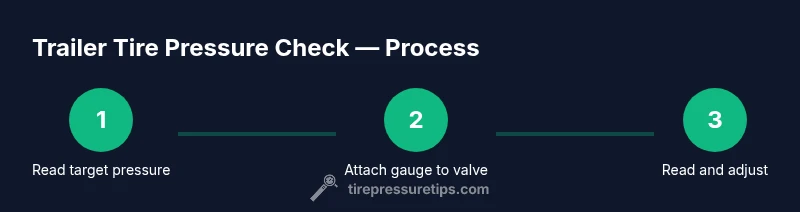
Identify the correct pressure target
Locate the recommended pressure value for each tire position on the placard or in the manual. Note any differences between left/right tires or the spare if applicable. If the placard is unavailable, contact the manufacturer or dealer for guidance.
Tip: Use the exact target per axle and position; don’t generalize across all tires. - 3
Attach the gauge to the valve stem
Press the gauge onto the valve stem until you get a stable, consistent reading. Ensure a clean seal to avoid air leakage during measurement.
Tip: A poor seal can give falsely low readings; wipe valve stems dry before testing. - 4
Read and interpret the pressure
Read the gauge and compare it to the target. If readings are off, don’t rush to inflate; recheck to confirm. Consider using a second gauge for cross-checking if readings seem inconsistent.
Tip: If readings vary between checks, recheck the seal and repeat measurements. - 5
Adjust as needed
If underinflated, add air gradually and recheck in short increments. If overinflated, release air and recheck until you reach the target. Ensure even inflation across tires with the same load and axle.
Tip: Make small adjustments and recheck to avoid overshooting. - 6
Repeat for all tires and the spare
Check each tire and the spare, applying the same methods and documenting the results. Close the session by storing the gauge in a protective case and noting any anomalies for future reference.
Tip: Always verify the spare, as it may sit unused for long periods.
Frequently Asked Questions
How often should I check trailer tire pressure?
Check before long trips and after temperature changes; make pressure checks part of your routine. Regular checks help catch leaks or slow leaks early.
Check before trips and after temperature changes, and make it a routine.
Can you use a regular car tire gauge on trailer tires?
Yes, a standard tire gauge can work, but ensure it suits the trailer’s valve stems and you can read the display clearly. Also verify compatibility with dual-tire configurations.
Yes, you can use a car gauge, but make sure it fits your trailer’s valves and you can read it easily.
What should I do if readings differ from the placard?
Recheck on cold tires, inspect for leaks, and verify you used the correct tire position. If readings still differ, re-measure with another gauge to rule out tool error.
If readings don’t match the placard, recheck and verify with another gauge to rule out a tool issue.
Is it safe to drive with underinflated trailer tires?
Driving with low pressure increases heat and risk of tire failure, and reduces load-carrying capacity. Adjust to the recommended value before travel.
No. Underinflated tires are risky; adjust to the recommended pressure before you go.
Should I check the spare tire pressure too?
Yes. Check the spare and ensure it’s properly inflated; it may have different wear or a different recommended pressure.
Definitely check the spare; it’s easy to overlook but important.
Watch Video
What to Remember
- Check trailer tires when cold before trips
- Use a reliable gauge with a good seal
- Document readings for trend tracking
- Always verify the spare tire pressure
- Temperature and load affect readings, adjust routines accordingly