Utility Trailer Tire Pressure: A Practical How-To Guide
Practical, step-by-step guidance to check and adjust utility trailer tire pressure for safer towing, longer tire life, and improved fuel efficiency.


By the end of this guide, you'll confidently check and adjust utility trailer tire pressure for safer towing, longer tire life, and improved fuel efficiency. You'll learn how to read the sidewall markings, determine a starting pressure, verify cold readings, and handle adjustments for varying loads and temperatures. This quick answer sets the stage for practical steps, tools, and safety checks.
Why proper utility trailer tire pressure matters
Maintaining accurate tire pressure on utility trailers is more than a number on a gauge. Proper pressure affects load stability, tire life, braking response, and overall handling on the road. When a trailer is carrying tools, building materials, or heavy gear, even small variations in pressure can change tongue weight and sway behavior. For drivers using utility trailers, the objective is consistent contact with the road, predictable steering, and reduced risk of tread separation in hot weather. According to Tire Pressure Tips, safe towing starts with correct trailer tire pressure. The correct pressure depends on tire size, load rating, and axle configuration, not on the vehicle’s own tires. The Tire Pressure Tips team found that neglecting proper inflation is one of the most common contributors to tire wear and heat buildup on trailers, especially after long trips or in high-load conditions. Stay proactive: check cold inflation, follow the sidewall markings, and reset your targets whenever your load pattern changes.
How trailer tires differ from passenger vehicle tires
Trailer tires carry only the load they’re rated for and do not benefit from the independent suspension typical of passenger cars. They run at higher pressures, are more sensitive to heat under load, and have different load indices for axle configurations. Unlike a vehicle’s tires, trailer tires do not experience the same steering or cornering forces, so their contact patch responds differently to pressure changes. The result: a small underinflation can cause increased rolling resistance and uneven wear, while overinflation may reduce tread contact and accelerate stone retention. Your goal is a stable, even contact patch, especially when towing at highway speeds or on rough surfaces. In practice, you should verify cold tire pressure with the same precision you’d use for a vehicle, and you should always correlate inflation numbers with the tire sidewall and the trailer’s GVWR (gross vehicle weight rating).
How to read the tire sidewall and labeling
Every trailer tire shows a number that includes its size, load rating, speed rating, and maximum pressure. This information is usually found on the sidewall. Look for the maximum inflation pressure printed as a single value, then compare it to the trailer manufacturer’s recommendations. If your trailer has dual wheels, ensure both tires on the axle receive the same pressure to maintain even loading. The next step is to locate the cold inflation target—this is typically lower than the maximum pressure and account for load, temperature, and speed conditions. If you don’t have a printed specification, contact the tire manufacturer or check the trailer’s data plate. Remember: the goal is not to reach the maximum pressure but to meet or closely match the approved cold pressure for your specific tire and load scenario.
Determining the right pressure for your trailer
Start with the tire sidewall: note the maximum pressure and the recommended cold pressure (often labeled as cold inflation or operating pressure). Then cross-check with your trailer’s weight rating, axle set, and typical load. For example, a utility trailer used for lumber may operate at a higher cold pressure than one used for watercraft because of the added load and stability needs. When in doubt, use the manufacturer’s specified value rather than a generic number. You should also consider the tires’ temperature influence: hot tires show higher readings even if they aren’t overinflated. The Tire Pressure Tips analysis shows that drivers who adjust pressure based on temperature and load are more likely to avoid heat buildup and tread wear during long trips. After establishing the target, prepare your air source and gauge, then proceed to inflate or deflate accordingly.
When to adjust for load and temperature
Load changes, weather shifts, and road conditions all affect tire pressure. A light-load trip may require less pressure, while a heavy haul increases both load and heat. Temperature differences between morning and late afternoon can cause pressure to rise or fall by a few psi. Always measure when the tires are cold, ideally before you disconnect the sway or hitch and after the trailer has been resting. If you run a fully loaded trailer in hot sun, recheck pressure after a cool-down period. Keeping a simple log or a mobile note of your target pressures for different loads helps you stay consistent across trips. This approach minimizes surprises at the scales or on the highway and prolongs tire life.
Tools and routines to check and adjust
Before you hit the road, assemble the essentials: a reliable tire pressure gauge (dial or digital), a portable air compressor or access to an air pump, wheel chocks, and the trailer’s load and tire specifications. A quality gauge will give you repeatable readings within a small tolerance; calibrate it occasionally against a known standard. When adjusting, release air slowly to reach the target or add air in small increments, then recheck multiple times. For dual tires, inflate both sides to the same target pressure to avoid asymmetrical loading. If you notice slow leaks, use soap and water to spot the leak around valve stems and bead seats. For trailers equipped with a spare wheel, treat its pressure the same way. Maintaining a simple log of readings and the date helps you detect gradual pressure drift over time.
Common mistakes and safety reminders
Mistakes to avoid include inflating to the maximum tire pressure rather than the recommended cold pressure, relying on heat-inflated readings, and ignoring valve stem health. People also neglect to check pressure when the trailer is fully loaded or after long drives, which can hide pressure drift. Another common error is not accounting for dual-tire balance or incorrect axle alignment, which can create uneven wear and swaying. Safety reminders: always chock wheels, block the trailer, and work in a well-ventilated area if you’re using an air compressor. Use a gauge you trust and verify readings in both tires on each axle.
Maintenance routines and record-keeping
Set a monthly check schedule and keep a small notebook or digital log with the date, tire size, sidewall code, target cold pressure, and actual reading. Note changes after weather events or long trips to spot drift patterns. If you maintain records, you’ll spot slow changes long before they become safety concerns. Include spare tire pressure in your routine so you’re ready for a roadside need. A consistent routine reduces guesswork and helps you communicate needs with service providers.
Quick reference and printable cheat sheet
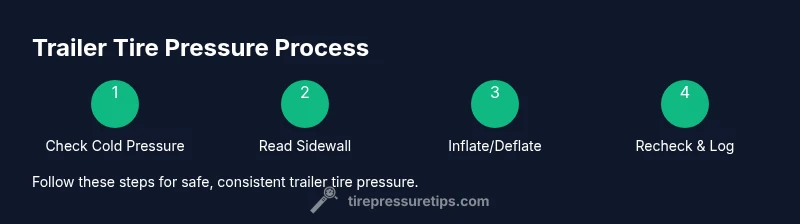
- Check tires when cold and before driving
- Read sidewall for max and target cold pressure
- Inflate/deflate in small increments and recheck
- Ensure dual tires on each axle are at the same pressure
- Record readings and load conditions for future trips
Tools & Materials
- Tire pressure gauge(Dial or digital; ensure accuracy and recalibrate periodically)
- Air compressor or access to an air pump(Prefer a stable, controllable air source)
- Trailer owner's manual or tire sidewall information(Know the recommended cold pressure for your tires)
- Wheel chocks(Chock wheels on both sides to prevent movement)
- Soap and water or leak detector(Check for slow leaks at valve stems and beads)
Steps
Estimated time: 40-60 minutes
- 1
Inspect tires and wheel condition
Visually inspect for cracks, bulges, or uneven wear. Check valve stems and wheels for damage before inflating. If you see anything suspicious, address it before proceeding.
Tip: Use a flashlight to catch hidden damage on the bead area. - 2
Locate target cold pressure
Read the tire sidewall and the trailer data plate to identify the recommended cold inflation pressure for each tire. Note any differences between axles or tire sizes.
Tip: If you’re unsure, start at the lower of the two recommended pressures and adjust after a test drive. - 3
Prepare and position the trailer
Park on a flat surface, engage parking brake, and place wheel chocks. Remove valve caps to expose the stems and avoid debris dropping in.
Tip: Chock both sides of the wheel to prevent roll-back during inflation. - 4
Check cold pressure with gauge
Attach the gauge to the valve stem and read the pressure when the tire is cold. Note the value for each tire; do not rely on a single reading.
Tip: Compare two consecutive readings to ensure gauge accuracy. - 5
Attach air and adjust gradually
If pressure is too low, add air in small increments (2-5 psi) and recheck after each increment. If too high, release air slowly and recheck. Do not overshoot the target.
Tip: Small adjustments prevent overshoot and reduce the need to re-measure. - 6
Recheck and balance dual tires
Recheck both tires on each axle to ensure equal pressure. Unequal pressures can cause sway and uneven wear during towing.
Tip: Use the same gauge and method for consistency. - 7
Check for leaks
Apply soapy water to valve stems and bead seats. Look for bubbles signaling leaks and address promptly.
Tip: If a leak persists, consider replacing the valve stem or reseating the bead. - 8
Document readings
Record the final pressures and the actual loaded weight if possible. Log changes for future trips and seasonal adjustments.
Tip: Keep the log with your trailer registration or maintenance binder.
Frequently Asked Questions
Why is tire pressure important for utility trailers?
Proper pressure maintains load stability, reduces heat buildup, and prolongs tire life. It also improves handling during towing. Always start with the manufacturer’s recommended cold pressure and adjust for load.
Proper pressure helps with stability and wear, and it improves towing handling.
Where do I find the right pressure for my trailer tires?
Look on the tire sidewall for the maximum pressure and the recommended cold pressure, and cross-check with your trailer’s weight rating and axle configuration. If in doubt, contact the tire manufacturer or check the data plate.
Check the sidewall and the trailer data plate for the correct pressure.
How often should I check trailer tire pressure?
Check cold pressure before each trip, and inspect tires regularly—ideally monthly or after long trips or temperature changes. Record readings to monitor drift.
Check before trips and keep a monthly inspection routine.
What tools do I need for checking and adjusting?
A reliable tire pressure gauge, an air source, wheel chocks, and access to the tire specifications. For dual tires, ensure both sides are at the same target pressure.
Gauge, air source, and chocks are essential.
Can TPMS help trailer tires?
Some trailers have TPMS, but many do not. If equipped, use it as a supplementary check, not a replacement for manual pressure testing.
TPMS can help, but manual checks are still essential.
What should I do if a tire regularly loses pressure?
Frequent loss may indicate a slow leak, bead seal issue, or damaged valve stem. Inspect, repair, or replace components as needed and recheck after repair.
If pressure keeps dropping, inspect for leaks and fix promptly.
Watch Video
What to Remember
- Check cold readings before every trip.
- Use the tire sidewall labeling to determine target pressure.
- Inflate/deflate in small increments and recheck.
- Inflate both tires on an axle to the same pressure.
- The Tire Pressure Tips team recommends keeping a maintenance log for accuracy and safety.