Camping Trailer Tire Pressure: A Practical Guide
Learn how to check, adjust, and maintain camping trailer tire pressure with practical steps. This guide covers cold vs hot pressure, TPMS use, and a repeatable pre-trip routine for safer camping trips.


You will learn how to safely check, adjust, and maintain camping trailer tire pressure. We cover how to determine the correct cold tire pressure for your trailer, how to use a tire pressure gauge and TPMS, how temperature and load affect pressure, and a step-by-step routine you can follow before every trip.
Why camping trailer tire pressure matters
According to Tire Pressure Tips, proper tire pressure for camping trailers directly affects safety, fuel efficiency, and tire wear. When you’re parked at a campground or headed to a remote site, properly inflated tires stabilize the trailer, improve handling, and reduce the risk of blowouts. Underinflation can cause increased rolling resistance and heat buildup, while overinflation can lead to a harsher ride and uneven tread wear. For trailers, the correct pressure depends on the axle load, tire size, and the trailer’s own weight. Always start by checking the cold-psi spec on the trailer placard or tire sidewall, then verify with ambient temperature and recent load changes. A simple, consistent routine beats guessing on the road and keeps you safer on long trips. This section sets the foundation for reliable, repeatable checks that you can perform anywhere your camping adventures take you.
Understanding cold vs hot tire pressure on camping trailers
Tire pressure is not a fixed value; it changes with temperature. Cold pressure is the reading you get when tires are at ambient temperature and have not been driven for at least three hours. After you drive, heat builds and pressure rises. If you check immediately after a drive, you risk overestimating the needed pressure. For camping trailers, plan to check and adjust when the tires are cold, ideally before departure or after a long rest. Also consider that the payload—water, gear, and supplies—adds weight and can lower the effective pressure you need. Inconsistent readings across axles can indicate a slow leak or a faulty valve stem; investigate promptly. Environmental changes, such as altitude or desert heat, can subtly alter readings over the day, so a quick recheck once you camp out can save trouble later.
How to determine the correct pressure for your trailer
Start with the trailer's placard on the hitch or inside a door. If no placard is present, refer to the tire sidewall for the maximum psi, but never go above your axle rating. Choose the lower pressure between the vehicle/axle rating and the tire’s maximum psi. Then adjust gradually using a reliable gauge and check again after a few minutes of stabilization. If you regularly tow in hot conditions or with heavy loads, re-check and adjust as needed. Document your target pressure in your trailer manual or a note in your phone so you don’t have to guess next trip. In practice, many trailers run a slightly higher cold pressure on dual-tire axles to balance load distribution; however, always verify with your own placard and the tire manufacturer’s guidance. These checks form the backbone of safe trailering and prevent premature tire wear or blowouts.
Tools and supplies for checking trailer tire pressure
Before you start, assemble a small kit that travels with you: a tire pressure gauge (dial or digital) with a wide range to accommodate larger trailer tires, a TPMS reader if your trailer has sensors, a portable air compressor or access to an air pump at a gas station, a log book or notes app to track readings, and a pen for marking adjustments. Soapy water can help reveal slow leaks around valve stems or bead seats. If you tow in variable conditions, include a small thermometer to log ambient temperatures during checks. With these tools, you can perform accurate checks quickly and repeatedly, which is essential for maintaining safe tire pressure on long camping trips.
Step-by-step quick checks you can perform before each trip
Before you hit the road, perform a short but thorough pre-trip check routine. This section lays out practical actions you can perform in sequence to reduce risk and maximize tire life. We’ll cover how to find the correct spec, how to read gauges accurately, and how to adjust with confidence.
Common mistakes and quick fixes
Common mistakes include inflating to the tire’s maximum rating without considering actual load, neglecting the spare tire, ignoring slow leaks detected by TPMS, failing to account for ambient temperature, and not rechecking after loading changes. Fixes include using the placard as the primary guide, verifying across both axles, and logging readings to review trends over time. Regular maintenance habits like checking pressure after a trailer swap or a seasonal shift keep your tires in good health and improve overall towing safety.
Tools & Materials
- Tire pressure gauge (dial or digital)(Choose a gauge designed for higher psi and larger trailer tires; verify accuracy before each use.)
- TPMS reader or dash display(Useful if your trailer is equipped; rely on a gauge if TPMS is unavailable or gives erratic readings.)
- Portable air compressor or access to air pump(Must deliver enough air for quick top-offs without overheating tires.)
- Trailer manual or placard with recommended psi(Use as the primary reference for target pressures per axle.)
- Logbook or notes app(Record target pressures and actual readings for trend tracking.)
- Soap and water for leaks(Helpful to identify slow leaks at valve stems or beads.)
- Marker and flashlight(Useful for labeling tires or inspecting in dim conditions.)
Steps
Estimated time: Estimated total time: 10-15 minutes.
- 1
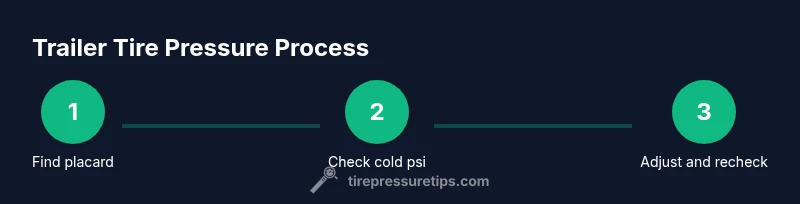
Find the recommended cold psi
Locate the placard on the hitch or inside a door. If you tow with dual tires, note whether the spec differs by axle. Record the recommended cold pressure for both axles. Reason: starting from the correct baseline prevents guesswork and under/over-inflation.
Tip: If two numbers are listed, default to the lower one to maintain a safety margin. - 2
Check tires when cold
Park in shade and wait at least 3 hours after driving. Cold readings ensure accuracy because heat expands air and skews results. If you can’t wait, note the difference and recheck later when cold.
Tip: Avoid checking after a long drive; hot tires overstate needed pressure. - 3
Attach gauge and read pressure
Remove valve caps, press the gauge onto the valve stem firmly, and take the reading. If you have dual tires, measure both tires on each axle and record the lower value as the target for safety.
Tip: Ensure the gauge seating is airtight to prevent false readings. - 4
Compare and adjust
If the reading is below target, add air in small increments (2–3 psi). Recheck after 1–2 minutes to settle. Do not exceed the placard or tire max rating.
Tip: Always inflate in small steps to avoid overinflation. - 5
Recheck after a brief rest
Let tires rest for 5–10 minutes after adjusting, then recheck. This confirms your pressure remains stable once the tire cools.
Tip: Check both axles again to ensure even pressure across the trailer. - 6
Document and monitor
Log the final pressure for each tire and the ambient temperature. Compare with future readings to catch leaks or slow changes early.
Tip: Keep the log accessible—near the hitch or in your towing app.
Frequently Asked Questions
How often should I check camping trailer tire pressure?
Check cold tire pressure before every trip and recheck after loading changes or temperature swings. Regular checks prevent underinflation or overinflation which can cause wear or blowouts.
Check cold tires before each trip and recheck after loading changes or temperature swings.
Can I rely on TPMS for trailer tires?
TPMS is helpful but not perfect; sensors can fail or lag. Always verify readings with a manual gauge.
TPMS helps, but always verify with a gauge.
What happens if I overinflate a camping trailer tire?
Overinflation can cause a harsher ride, reduced contact with the tread, and increased risk from road hazards. Stay at the placard recommendation.
Overinflating can be dangerous; follow the spec.
Should I adjust pressure for hot weather?
Heat raises pressure. Check when cold and adjust after long drives or hot days to maintain safe levels.
Heat raises pressure; recheck after driving.
Is it okay to inflate tires to the max psi?
No. The maximum psi listed on the sidewall is not a target; use the placard or axle spec as the guide.
No, don’t inflate to the max—follow the spec.
Watch Video
What to Remember
- Check cold psi before each trip.
- Follow placard and axle ratings for safety.
- Use a reliable gauge and TPMS when possible.
- Log readings to track changes over time.
- Avoid inflating to the max; stay within the recommended range.