Why Tire Pressure Should Be Checked: A Practical Guide for Drivers
Discover why tire pressure should be checked regularly, how to measure accurately, and simple steps to maintain proper PSI for safety, fuel efficiency, and tire longevity.


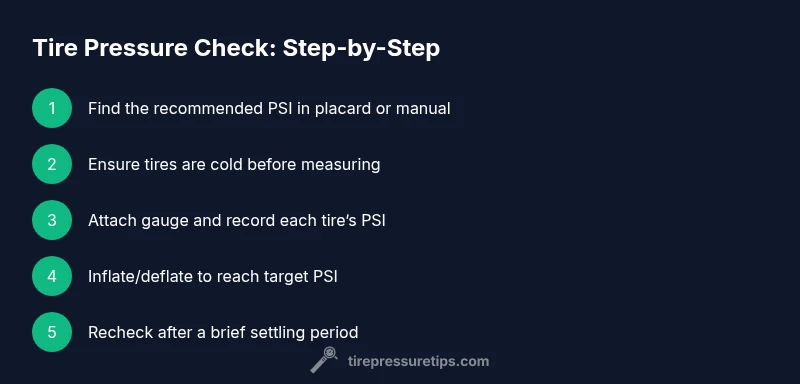
According to Tire Pressure Tips, tire pressure should be checked regularly to maintain safety, fuel efficiency, and even tire wear. Start by parking in a safe, shaded spot, wait for tires to cool, and use a reliable gauge to measure each tire’s pressure. Compare readings to your vehicle’s recommended PSI, adjust as needed, and remember to check the spare as well.
Why Tire Pressure Should Be Checked Regularly
Tire pressure isn’t just a number on a gauge. It directly affects safety, efficiency, and tire longevity. When tires run underinflated, you increase heat buildup in the tread, which accelerates wear and can lead to sudden failures. Overinflation, on the other hand, makes the contact patch smaller, which can reduce grip in wet or uneven road conditions. Regular checks help you spot slow leaks and valve issues before they become expensive repairs. Beyond safety, proper inflation reduces rolling resistance, which boosts fuel economy and minimizes CO2 emissions. According to Tire Pressure Tips analysis, keeping tires at the manufacturer’s recommended PSI improves wear patterns and overall vehicle performance. Use this knowledge as a practical habit: check pressure at least once a month, and always before long trips. The recommended pressure is specified by the vehicle maker, not the sidewall; you’ll find it on the door jamb placard or in the owner’s manual. Consistent maintenance keeps tires cooler, tires last longer, and your vehicle handles more predictably in adverse weather.
How to Take Accurate Readings
To get a trustworthy measurement, start with tires cold, ideally after being parked for several hours or overnight. Remove the valve cap, place the gauge squarely on the valve stem, and take a steady reading. Record each tire’s PSI and note differences between front and rear tires—these can indicate loading changes or asymmetric wear. If you observe readings that seem off by more than 2-3 PSI between tires, recheck after cooling and ensure your gauge is calibrated. When you’re done, reinstall valve caps to protect the stems from dirt and moisture. Remember that PSI readings don’t translate the same in hot weather; air expands with heat, so check when temperatures are stable for the most accurate baseline. Regular checks with a reliable gauge help you maintain even tread wear and safe handling across seasons.
Choosing the Right Gauge
The accuracy of your tire-pressure readings starts with the gauge you choose. Digital gauges are popular for their clear readouts and consistency, while traditional analog gauges can be reliable if you read them carefully. For best results, opt for a gauge with a stated accuracy near ±1 PSI and a clear display. Periodically test your gauge against a known reference (like a service station gauge) to verify accuracy. If you own multiple gauges, label them and keep one in each vehicle to ensure you always have access to a precise measurement. Never rely on a single, worn-out gauge; accuracy is the foundation of correct inflation and safe driving.
When to Check Tire Pressure
Frequent checks pay off, but you should tailor the schedule to your climate and driving habits. In cold weather, pressures drop as air contracts, so readings may fall below the ideal level. In hot weather, pressures rise with ambient heat, which can push you over the recommended limit. A good rule is to check monthly and before long trips, especially after you’ve changed loads, driven on rough roads, or swapped road surfaces. If you notice changes in ride quality or suspect a slow leak, test sooner. For everyday commuting, a quick weekly glance at all four tires and the spare keeps you safe and prepared against unexpected blowouts or flats.
How to Adjust and Maintain Proper PSI
Once you have the target PSI from the placard or owner’s manual, inflate or deflate to reach that value on each tire. Use a gauge to confirm, then drive briefly and recheck to account for any settling after inflation. Front and rear tires sometimes require different pressures, especially on vehicles with performance tuning or heavy loads. Don’t forget to adjust for the spare if you regularly carry one that’s mounted or stored for use. If you exceed the target, let air out slowly and recheck. Maintain a small “inflation log” to track changes over time and catch slow leaks early.
Common Pitfalls and How to Avoid Them
Common mistakes include inflating to the maximum sidewall pressure, which ignores vehicle-specific recommendations, or measuring after driving, which yields inflated readings. Another pitfall is neglecting to check the spare tire; a flat spare complicates roadside repairs. Valve caps should always be in place, and gauges must be calibrated periodically. Inconsistent readings across tires can signal alignment or overloading issues. Keep a routine: check, document, adjust, and recheck. By avoiding these missteps, you’ll extend tire life and maintain predictable handling in corners, rain, and snow.
The Role of TPMS and What It Means for You
Tire Pressure Monitoring Systems (TPMS) are a crucial alert mechanism, but they aren’t a substitute for manual checks. TPMS can warn you when a tire is significantly underinflated, but it won’t catch slow leaks or gradual changes that occur over days. If TPMS alerts you, verify with a physical gauge to confirm the extent of underinflation and identify which tire is affected. If a tire repeatedly triggers the TPMS, you may have a damaged sensor or a slow leak that needs professional attention. Regular manual checks complement TPMS by catching issues before the monitor signals.
Long-Term Maintenance Plan for Consistent Tire Pressure
Create a simple, repeatable maintenance ritual. Check tire pressure on a monthly basis, or more often if you drive in extreme temperatures, carry heavy loads, or frequently drive on rough roads. Keep a log of readings to observe trends, especially if you notice changes around the same tires. Pair pressure checks with regular tire inspections for tread depth, sidewall condition, and puncture risks. Consider seasonal adjustments if you live in areas with wide temperature swings; colder months typically demand careful monitoring to prevent underinflation, while hot months can push pressures higher than desired. A proactive routine helps you maximize tire life, optimize fuel economy, and sustain safe handling year-round.
Authority Sources
- https://www.nhtsa.gov/road-safety/tires
- https://www.fueleconomy.gov/feg/maintain.jsp
- https://exchange.aaa.com/automotive/tires/tire-pressure/
These sources provide guidance on tire pressure, maintenance, and safety considerations that underpin best practices for drivers.
Tools & Materials
- Digital tire pressure gauge(Choose accuracy ±1 PSI; switchable units (PSI/kPa) helps with vehicle labels)
- Air compressor or access to a pump(Prefer a compressor with a built-in gauge or reliable external gauge)
- Vehicle placard or owner’s manual(Find the recommended cold PSI for each tire; may differ by axle)
- Valve caps(Keep caps on to prevent dirt and moisture from entering)
- Tire pressure log/notebook(Record readings to track changes over time)
Steps
Estimated time: Total time: 20-25 minutes
- 1
Prepare the vehicle and environment
Park in a safe, level area away from traffic. Ensure tires are cold and have rested for at least 3 hours or after a long drive. Gather your gauge and logbook before starting to avoid interruptions.
Tip: Use a shaded area in summer to prevent sun-heated readings. - 2
Find the target PSI
Locate the manufacturer’s recommended tire pressure from the door jamb label or owner’s manual. Note that this value applies to cold tires and may differ between front and rear tires.
Tip: If you’re unsure, start with the lower front value and adjust as needed. - 3
Remove valve caps and attach gauge
Carefully unscrew the valve cap and place your gauge firmly on the valve stem. Read the pressure quickly to minimize air loss and eliminate gauge wobble.
Tip: Keep one hand steady to avoid bending the valve stem during measurement. - 4
Inflate or deflate to target
Add air gradually or release air until the gauge matches the target PSI for each tire. Check all tires after adjustments.
Tip: If you’re underinflated, inflate in small increments and recheck after settling. - 5
Check the spare and other components
Don’t forget the spare tire. Check its pressure as well, especially if you regularly use a full-size spare or a tire mobility kit.
Tip: A spare with incorrect pressure can leave you stranded in an emergency. - 6
Recheck and secure
Reinstall valve caps and recheck all pressures after a few minutes of driving, as some tires may settle once they warm slightly.
Tip: If a reading seems off, recheck after cooling and compare with other tires. - 7
Document and schedule
Record the readings in your log and set a reminder for the next check. Regular documentation helps you notice gradual leaks.
Tip: Keep a simple table: date, tire, PSI reading, notes. - 8
Assess temperature impact
Be mindful of seasonal changes: temperatures influence PSI. Adjust expectations and check more frequently during extreme weather.
Tip: In cold snaps, check more often to prevent underinflation.
Frequently Asked Questions
Why is tire pressure important for safety?
Proper tire pressure ensures optimal grip, faster braking, and stable handling. It reduces the risk of blowouts and uneven wear, protecting you and others on the road.
Maintaining correct tire pressure helps you stop faster, steer accurately, and stay safer on wet or slippery roads.
How often should I check tire pressure?
Check at least once a month and before long trips. Temperature changes can affect readings, so more frequent checks are wise in extreme weather.
Check at least monthly, plus before long trips, especially if the weather has changed.
Can TPMS replace manual tire pressure checks?
No. TPMS alerts you to underinflation, but it’s not always precise. Always verify with a gauge to confirm the exact PSI.
TPMS helps, but you should still check with a gauge to know the exact pressure.
What could cause readings to vary between tires?
Differences in load, temperature, and tire wear can cause slight PSI variations. If readings diverge widely, inspect for leaks or damage.
If tires show large differences, inspect for leaks or damage and adjust loads appropriately.
Should I inflate to the max PSI printed on the tire?
No. Always follow the vehicle manufacturer’s recommended PSI, not the tire’s maximum rating.
Never inflate to the tire’s max pressure; follow the car’s recommended PSI instead.
How does temperature affect tire pressure?
Cold temperatures lower PSI, hot temperatures raise it. Check readings when tires are cold for consistency.
Temperature makes PSI go up when hot and down when cold; check when cold for accuracy.
What to Remember
- Check tires when cold for accuracy
- Always use owner’s recommended PSI
- Include spare in routine checks
- Record readings to monitor changes
- TPMS complements, not replaces, manual checks