Tire Pressure 265/75r16: Practical Inflation Guide
Learn how to check, set, and maintain tire pressure for 265/75r16 tires with practical steps, TPMS insights, and seasonal tips. Written by Tire Pressure Tips for safe driving and optimal wear.


With this guide, you’ll learn to check and adjust tire pressure for 265/75r16 tires accurately, using your vehicle’s specified cold pressure, a reliable gauge, and an inflator. We cover TPMS behavior, temperature effects, and safe inflation practices—so you can improve safety, fuel efficiency, and tire wear. This article is practical, not theoretical.
Why tire pressure 265/75r16 matters
The 265/75r16 size is a common specification for light trucks and sport-utility vehicles, providing a balance of load capacity and on-road comfort. When you maintain correct tire pressure for this size, you improve handling, braking response, and tire life, while also preserving fuel economy. Underinflation causes the tire to flex more at the sidewalls, generating heat and uneven wear, which can shorten the tire’s life and increase the risk of a blowout under load. Overinflation reduces the tire’s contact patch with the road, worsening ride quality and increasing wear in the center tread. For tire pressure 265/75r16, the right target depends on your vehicle and typical payload, not simply the tire size. According to Tire Pressure Tips, starting with the vehicle manufacturer’s specification is the best path to accuracy and safety. In 2026, drivers who routinely check pressure see more consistent wear patterns and better fuel economy over the tire life cycle.
How to locate the correct inflation specification for 265/75r16
Your tire pressure target is not the maximum sidewall number; it’s the specification found in your owner's manual or on the door jamb placard. The placard lists front and rear cold pressures tailored to normal load. If you regularly drive with a heavy payload, tow a trailer, or carry frequent passengers, the numbers may shift upward. Always avoid inflating to the sidewall maximum; the maximum is a limit, not a recommended operating pressure. For the 265/75r16 family, you’ll typically see separate front and rear targets, and some manufacturers provide different values when the vehicle is fully loaded. The key is to honor the official spec for your exact vehicle and tire combination. If the placard is missing or faded, consult the owner’s manual or your trusted tire shop. Remember: cold pressure is measured after the vehicle has been stationary for several hours or overnight, not after a drive, to reflect accurate load-bearing capacity.
Using a gauge correctly: a practical measurement guide
Take readings when tires are cold and the vehicle has not been driven for several hours. Remove the valve cap, press the gauge onto the valve stem firmly, and read the pressure without wiggling the gauge. If you use a dial gauge, hold it steady until the needle settles; if digital, pause briefly to capture the display. Compare the result to the target pressure on the placard; if it’s low, add air in small increments (2–3 psi at a time) and recheck. If it’s high, release air gradually by pressing the core with the gauge or using the tire valve stem tool. After inflation, recheck both front and rear tires to confirm consistency. When you’re done, recap the valve stem with a new cap to protect the stem from dirt and moisture. For optimal accuracy, measure only when the tire is cold and the ambient temperature is stable. Some drivers find it helpful to record pressures in a notebook for ongoing monitoring. In practical terms, check pressures monthly or before long trips, especially in cold weather when the readings can dip.
TPMS: understanding sensors with 265/75r16
Tire Pressure Monitoring Systems (TPMS) provide a convenient alert if pressure drops significantly below the vehicle’s target. However, TPMS readings are not a substitute for manual checks. A TPMS warning can be triggered by temperature changes, a slow leak, or a sensor fault, and it won’t tell you the exact psi. Regular manual checks help you verify whether the TPMS reading matches the actual pressure. If you notice a discrepancy, inspect the valve stem, punctures, or wheel rim for damage and consider a TPMS reset or sensor service. In some vehicles, the TPMS may require a relearn procedure after tire service or rotation; consult the manual for the correct steps. The goal is to use TPMS as an early warning, while relying on direct gauge measurements for precise inflation.
Common mistakes and how to avoid them
Common errors include inflating or deflating after a drive (readings will be high when tires are hot), using the wrong gauge, ignoring the placard in favor of sidewall numbers, and inflating to the tire’s maximum rating rather than the recommended cold pressure. Another frequent mistake is neglecting the spare tire—if you carry a full-size spare, check its pressure too, especially on older vehicles. Finally, never assume all 265/75r16 tires share the same target; different vehicle configurations, trim levels, or aftermarket wheels may shift the recommended pressures. To avoid these pitfalls, develop a simple, repeatable routine: check cold, use a reliable gauge, inflate to the specified cold pressure, recheck, and document the results for future reference.
Seasonal and load variations: tailoring 265/75r16 pressures
Temperature and load drive changes in tire pressure. In colder weather, pressures dip, while summer heat can push readings higher. If you routinely carry heavy loads, you may need higher pressures to maintain a balanced contact patch. When you replace tires or change wheel sizes, revisit the placard value, because even the same tire size on a different vehicle can have different recommended pressures. For anyone who wants predictable handling year-round, the best practice is to check pressures at every significant seasonal transition and before long road trips, adjusting as your load and speed requirements change. The underlying rule stays simple: follow the manufacturer’s specification and verify with a gauge rather than guessing.
Additional context for 265/75r16 enthusiasts
If your vehicle is commonly used for off-road duty or towing, you may observe slightly different front and rear pressures; this supports improved stability when the vehicle is carrying a load or navigating uneven surfaces. When adjusting pressures, keep an eye on the tire wear patterns: underinflation wears the outer edges more, while overinflation tends to wear down the center tread. For regular street driving with 265/75r16 tires, maintain a consistent pattern that matches the placard and your typical load. Regular checks, especially after a long trip or a period of extreme weather, help you catch slow leaks early and keep your vehicle performing as designed.
Tools & Materials
- Tire pressure gauge (dial or digital)(Choose a gauge you can read easily and calibrate periodically for accuracy)
- Inflation source (air compressor or gas station pump)(Ensure it’s capable of precise small adjustments; 2–3 psi increments are ideal)
- Vehicle owner's manual or door jamb placard(Shows the official cold pressure target for front and rear tires)
- Notebook or device to log readings(Helpful for tracking changes over time and under different loads)
- Valve stem caps and lint-free cloth(Keep stems clean and capped to avoid contamination)
Steps
Estimated time: Estimated total time: 15-25 minutes
- 1
Prepare your tools and vehicle
Park on a level surface and let the tires cool for at least 3 hours if possible. Gather your gauge, inflator, and the placard or manual. This ensures readings won’t be skewed by recent driving heat.
Tip: Having the vehicle warmed up can give falsely high readings; always measure cold tire pressures. - 2
Find the correct pressure specification
Locate the recommended cold pressures for front and rear on the door placard or in the owner’s manual. If you tow or carry heavy loads, note any higher target values for the rear tires and adjust accordingly.
Tip: Never use the tire sidewall maximum as your operating pressure; it’s a limit, not a target. - 3
Check cold tire pressure with a gauge
Remove the valve cap and firmly press the gauge onto the valve stem. Read the pressure, ensuring the gauge settles before recording. Mark readings if you’re tracking changes over time.
Tip: Take multiple readings from the same tire to confirm accuracy. - 4
Inflate or deflate to target pressure
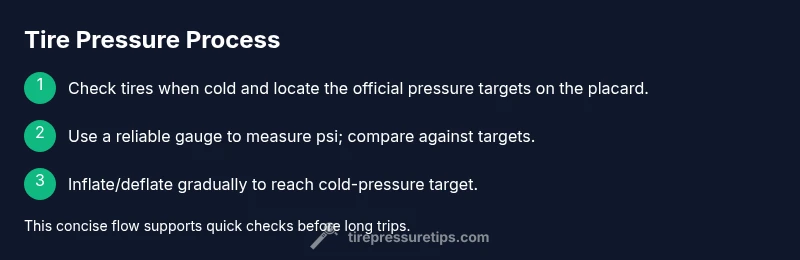
If below target, add air in small increments (2–3 psi), then recheck. If above target, release air gradually and recheck. Repeat until you reach the exact cold pressure specified.
Tip: Do not rush; small adjustments prevent overshoot and reduce the need for rework. - 5
Recheck front, rear, and spare as needed
Verify all relevant tires meet their targets. If you regularly carry heavy loads or drive with a full spare, check the spare’s pressure too.
Tip: Inconsistent readings across tires can indicate a leakage or valve issue; inspect if discrepancies persist. - 6
Document and monitor
Log the date, tire sizes, and pressure targets. Recheck periodically, particularly after temperature swings or long trips.
Tip: Maintaining a simple log helps reveal gradual leaks or sensor issues before they become problems.
Frequently Asked Questions
What is the recommended cold tire pressure for 265/75r16 tires?
The exact pressure depends on your vehicle and load. Look up the door placard or owner's manual for the official cold-presser values for your front and rear tires. Do not rely on the tire size alone. This ensures safe handling and even wear.
Check the door placard for the exact cold pressures for your 265/75r16 tires; use the manual if the placard is missing.
Does TPMS replace manual tire pressure checks?
No. TPMS provides alerts when pressure drops, but it doesn’t give a precise psi reading. You should still verify pressures with a gauge regularly.
TPMS helps, but you still need to measure tire pressure with a gauge for accuracy.
How does temperature affect tire pressure?
Temperature changes influence pressure; colder weather lowers psi, while heat raises it. Always measure when tires are cold to avoid reading errors, and adjust as seasons change.
Temperature changes can shift readings; measure cold and recheck after temperature swings.
Can I inflate to the maximum sidewall pressure?
Inflating to the maximum listed on the sidewall is not recommended unless the placard specifies it for your vehicle. Use the manufacturer’s target pressure for safety and even wear.
Only inflate to the placard-specified pressure, not the sidewall maximum.
What if the TPMS light stays on after inflation?
If the light remains on after adjusting pressures, you may have a TPMS sensor fault or a leak. Have the system inspected by a professional.
If the light won’t go away after inflating, seek a sensor check.
Is it okay to rotate pressures for a spare tire?
Yes, check and maintain the spare at a safe, similar level if you carry a full-size spare. Reference the placard and adjust for any differences in load or use.
Check the spare’s pressure too if you carry one, and match it to your typical usage.
Watch Video
What to Remember
- Check the official cold pressure on the placard.
- Use a reliable gauge and inflate in small increments.
- Do not exceed the vehicle’s recommended pressures.
- TPMS aids monitoring but isn’t a substitute for measurement.
- Log readings to track changes over time.