Motor Tyre Pressure Guide: Check, Adjust & Maintain
Learn how to check and maintain motor tyre pressure for safety, fuel efficiency, and longer tire life. This comprehensive guide covers targets, tools, step-by-step actions, and TPMS considerations for consistent performance.


By the end of this guide you will be able to check, adjust, and maintain motor tyre pressure accurately, using a reliable gauge and your vehicle’s recommended targets. You’ll learn where to find the correct PSI, how temperature affects readings, and how to prevent under- or overinflation to improve safety and fuel efficiency.
Understanding motor tyre pressure
Motor tyre pressure refers to the air pressure inside each tire, measured in psi (pounds per square inch) or kPa. For most passenger cars, you will have separate targets for the front and rear tires. Maintaining the recommended pressure improves steering, braking, fuel efficiency, and tire wear. According to Tire Pressure Tips, understanding motor tyre pressure is the foundation of safe driving and predictable handling. Always refer to your vehicle manual and the placard on the driver’s door jamb to confirm the exact numbers.
Why correct tyre pressure matters for motor vehicles
When tires are underinflated, the contact patch becomes larger, heat builds, and rolling resistance rises, which can reduce fuel economy and shorten tire life. Overinflation makes the tire stiffer and reduces grip on wet surfaces. The Tire Pressure Tips team notes that correct pressure supports steady steering response and even tread wear, while helping TPMS readings stay accurate. Maintaining proper pressure also reduces uneven wear patterns and can improve braking performance.
How to find the right tyre pressure for your car
Your vehicle’s recommended pressures are not the same for every model. Start with the placard on the driver’s door jamb or the owner’s manual. Front and rear tires often have different targets. If you have a spare tire, some cars specify a pressure for the spare as well. Always use cold tires for measurement. If you drive long distances, recheck after your trip, since heat can temporarily raise pressure readings.
Tools and methods to check tyre pressure accurately
A reliable tire pressure gauge is essential. Digital gauges are easy to read; analog gauges work well if you can see the scale clearly. Use an air compressor at home or at a service station to adjust pressure. TPMS is a helpful alert system, but it does not replace manual measurement. The Tire Pressure Tips analysis emphasizes using a calibrated gauge for consistent results. Keep the gauge clean and store it in a dry place.
Step-by-step quick overview
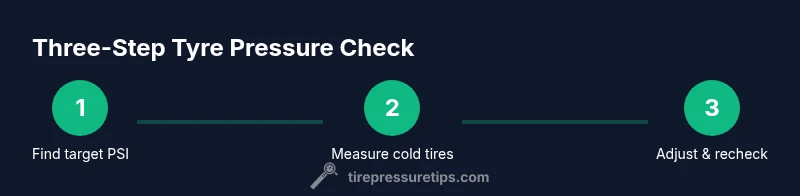
Pull over on level ground, ensure tires are cold, and have your owner’s manual or door placard handy to confirm the target PSI. Use a gauge to read each tire, then inflate or deflate to the recommended level. Recheck after adjustment and reinstall valve caps. For the spare, follow the same practice if it will be used in an emergency. This overview complements the detailed steps that follow.
Tire pressure and temperature changes
Air pressure in tires changes with temperature. Colder mornings tend to reduce PSI, while driving heat can raise it. Seasonal changes, altitude, and even geography can influence readings. Inconsistent readings often come from measuring after driving or in extreme temperatures. Make a habit of checking when tires are cold to get the most accurate result.
Common myths vs facts about motor tyre pressure
Myth: Nitrogen is always better than air. Fact: Nitrogen provides stable pressure but offers no universal safety advantage for typical passenger cars. Myth: TPMS alone guarantees safe performance. Fact: TPMS helps monitoring but should be complemented by manual checks with a gauge. Myth: All tires share the same target pressure. Fact: Front and rear pressures can differ by model and load, so verify the placard.
How to maintain consistent pressure over time
Set a reminder to check tyre pressure monthly and before long trips. Always carry a portable gauge and calibrate it periodically. Temperature awareness matters: morning checks are most reliable in many climates. When you rotate tires, verify that the pressures stay within the target range for each axle. Tire care also includes inspecting for leaks, punctures, and valve stem condition.
Quick troubleshooting: TPMS light and low-pressure symptoms
If the TPMS warning lights up, check all four tires as soon as possible, starting with the tires that show visual signs of wear or underinflation. If readings are inconsistent with the placard, recheck after cooling and consider a professional calibration if readings remain off. A stubborn TPMS light could indicate a faulty sensor or a slow leak.
Tools & Materials
- Tire pressure gauge (digital or analog)(Calibrated; read in psi or kPa; keep in good condition)
- Air compressor or service station air pump(Use to adjust pressure; ensure it has a proper nozzle and regulator)
- Vehicle owner’s manual or door placard(Contains the exact recommended psi per axle)
- Valve cap removal tool or clean cloth(Keep caps clean to prevent leaks)
- Notebook or digital device to record pressures(Helpful for tracking changes over time)
Steps
Estimated time: 30-45 minutes
- 1
Prepare and verify cold tires
Park on level ground and turn off the engine. Wait for tires to cool (at least 3 hours after driving) to avoid inflated readings. Gather your placard or manual and your gauge.
Tip: Waiting for cold tires improves accuracy; recording the room temperature can help compare readings later. - 2
Find the correct pressure targets
Locate the recommended PSI for front and rear tires on the door placard or in the owner’s manual. Note if there are separate targets for different axle loads or tire sizes.
Tip: Double-check if a spare tire has a listed pressure and include it in your notes. - 3
Remove valve caps
Carefully unscrew the valve cap and set it aside in a clean, dry spot. Check the valve stem for damage before measuring.
Tip: Keep caps clean; a dirty valve cap can contaminate readings and cause leaks. - 4
Attach gauge and read
Firmly press the gauge onto the valve, then read the pressure without bending down awkwardly. Record each tire’s reading and compare with the target.
Tip: Read at eye level for accuracy; if the gauge is slow to respond, re-seat and read again. - 5
Inflate or deflate to target
If low, add air in small increments and recheck after each addition. If high, release air gradually until the target is reached. Repeat for all tires.
Tip: Avoid overinflation; small adjustments make big differences in handling. - 6
Reassemble and confirm
Replace valve caps securely and recheck all tires. Record the final readings and note any tires that require more frequent monitoring.
Tip: Recheck after a short drive to ensure the pressure remains stable.
Frequently Asked Questions
Why should I check tyre pressure when tyres are cold?
Cold tires provide the most accurate readings because heat from driving temporarily increases PSI. Checking cold helps you set the correct target and avoid overinflation.
Check tires when cold for accurate readings and safer inflation levels.
What if the TPMS light stays on after inflating to the target?
A persistent TPMS light could indicate a sensor issue or a slow leak. If readings are inconsistent with the placard after inflation, have the system inspected by a qualified technician.
If the TPMS light remains on after inflation, it may signal a sensor problem or leak; get it checked.
Is nitrogen better than air for tyre pressure?
Nitrogen can reduce small pressure changes due to temperature, but for everyday driving the benefit is minimal. Using regular air and maintaining correct pressure is typically sufficient.
Nitrogen offers a small consistency benefit, but regular air with correct pressure is usually enough.
Should front and rear pressures be different?
Yes. Many cars have different targets for front and rear tires due to weight distribution and handling characteristics. Always follow the placard or manual for each axle.
Front and rear pressures can differ; follow the car’s manufacturer targets.
How often should I check tyre pressure?
Check at least monthly and before long trips. Inspect tires for signs of wear, damage, or slow leaks during each check.
Check monthly and before trips to maintain safe, efficient tires.
Watch Video
What to Remember
- Know your vehicle’s recommended PSI from placard or manual
- Check cold tires for accuracy
- Use a calibrated gauge for reliable readings
- Inflate/deflate gradually to avoid overinflation
- Schedule regular checks and document changes