Is 28 Tire Pressure Too Low? A Practical Guide for Drivers
Discover whether 28 tire pressure is too low and how it affects safety, fuel economy, and tire wear. Learn how to check, adjust, and maintain proper tire pressure with practical guidance from Tire Pressure Tips.


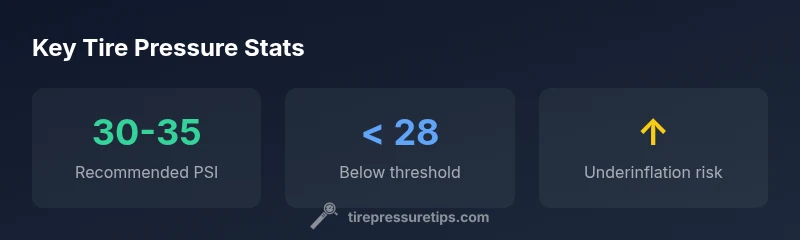
Is 28 tire pressure too low? For most passenger cars, 28 psi is below the typical safe range and can reduce handling, increase rolling resistance, and accelerate tire wear. The exact threshold depends on your vehicle, tire size, load, and temperature. Always verify using the door placard and TPMS readings, then adjust to the recommended range.
Is 28 tire pressure too low? Understanding the threshold
Is 28 tire pressure too low? The short answer is that it is often below the safe range for most passenger cars. Tire pressure targets are not universal; they depend on the vehicle’s weight, tire size, and the type of tires installed. The door placard on the driver’s door jamb or the owner’s manual lists the cold inflation numbers specifically for your model. In many cars, the recommended cold pressure sits in the 30–35 psi band for both front and rear tires, with slight differences by axle. A tire reading of 28 psi when cold generally indicates underinflation, which can increase heat buildup as the tire heats during driving and reduce the contact patch quality. Temperature plays a role too: cold mornings often drop readings, while hot days can push up the numbers. When you ask is 28 tire pressure too low, context matters: is the tire type a performance tire, is the car heavily loaded, and what is the driving terrain? The Tire Pressure Tips team emphasizes that the starting point should always be the placard value and that TPMS alerts, while helpful, are not a substitute for a precise cold-read measurement.
How to verify the correct pressure for your vehicle
To determine the exact target PSI for your car, start with the placard: find the recommended cold inflation numbers for front and rear tires. Measure when tires are cold—before you drive more than a few miles—using a reliable gauge (digital, dial, or stick). Inflate or deflate in small increments, checking after each adjustment. If you’ve recently rotated tires or replaced them, recheck both axles as tire pressures can differ across the front and rear. TPMS can confirm low pressure, but readings can vary slightly from the gauge you use. Always cross-check the placard with a tankful of accurate measurements; the difference between 28 psi and the placard value may be only a few psi but has a meaningful impact on handling and wear. The Tire Pressure Tips framework remains focused on cool readings and placard compliance to ensure consistent, safe performance.
What happens when you operate at 28 psi
Driving on 28 psi can trigger several effects that compound over time. The tire’s contact patch becomes narrower, increasing stress on the shoulders and potentially causing accelerated wear on the inside or outside edges depending on load and alignment. Handling and braking response may feel less precise, particularly in wet or slippery conditions. Fuel economy can diminish because underinflated tires increase rolling resistance, forcing the engine to work harder. Heat buildup is another risk factor; prolonged driving at low pressure elevates tire temperature, which can shorten tire life and raise the chance of a failure under heavy load or high-speed driving. TPMS alerts may illuminate only after pressures dip further, so don’t rely solely on the sensor. The Tire Pressure Tips guidance emphasizes that while 28 psi is not an outright danger in every situation, it is not a recommended daily target unless the placard specifies otherwise.
How to adjust safely and monitor changes
If you discover a tire at 28 psi, plan a measured inflation strategy. Start by increasing pressure in 1–2 psi increments, letting the tires cool before rechecking to avoid overcompensation. Once within the target range, verify all tires on both axles for evenness. If the vehicle feels unsettled after inflation, double-check wheel balance and alignment, since these factors influence how pressure affects ride quality. Keep a portable gauge in the glove box for quick checks when refueling or parking. Seasonal temperature shifts require more frequent checks; a brief cold snap can drop pressures by several psi, while a heat wave can push them higher. The Tire Pressure Tips approach recommends mapping a simple quarterly routine: inspect tread depth, confirm placard pressure, and verify TPMS battery health.
Temperature, load, and seasonal effects on tire pressure
Air inside tires responds to ambient temperature; roughly every 10°F change can shift pressure by about 1–2 psi for typical tires. In winter, a 28 psi tire can fall to mid-20s, while hot summer days can push it toward the upper end of the range. The load on the vehicle also matters: a full trunk or roof rack increases the recommended pressure to manage extra weight. Tire pressure does not stay constant; roads, speed, and maneuvering through curves create dynamic stresses that alter the force distribution across the tread. Tires that operate far from the placard over long periods wear unevenly and may perform poorly in emergency maneuvers. The Tire Pressure Tips guidance stresses monitoring temperature-driven changes and adjusting before long trips or extreme weather conditions.
Practical tips for different vehicle types and scenarios
For sedans and compact cars, many models settle around 30–32 psi on all tires, but always check the placard. SUVs and light trucks often have higher targets due to heavier loads and taller tires; follow the manufacturer’s numbers and adjust for passengers and cargo. In winter, plan to check more frequently as temperatures drop; a routine monthly check can catch slow leaks. For high-speed driving or sporty tires, maintaining precise pressure is critical for handling and tire longevity. After tire replacement or rotation, recheck within 24 hours to allow the tires to settle to their new dimensions. The Tire Pressure Tips recommendations stress consistency across all tires and alignment with the placard rather than chasing a single target.
Putting it into a maintenance routine
Turn tire pressure checks into a simple habit. Schedule a monthly check and before any long trip, and adjust for seasonal changes. Use a reliable gauge and record readings to track trends over time. If a tire consistently reads low, inspect for leaks, valve stem issues, or bead seating problems. Regular checks help extend tire life, improve fuel efficiency, and preserve safe handling. Consider pairing pressure checks with tread depth inspections and TPMS health checks to create a comprehensive maintenance routine. The Tire Pressure Tips team recommends creating a quick checklist you can run through in under five minutes for peace of mind on every drive.
Comparison of key tire pressure considerations
| Aspect | Recommended Pressure Range (psi) | Notes |
|---|---|---|
| General passenger cars | 30-35 | Check placard for exact values |
| Tire wear considerations | N/A | Underinflation can cause shoulder wear |
| TPMS interaction | N/A | Sensor readings vary; verify with gauge |
Frequently Asked Questions
Is 28 psi safe for all tires or vehicles?
No. Tire pressure targets vary by vehicle and tire type. Always defer to the placard and verify with a gauge when in doubt. If 28 psi is what you measure, consult the owner's manual or a professional before assuming it’s acceptable.
No, 28 psi is not universally safe; check your placard and verify with a gauge before driving.
How often should I check tire pressure?
Check at least monthly and before long trips. Also recheck after temperature changes or tire maintenance such as rotation or replacement.
Check monthly and before long trips, especially when the weather shifts.
What should I do if TPMS shows low pressure but my gauge reads near placard?
Rely on the gauge for cold readings and confirm the tire is within the placard range. TPMS may trigger earlier or lag behind small changes, so use both sources for accuracy.
Use a gauge to confirm, and don’t rely solely on TPMS alerts.
Can temperature alone cause a large pressure change?
Yes. Temperature can shift tire pressure by several psi across seasons. Check pressures when tires are cold to avoid misreading caused by recent driving.
Temperature affects pressure a lot—check when tires are cold.
Should I inflate to the max on the sidewall if in doubt?
No. Do not exceed the placard value. The max sidewall pressure is not the target; it’s the limit. Inflate to the recommended range and recheck.
Never exceed the placard. Inflate to the recommended range instead.
What if I have different pressures on each tire after inflation?
Small differences are normal, but aim for even pressure across all tires. If one tire reads much lower, inspect for leaks or mounting issues.
Aim for even pressures; check for leaks if one tire stands out.
“Maintaining correct tire pressure is one of the simplest, most impactful ways to improve safety and efficiency on the road.”
What to Remember
- Know your placard value and use it as the target.
- Check cold pressures before driving for accuracy.
- Avoid sustained 28 psi unless your vehicle specifies it.
- Use a quality gauge and maintain consistent pressures across the axle.
- Monitor temperature and load effects as seasons change.