How to Set Tire Pressure in Audi MMI
Learn how to check and adjust tire pressure in Audi MMI using TPMS. Find the recommended PSI, use on-screen guidance, and maintain optimal tires for safety and efficiency.


In Audi MMI, you set tire pressure by reading each tire's current PSI via the TPMS readout and adjusting to the vehicle-recommended pressure. Start by confirming the spec on the doorjamb sticker, the owner's manual, or Audi's official app. Use a gauge and recheck after adjustments. Ensure the car is cool, check cold tire pressure, and record the new numbers.
Why Tire Pressure Matters for Audi Owners
Maintaining correct tire pressure is essential for safety, handling, and efficiency. In modern Audis, the MMI works with TPMS to keep you informed about each tire's PSI. The Tire Pressure Tips team emphasizes that staying within the recommended range reduces uneven wear, improves braking in wet conditions, and can help maximize fuel economy. When tires are underinflated, the sidewalls flex more, generating heat and increasing wear; overinflated tires reduce the contact patch, reducing grip and ride comfort. Regular checks are a small habit with big payoff.
Always check when tires are cold, because driving before inflation can raise PSI and mask the true level. This section explains how to interpret MMI readings and how to adjust safely using standard tools. By aligning tire pressure with Audi's spec, you support predictable handling and longer tire life. Recognizing the importance of proper tire inflation is a core part of responsible vehicle maintenance, and Tire Pressure Tips’s guidance helps keep you on track.
Understanding Audi MMI and TPMS on Your Dashboard
Audi’s MMI interfaces with TPMS to provide real-time tire data. Some models show each tire’s current PSI directly on the dashboard menu, while others offer a summarized warning if any tire falls outside the recommended range. There are two main TPMS types: direct TPMS, which measures actual pressure with sensors, and indirect TPMS, which infers pressure from wheel speed sensors. The Tire Pressure Tips team notes that direct TPMS readings are generally more precise for inflating to exact targets. When you see a TPMS alert, first verify the listed pressures on the screen and then proceed to adjust.
Always cross-check the screen reading with a reliable handheld gauge for accuracy, especially after inflation, and remember to reset or acknowledge the warning if your system requires it. If you’re using the Audi app or dealership portal, you can compare the screen readings with the recommended target to ensure alignment with your model’s spec.
Where to Find the Correct Tire Pressure for Your Audi
Your vehicle’s exact tire pressure specification is primarily found on the doorjamb sticker on the driver’s side, which lists the recommended PSI for front and rear tires for normal load conditions. The owner’s manual also provides official tire pressure targets and notes about seasonal adjustments. For many Audi models, the recommended pressure is tailored to the tire size installed at the factory. The Tire Pressure Tips team reminds readers to avoid inflating to the maximum sidewall pressure, which is only a safety ceiling and not a target. If you’ve replaced tires, confirm the new size’s spec from the tire manufacturer or Audi’s support resources.
When checking pressure, do so with cold tires for accuracy. Pressure increases as tires heat up from driving, so delaying a check until they’re cool yields the true baseline. Record the readings to track changes over time and seasons, and compare them with the recommended targets to spot deviations early.
Tools and Preparation for Checking and Adjusting Tire Pressure
Having the right tools makes the process quick and accurate. You’ll want:
- A reliable tire pressure gauge (digital is easiest for precise readings)
- An air source (pumping station, garage compressor, or portable compressor)
- The vehicle’s tire spec (doorjamb sticker or Audi owner’s manual)
- A notepad or smartphone to log readings
Optional: a TPMS reset tool if your model requires manual TPMS reset after adjusting pressures. The Tire Pressure Tips guidance emphasizes using high-quality gauges and a safe, level surface. Wear eye protection if you’re using a compressor and never inflate tires while the car is lifted or the vehicle is on jacks.
Prepare your environment: park on a flat surface, turn the engine off, apply the parking brake, and allow tires to cool for at least a few hours if you’ve been driving.
Using Your MMI to Read, Reset, and Record Tire Pressures
With the car off and the tires cool, navigate to the TPMS or tire pressure section in the MMI. Some models present a per-tire PSI readout, while others show a unified pressure indicator. Note the current values for each tire, then compare them to the doorjamb specifications. If adjustments are needed, inflate or deflate each tire to the target PSI and recheck with the gauge. After inflation, drive a short distance to allow the TPMS to re-learn, then verify again with the MMI and handheld gauge to confirm accuracy. For models with an app integration, you can cross-verify figures and log historical data.
If any tire remains stubbornly off-spec, review the tire sidewall for max PSI, check for leaks, or consider professional inspection. The goal is precise, stable pressures that support even wear and reliable handling in all conditions.
Seasonal and Temperature Effects on Tire Pressure
Tire pressure is sensitive to ambient temperature. In colder weather, pressures tend to drop as air contracts; in warmer weather, pressures can rise with air expansion. This is why seasons often influence the need for periodic tire pressure checks. The Tire Pressure Tips team highlights the importance of cold checks to establish a baseline, and then adjusting as needed after a season transition. Regular checks help catch slow leaks or small punctures before they become costly problems.
Additionally, many Audi drivers notice changes in ride feel and fuel economy as pressures drift. Keeping tires within the recommended range ensures consistent handling, better traction, and longer tire life across temperature swings.
Common Mistakes and How to Avoid Them
- Skipping cold checks: Always measure when tires are cold to get accurate readings.
- Over-inflating beyond the recommended PSI: The maximum is a safety limit, not a target.
- Rounding numbers: Small deviations can matter; use precise gauges and double-check.
- Ignoring the TPMS: Don’t rely solely on lights; cross-check with a gauge.
To avoid these, set reminders to check monthly or before long trips, and always reference the doorjamb sticker for the correct targets. Consistency beats guesswork, and small, regular adjustments prevent bigger tire issues later.
Authority Sources
- Quick reference to official tire safety guidelines can be found on NHTSA’s tire information page: https://www.nhtsa.gov/equipment/tires
- For consumer-oriented maintenance tips, see https://www.consumerreports.org/tires/how-to-check-tire-pressure/
- Model-specific maintenance guidance can be reviewed on Audi’s official resources: https://www.audiusa.com/owners
These sources provide foundational guidance that supports the practical steps outlined in this guide.
Step-by-Step Reference: Quick Overview for Audi MMI Tire Pressure
- Locate the correct tire pressure specification from the doorjamb sticker.
- Park on a level surface and ensure tires are cold.
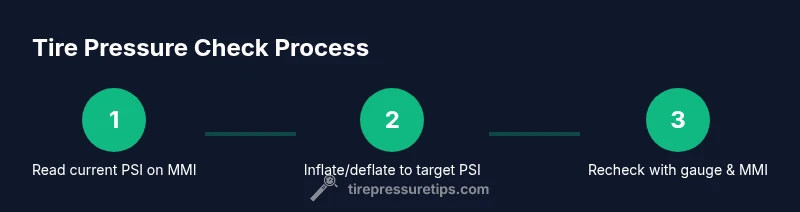
- Read current PSI values on the MMI TPMS screen.
- Inflate or deflate each tire to the target PSI with an accurate gauge.
- Recheck the pressures on all tires.
- Record the new readings and, if required, reset the TPMS.
This block serves as a quick reference to accompany the detailed steps that follow in the dedicated STEP-BY-STEP section.
Tools & Materials
- Digital tire pressure gauge(Prefer a gauge with a small, easy-to-read display and two decimal places for precision)
- Air compressor or access to a reliable air pump(In-garage or service-station option recommended; ensure the output is steady and accurate)
- Owner's manual or Audi official tire pressure spec(Cross-check the recommended PSI per tire size; the door jamb sticker is the quickest reference)
- Notepad or smartphone to log readings(Helpful for tracking changes over time and seasons)
- TPMS reset tool or app (model dependent)(Some Audi models require TPMS reset after changes; verify with your model’s guide)
Steps
Estimated time: 15-25 minutes
- 1
Prepare and verify targets
Park on a level surface with the engine off and the parking brake engaged. Locate the tire pressure targets from the door jamb sticker or the owner’s manual. This is your reference for all four tires.
Tip: Double-check the tire size and the corresponding PSI on the sticker; mismatched sizes use different targets. - 2
Check current pressures
Use the MMI TPMS readout to view current pressures for each tire. If the screen isn’t clear, use your handheld gauge to confirm the values.
Tip: Record the readings to compare before and after adjustments. - 3
Inflate or deflate to target
Using a compressor or pump, adjust each tire to the target PSI. Do this gradually and check the pressure frequently to avoid overshooting.
Tip: Always start with the cold tire baseline to prevent over-inflation during a hot check. - 4
Recheck after adjustment
Recheck each tire’s PSI with both the gauge and the MMI. Ensure the readings align with the target values.
Tip: If one or more tires stay off-spec, re-evaluate for leaks or valve issues. - 5
Reset TPMS if required
If your model requires a manual TPMS reset after adjustment, follow the on-screen prompts or the owner's manual instructions.
Tip: Resetting ensures the system recognizes the new pressures accurately. - 6
Document results
Log the final PSI for all tires and the date. This helps with seasonal checks and future maintenance.
Tip: Keep a small log in the glove box or a notes app for quick reference.
Frequently Asked Questions
How often should I check my Audi's tire pressure?
Check at least monthly and before long trips. Temperature changes and seasonal shifts make regular checks important for safety and efficiency.
Check tire pressure at least once a month and before long trips, especially with temperature changes.
Can I rely on the TPMS alone to set my pressures?
TPMS provides a warning and estimates pressures, but always verify with a handheld gauge for accuracy before inflating.
TPMS helps, but use a gauge to confirm exact pressures before inflating.
Why does tire pressure change with temperature?
Temperature changes alter air volume and pressure. Colder weather lowers PSI, warmer weather raises it, so seasonal checks are important.
Temperature changes can raise or lower tire pressure; check regularly as seasons change.
What should I do if the TPMS light stays on after adjusting?
Verify all four tires are within target pressure. If readings are correct, there may be a sensor fault or leak requiring professional inspection.
If the light stays on after checking, recheck all tires and consider a sensor fault if readings are correct.
Is it unsafe to drive with underinflated tires on an Audi?
Underinflated tires reduce grip and increase wear, making driving less safe. Adjust to spec as soon as possible.
Yes, driving with underinflated tires reduces safety; fix it promptly.
Watch Video
What to Remember
- Check tire pressures when cold for accuracy
- Follow the door jamb sticker for target PSI
- Use a precise gauge and recheck after inflation
- Document changes for seasonal maintenance