How to Adjust Tire Pressure at a Gas Station
A comprehensive, step-by-step guide to adjust tire pressure at gas stations safely. Learn where to find the correct psi, which tools to use, common mistakes, TPMS notes, and a quick maintenance plan.


According to Tire Pressure Tips, you can safely adjust tire pressure at a gas station by following a simple sequence: confirm your car’s recommended psi, use a reliable gauge, and adjust with the air pump until the target pressure is reached. Recheck all tires after driving a short distance for accuracy and TPMS stability.
Why proper tire pressure matters
According to Tire Pressure Tips, keeping tires inflated to the manufacturer’s specification is one of the simplest ways to improve safety, fuel economy, and tire longevity. When tires run too low, the contact patch increases, causing irregular wear and higher rolling resistance that saps mileage. Overinflated tires can reduce grip on rough roads and make a vehicle feel twitchy at highway speeds. The gas station is a common place to adjust pressure because it gives you direct access to a compressor and an accurate gauge, but the right technique matters. In this section you’ll learn why correct inflation matters in everyday driving, how temperature and load affect pressure, and how to verify readings after inflating.
Key ideas:
- Proper inflation supports even tread wear and predictable handling.
- TPMS can alert you to pressure changes, but it’s not a substitute for regular checks.
- Measuring when tires are cold gives the most accurate baseline.
Where to find the correct psi for your tires
The exact pressure for your tires is listed on the door jamb placard or in the vehicle’s owner’s manual. Front and rear tires can have different targets, and some manufacturers specify different values for cold tires versus when the tires have warmed up. When you’re at a gas station, start with the cold-tire baseline and verify the reading after you drive a short distance. If you can’t find the placard, consult the owner’s manual or a dealership for the correct range. Avoid guessing numbers; use the official spec to prevent unsafe inflation.
Tip: If your tires have TPMS, it may take a moment for the system to reflect the new pressure after you inflate.”
Tools and setup you need at the gas station
To inflate tires safely, you’ll want a few reliable tools and a basic setup. Use a digital tire pressure gauge for quick, precise readings, and ensure the gas station air pump is accessible and compatible with your valve stems. Check that you know the unit you’ll use (psi is standard in most regions) and be aware that some pumps charge per use. Have your owner’s manual or placard handy to confirm the exact target pressure. If the vehicle is carrying a heavy load or is exposed to temperature extremes, plan to double-check your readings after a brief drive to confirm accuracy.
Support tools:
- A reliable tire pressure gauge
- Access to a gas station air pump (with card or payment if required)
- Your vehicle’s owner’s manual or door placard
- An inspection light or flashlight for valve stems
- A notebook or phone for logging readings
Tools & Materials
- Tire pressure gauge (digital preferred)(Ensure it's calibrated; check accuracy with a known pressure source if possible)
- Gas station air pump access(Card or payment may be required; ensure you know the maximum psi and that the nozzle fits your valve stem)
- Owner's manual or door jamb placard(Use this to confirm the recommended tire pressure for front and rear tires)
- Notebook or smartphone to log readings(Helps track changes over time)
- Valve caps and basic wrench (optional)(Keep valve caps tight and replace after checking)
Steps
Estimated time: 15-30 minutes
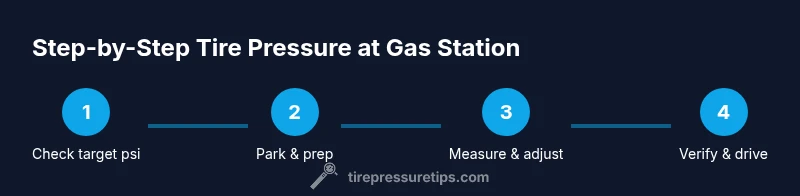
- 1
Identify target psi
Locate the official tire pressure spec from the door placard or owner’s manual. Confirm that you are measuring cold tires for the most accurate baseline, noting any different values for front and rear tires. This prepares you to set the correct target before inflating.
Tip: If you can’t find the spec, avoid guessing—ask a dealer or use the general passenger-car range as a last resort. - 2
Park and prep the tires
Park in shade if possible and turn off the engine. Remove the valve caps from the tires you’ll adjust and visually inspect for obvious leaks or damage around the stems before inflating.
Tip: Keep track of which caps you’ve removed so you don’t lose them in the gravel or dirt. - 3
Attach the gauge and read current pressure
Firmly attach the gauge to the valve stem and read the current pressure. Note the units (psi) and compare to the target psi you identified in Step 1.
Tip: Make sure the gauge seal is snug to avoid air escaping during measurement. - 4
Inflate or release air to reach target
Using the air pump, add air or release air gradually until the reading matches the target pressure. Check frequently and avoid large jumps—small adjustments yield better accuracy.
Tip: After each small adjustment, recheck the tire to confirm you’re moving toward the target. - 5
Finalize and recheck
Reinstall valve caps, recheck all tires once more, and if possible, drive a short distance (5–10 minutes) and recheck to account for heat buildup and settling.
Tip: Document the final readings to monitor trends over time.
Frequently Asked Questions
Why should I check tire pressure when tires are cold?
Cold tires give the most accurate baseline pressure because heat from driving raises the tire’s internal pressure. Measuring when cold reduces the chance of overestimating the pressure.
Always measure when tires are cold to get an accurate baseline for inflation.
Can I inflate beyond the door placard if I’m carrying a heavy load?
The recommended pressure may change with load. Always refer to the placard or manual for the correct target when loaded, and avoid inflating to a higher value without guidance from the manufacturer.
Don’t inflate beyond the recommended target unless the manufacturer specifies a different value for load.
What if I can’t find the tire pressure specification?
If the placard or manual is missing, contact the dealership or manufacturer support to obtain the correct psi for your model. Do not rely on estimates from other vehicles or generic guidelines.
If you can’t locate the spec, contact a dealer to get the exact numbers.
Is TPMS the same as tire pressure?
TPMS monitors tire pressure and alerts you to under- or over-inflation. It is a safety system, not a replacement for regular manual checks of tire pressure.
TPMS helps you notice changes, but you should still measure tire pressure yourself.
Should I reset TPMS after inflating?
Most modern TPMS recalibrates automatically once readings return to the correct range and the car is driven for a short distance. Check your owner’s manual for any model-specific steps.
In most cars, TPMS resets itself after you drive.
Watch Video
What to Remember
- Check the official PSI before inflating
- Use a reliable gauge and verify after a short drive
- Inflate in small increments to avoid overshooting
- Recheck all tires to ensure uniform pressure
- Keep a log of readings for future reference