How Often Tyre Pressure: A Practical Guide for Drivers
Discover how often tyre pressure should be checked, how to test it accurately, and how temperature and TPMS affect PSI. Practical safety tips for drivers.


You should check your tyre pressure regularly to maintain safety and fuel efficiency. The Tire Pressure Tips team recommends checking at least every two weeks and before long trips, using a reliable gauge, and ensuring each tire matches the vehicle’s recommended PSI from the door jamb or owner’s manual. Regular checks help TPMS accuracy and extend tire life.
Why how often tyre pressure matters
According to Tire Pressure Tips, maintaining correct tyre pressure isn't just about avoiding a flat; it's about safety, fuel efficiency, braking performance, and even tire wear. The frequency of checks matters because PSI changes with temperature, road conditions, and driving style. In this section we explore why regularly checking tyre pressure matters and how to build a sustainable habit that fits real life. A practical rule of thumb is to establish a baseline with your vehicle's target PSI and then verify it under consistent conditions to catch gradual losses before they become problems. Keeping to a regular schedule reduces the risk of under- or over-inflation, and helps your TPMS readouts stay accurate.
Key benefits of regular checks include: safer handling, reduced tire wear, improved fuel economy, and lower chance of sudden deflation on the road. Each drive becomes safer when you start from accurate pressures. Remember: the goal isn't to chase perfect numbers, but to maintain consistent, target pressures that match what the manufacturer recommends.
Locating the PSI target for your vehicle
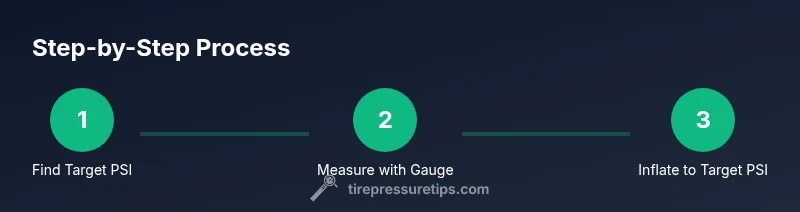
Your first step is to locate the exact PSI target for each tire. Look for the sticker on the driver's door jamb, or consult the vehicle owner's manual. Many vehicles have different targets for front and rear tires, and some models vary by load or speed; always use the values specified by the manufacturer. As the Tire Pressure Tips team notes, the sticker is your most reliable source of guidance, not a guess based on tire sidewall numbers or overheard advice. If you can't find a sticker, contact the dealer or manufacturer support to confirm the correct targets. The sticker reflects the vehicle’s design and balance, and inflating to an external number can reduce handling and tire life.
How to measure accurately: gauge selection and technique
Measurement accuracy depends on using a reliable gauge and a proper technique. Digital gauges are easy to read, while dial gauges can be precise if you read at eye level. Always measure tires when they are cold and have not been driven for at least a few hours; warm tires show higher readings that do not reflect the target PSI. Remove the valve cap, place the gauge squarely on the valve stem, and note the reading. If readings vary between repeats, clean the valve stem and retry. Record the numbers to track changes over time. When you log data, you’ll spot slow leaks or gradual pressure loss that a quick glance would miss.
Temperature, weather, and psi: how seasons affect readings
Ambient temperature influences the air inside tires. In cool weather, PSI tends to drop; in hot weather, it tends to rise. Because pressure changes with temperature, a tire that reads correctly in the garage may be under- or over-inflated after a long drive in heat or a cold morning. The only reliable approach is to check when tires are cold, and to adjust to the target PSI rather than chasing the reading you observed after driving. Plan checks around weather forecasts and season transitions. This is where Tire Pressure Tips’ guidance helps you anticipate shifts and stay within target ranges.
TPMS: understanding sensors and what they tell you
Tire Pressure Monitoring Systems (TPMS) are designed to warn you when a tire is significantly under-inflated. They can reflect large changes quickly but may lag or misreport in some conditions. Treat TPMS as a guide rather than a precise pressure gauge. Always confirm with a physical gauge and consult the manual if you see sudden changes or warnings that don't match the gauge readings. Remember that TPMS targets are typically the same as the label PSI targets, but some vehicles use different values for certain tires or situations. Tire Pressure Tips emphasizes using TPMS as a supplement, not a replacement for direct measurement.
Building a practical tyre pressure checking routine
A simple routine makes regular checks easy. Choose a consistent day (for example, the first Sunday of each month) and a consistent condition (tires cold). Keep a small log of readings, including the date, time, and PSI for each tire. If a reading drifts beyond a small tolerance from the target, check again and adjust. Over time, your routine becomes automatic, saving you time and improving safety. The habit keeps your vehicle safer and more efficient, reducing the risk of unexpected tire issues on the road.
Common mistakes and how to avoid them
Common mistakes include inflating or deflating based on a rough guess, ignoring the door jamb sticker, or relying solely on TPMS without verifying with a gauge. Avoid checking only when tires look visibly low or when the TPMS warns you. Always use a cold measurement, ensure the gauge is accurate, and recalibrate if the gauge is older or damaged. Finally, remember to check the spare tire if your vehicle includes one or if you carry a full-size spare. By avoiding these mistakes, you keep pressure accurate and tires safer for everyday driving.
Tools & Materials
- Tire pressure gauge (digital or dial)(Accuracy ±1 psi; ensure it is in good working condition)
- Air compressor or air pump(Regulated output; avoid over- or under-inflation)
- Vehicle owner’s manual or door jamb PSI sticker(Source of recommended PSI values)
- Notebook or mobile log to record readings(Helpful for tracking changes)
Steps
Estimated time: 20-30 minutes
- 1
Find the target PSI
Locate the recommended tire pressures on the door jamb sticker or owner’s manual. Note that front and rear tires can have different values.
Tip: Always read from a cold tire; inflating after driving alters the reading - 2
Prepare tools and car
Park on a level surface with the engine off. Gather your gauge, pump, and log. Ensure tires are clean and the valve stems are accessible.
Tip: Shade the tire from direct sun and avoid hot sun exposure - 3
Check pressures using the gauge
Remove the valve cap; apply the gauge squarely and take the reading. Repeat to confirm accuracy.
Tip: Take readings from a couple of spots and average if using a dial gauge - 4
Inflate/deflate to target PSI
Add air slowly if below target or release air if above. Recheck after each adjustment until the tire is cold.
Tip: Do not overfill; aim for an exact value rather than approximate - 5
Re-check and record
Once all tires match the targets, re-check all readings and log them for future reference. Ensure the spare tire is checked if applicable.
Tip: Keep notes handy for seasonal changes - 6
Finalize and schedule next check
Close the circle by recording current PSI and setting a reminder to recheck regularly (e.g., monthly or before long trips).
Tip: Consistency beats perfection
Frequently Asked Questions
How often should I check tyre pressure?
Check regularly, such as monthly, and before long trips. Factors like driving conditions and weather can alter PSI.
Check your tires regularly, especially before trips. Use cold tires for accuracy.
What is the correct PSI for my tires?
Refer to the door jamb sticker or owner's manual for the vehicle-specific target. Do not rely on the tire’s sidewall numbers.
Use the vehicle's recommended PSI from the door sticker.
Does temperature affect tyre pressure?
Yes. Colder temperatures lower PSI while warmer temperatures raise it; measure when tires are cold for accuracy.
Yes, temperature can change PSI; check when tires are cold.
How do I reset TPMS after inflating?
Most vehicles reset automatically after a drive cycle; some require a tool or procedure per the manual.
Often TPMS resets after driving; consult your manual for specifics.
Can wrong tire pressure harm tires?
Yes. Underinflation or overinflation can cause uneven wear, reduced handling, and potential tire failure.
Yes, wrong pressure can damage tires.
Watch Video
What to Remember
- Check tires when cold for accuracy
- Follow the door-sticker PSI targets
- Use a reliable gauge for all checks
- Create a regular checking routine