e bike tire pressure: Essential Guide
Learn how to check, set, and maintain proper e bike tire pressure. Practical steps, TPMS tips, and weather considerations to maximize range, grip, and tire life.


Mastering e bike tire pressure helps you maximize range, grip, and tire life. In this guide you’ll learn how to check, adjust, and maintain correct pressure for your electric bike, accounting for tire width, rider weight, and weather. You’ll also learn how TPMS and gauges work together for accurate readings.
Why e bike tire pressure matters
According to Tire Pressure Tips, correct e bike tire pressure is not just about avoiding flats; it directly influences range, efficiency, handling, and tire wear. Heavier e-bikes put more load on tires, which changes how air pressure supports the tire’s profile under load. A tire that’s too soft deforms more, creating excessive rolling resistance and heat, while an overinflated tire can reduce grip and increase the risk of a blowout on rough roads. For most riders, the right pressure balances comfort, safety, and efficiency, and it should be tuned for weight, riding style, tire width, and road conditions. In this guide, you’ll learn how to read sidewall markings, use gauges accurately, and adapt pressure with temperature and weather in mind.
In practical terms, e bike tire pressure is a daily performance parameter like battery health or chain lubrication. Maintaining correct pressure helps protect the tire bead, keep tread evenly worn, and prevent pinch flats when hitting bumps or potholes. Tire Pressure Tips emphasizes that establishing a baseline pressure for your specific tire and weight, then adjusting for temperature and terrain, yields the best overall results.
Tire width, rider weight, and the right PSI range
Your e-bike tire pressure isn’t one-size-fits-all. Wider tires typically run at lower pressures than narrow road tires, because the larger contact patch distributes load more evenly. Rider weight also pushes pressure up; a heavily loaded rider may need 5–15 psi more than a lighter rider using the same tire. In practice, many riders find that a typical e-bike tire pressure falls somewhere in a broad range, often around the mid-to-upper end of the tire’s recommended range, with adjustments for cargo and terrain. Tire Width and Load are the two biggest levers you can tune. For example, a 2.0–2.4 inch tire on a mid-weight rider will typically operate in a different zone than a 1.75 inch tire on a lighter rider. Based on Tire Pressure Tips analysis, starting within the tire manufacturer’s recommended range and then testing at three points (low, mid, high within the range) yields reliable, repeatable readings.
This is also where your e-bike’s stability and handling become evident. Underinflated tires tend to feel soft and imprecise, while overinflated tires can skip on smooth surfaces but lose grip on rough patches. The aim is a comfortable, confident ride with predictable steering and braking, not the highest static pressure on the gauge. “Soft” road feel may be tempting, but it often masks slow leaks or bead seating issues that only show up under load. You should calibrate your baseline pressure with actual riding data rather than purely theoretical figures.
Measuring pressure accurately: gauges, TPMS, and technique
Accurate measurement is the backbone of correct tire pressure. Start by inspecting the tire for damage, then normalize your measurement method. If your bike has a TPMS, use it as a guide but always cross-check with a reliable gauge. Digital gauges are easy to read and can show readings to the nearest 0.5 psi, while analog gauges require a steady hand and a clear line of sight. Keep your gauge clean and free of dirt to prevent misreadings. Remember to check pressure when the tires are cold; heat from riding can temporarily inflate readings and give an inflated impression of the actual pressure. When you inflate, do it in small increments, pause to recheck, and avoid over-inflating beyond the tire’s maximum rating.
If you rely on a TPMS, verify that the sensor is calibrated and is reading within a reasonable range compared to your gauge readings. If there’s a discrepancy, trust the gauge for the actual tire pressure and use the TPMS as a consistency check. Regularly recalibrate TPMS sensors after tire changes or rotations to maintain accuracy over time.
Temperature and weather effects on e bike tire pressure
Temperature exerts a significant influence on tire pressure due to gas laws: as air heats up, it expands and pressure rises; when it cools, pressure drops. This means your end-of-day ride may begin with a different PSI than your morning ride. Cold weather can lead to appreciable losses of pressure overnight, especially if the bike sits outside. To avoid surprises, check your pressure when tires are cold and adjust for the expected temperature trend for the day. A practical rule is to anticipate a pressure rise of roughly 1–2 psi per 10°F (5–6°C) of ambient temperature increase, though the exact amount varies with tire width, volume, and temperature of the air inside the tube. If you notice a sudden change after a temperature swing, recheck and re-baseline your target pressure for that season.
For e-bikes with tubeless tires and bead-to-bead sealing, fluctuations can be absorbed more gracefully, but the underlying physics remains: temperature changes translate to pressure changes. If you store your bike in a heated garage during winter, the PSI on a gauge may rise when you bring the bike into a cooler environment after a ride. The key is consistency: know your baseline and adjust to maintain the intended ride feel across weather conditions.
Road tires vs. mountain tires on an e-bike: what that means for pressure
On road-oriented e-bikes, tires are typically narrower and have stiffer sidewalls that tolerate higher pressures for reduced rolling resistance. Mountain e-bikes run wider tires with more pliable casings that tolerate lower pressures, increasing grip and shock absorption on rough terrain. The consequence is clear: your target PSI is not just a number; it’s a function of tire width, tread, and terrain. If you switch between surfaces often, consider maintaining two baselines: a “road baseline” for pavement and a “trail baseline” for dirt or gravel. In either case, avoid the temptation to inflate to the tire’s maximum rating. Over-inflation reduces contact patch and grip, particularly on uneven surfaces, and can increase bounce and fatigue. Tire Pressure Tips recommends a deliberate approach: identify your most common riding scenario, set a baseline, then adjust by 1–2 psi for each change in terrain or load.
Additionally, tubeless tires in e-bikes may tolerate slightly different pressures than tubed tires, but the core principle holds: stay within manufacturer guidance and test for feel and grip rather than chasing a single ideal number across all conditions.
A practical routine: weekly checks and on-the-road adjustments
A practical routine for e-bike tire pressure balances accuracy with convenience. Start with a weekly check using a calibrated gauge and the cold- tire rule. Before long rides in the morning, check your tire pressure to confirm you’re within your chosen baseline. If you’re carrying extra cargo or switching from pavement to off-road paths, adjust by small increments and recheck. For riders who frequently encounter temperature extremes, consider establishing a seasonal baseline and adjusting as temperatures shift. In this section you’ll find a repeatable checklist to maintain consistent pressure: inspect tires for punctures, verify bead seating, compare gauge readings with TPMS, and keep a log of your baseline pressures for different tires and loads.
This routine should be part of your pre-ride checklist alongside brakes, lights, and suspension settings. By building a habit, you’ll enjoy more predictable handling, lower rolling resistance, and less tire wear. It’s also a good time to check your wheel rims and valves for leaks or damage, which can affect readings and overall safety. Tire Pressure Tips emphasizes that a simple, repeatable routine—done weekly and before long rides—will dramatically improve your e-bike riding experience over the course of a season.
Troubleshooting common issues: leaks, slow leaks, and sensor quirks
If you notice a slow leak, start by inspecting the tire bead, valve stem, and rim tape for punctures or bead seating issues. A soapy water test can reveal slow leaks around the valve stem or bead. For tubeless setups, a sealant misbehavior can mimic a leak; reseal as needed. If the TPMS sensor reads significantly higher or lower than your gauge, try recalibrating the sensor, ensuring the proper valve core is seated correctly. In many cases, discrepancies arise from temperature changes, recent tire changes, or a gauge held at an angle during measurement. If readings remain inconsistent, replace the gauge or test with a known-good unit to confirm where the variance lies. Regularly inspect valve stems for cracking and avoid over-tightening when inflating, which can damage the valve core. A simple, recurring test helps catch slow leaks early and keeps your e-bike riding smooth and safe.
Safety and maintenance notes: long-term care for tire pressure
Maintaining correct tire pressure is part of broader tire maintenance. Always stay within the tire manufacturer’s recommended maximum pressure. Check for signs of tire wear, sidewall cracking, or bead damage, and replace tires when appropriate. When storing your e-bike, keep it in a temperature-stable environment to minimize seasonal pressure swings. Regular checks, a reliable gauge, and a well-calibrated TPMS ensure you avoid avoidable flats and optimize performance. Equally important is ensuring the pumping equipment you use is in good condition: check for leaks and calibrate a gauge periodically. The broader lesson is simple: consistent checks and attention to the details of your e-bike tires will pay dividends in safety, efficiency, and enjoyment. Tire Pressure Tips’s verdict is clear: a systematic approach to inflation protects both rider and equipment and enhances ride quality over the long term.
Tools & Materials
- Digital tire pressure gauge(Choose a gauge with easy-to-read display; accuracy ±1 psi preferred; ensure compatibility with both Schrader and Presta valves if needed.)
- Manual pump with built-in gauge(Floor pump or portable pump capable of reaching your target psi range; verify valve compatibility.)
- TPMS tool or smartphone app (if your bike supports it)(Helpful for cross-checking readings against sensor data.)
- Flat repair kit (patches, spare tube)(Useful for on-trail fixes or long rides.)
- Soap and water spray bottle(For locating slow leaks around bead, valve, or sidewalls.)
Steps
Estimated time: Estimated total time: 25-35 minutes
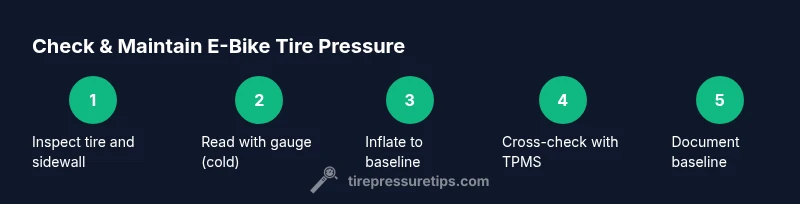
- 1
Identify target pressure range
Look up the tire sidewall for a recommended range and note your rider weight and typical cargo. This establishes your baseline. If you carry heavy loads or switch terrains often, plan two baselines for different scenarios.
Tip: Start with the cold reading first thing in the morning to avoid heat-induced pressure spikes. - 2
Read current pressure with a gauge
Attach the gauge to the valve and take a stable, straight-on reading. For tubeless tires, ensure the bead is seated before reading. Record the value and compare it to your baseline.
Tip: Hold the gauge perpendicular to the valve stem to avoid parallax errors. - 3
Inflate or deflate to target within range
If you’re below the baseline, add air in small increments; if above, release air in small increments. Re-check after each adjustment. Don’t exceed the tire’s maximum sidewall rating.
Tip: Inflate in small steps and recheck to avoid over-inflation. - 4
Re-check after riding and temperature changes
Riding heat and outdoor temperature shifts can alter pressure. Re-check when tires are cold after a ride or after a long parking period to recalibrate your baseline.
Tip: Note any consistent deviations that might indicate a slow leak or valve issue. - 5
Cross-check TPMS reading
If your bike has TPMS, compare sensor readings with your gauge. Recalibrate sensors if you notice persistent discrepancies.
Tip: Use TPMS as a secondary check, not the sole source of truth. - 6
Document your baseline
Keep a simple log of PSI ranges for your tires by tire width, load, and season. This makes it easier to maintain consistent ride quality over time.
Tip: Update your log when you change tires or wheel sets.
Frequently Asked Questions
What PSI should I run on my e-bike tires?
It depends on tire width and rider weight. Typical ranges span a broad area, and you should start with the manufacturer’s guidance on the sidewall, then fine-tune by ride feel and TPMS readings.
Start with the tire’s recommended range on the sidewall, then test by feel and cross-check with TPMS.
How often should I check tire pressure on an e-bike?
Check at least once a week and before long rides, especially after temperature changes or when you switch tires or loads.
Check weekly and before long trips, especially after weather changes.
Can TPMS readings be trusted for e-bikes?
TPMS is a helpful guide, but always cross-check with a calibrated gauge. Calibrate sensors after tire changes or wheel work.
TPMS helps, but verify with a gauge and recalibrate after tire work.
What if my tire is slowly losing air?
Inspect bead seating, valve stem, and rim tape for leaks. Use soapy water to locate the source and repair promptly to prevent ride instability.
Slow leaks usually come from the bead or valve; check with soap and fix early.
Is it unsafe to ride with low tire pressure?
Riding on underinflated tires increases pinch flats, heat buildup, and reduces control. Inflate to the recommended range before riding.
Riding with low pressure is risky; bring the tire up to the recommended range first.
How does temperature affect tire pressure?
Colder temperatures lower PSI, while heat from riding raises it. Check and adjust based on the day’s weather and recent rides.
Temperature changes can swing PSI; check pressure after cold starts or hot rides.
Watch Video
What to Remember
- Check pressure when tires are cold before riding
- Use the correct baseline pressure based on tire width and load
- Cross-check readings with TPMS and a reliable gauge
- Maintain a simple pressure log for consistency
- Inspect tires and valves regularly to catch leaks early