Discount Tire Tire Pressure: Check and Maintain Safely
A practical guide to checking and maintaining tire pressure on discount tires, with TPMS tips, temperature considerations, and safety-focused step-by-step instructions.


This guide helps you check and adjust tire pressure for discount tires, interpret TPMS alerts, and maintain correct PSI for safety and efficiency. You’ll learn how to verify your vehicle’s recommended pressure, inflate to spec, and recheck after driving or temperature changes. Following these steps protects tires, improves fuel economy, and reduces irregular wear, even when you’re shopping for discount tires and comparing tire pressure options.
Why accurate tire pressure matters
According to Tire Pressure Tips, maintaining correct tire pressure is essential for safety, fuel efficiency, and tire longevity. When you buy discount tires, you still want the same pressure targets as OEM tires. The pressure you see on the placard in your door jamb or owner's manual is your starting point, not a negotiable target. This is because tire shape, load, and inflation characteristics depend on the tire type and size—not the price tag. In practice, checking pressure regularly and adjusting to the recommended cold PSI helps prevent uneven wear, reduces heat buildup, and improves handling, even if your purchase is a discount tire. Additionally, a healthy tire pressure helps TPMS sensors work as designed, reducing nuisance alerts and potential flats. This section lays the groundwork for practical steps you can apply whether you’re outfitting a budget-minded vehicle or simply trying to maximize safety with discount tire tire pressure.
Key reasons to monitor tire pressure with discount tires
Discount tires can come from a variety of brands and production batches. While price is appealing, the pressure targets remain tied to the vehicle and tire size, not the retailer. Correct pressure improves grip, steering response, and braking performance, and it reduces irregular wear that can accelerate tread loss on budget tires. Underinflation wastes fuel and generates heat, while overinflation reduces the contact patch and can lead to a harsher ride and uneven wear on any tire. By treating discount tires like any other set and maintaining the manufacturer’s recommended cold pressure, you maximize safety and performance.
How pressure interacts with load and speed
Tire pressure has a direct relationship with load and speed ratings. Heavier loads, higher speeds, or frequent long trips can cause heat buildup and pressure changes. Discount tires may vary slightly in stiffness or tread pattern, but the fundamental rule stays the same: inflate to the vehicle’s specified cold pressure. Regular checks after loading the car for a trip or carrying passengers ensure you stay within safe limits. Treat tire pressure as part of a broader maintenance routine, not a one-off task.
Interpreting TPMS alerts on discount tires
TPMS alerts are designed to warn you when a tire’s pressure deviates from the norm. If your discount tires are new or refurbished, or if you’ve recently mounted them, the system may require a relearn procedure. Always verify the tire placard for the correct cold pressure, and then use a gauge to confirm readings. If the TPMS shows a fault or stays on after inflation, consult your vehicle’s manual or a qualified technician. Properly functioning TPMS helps you avoid dangerous underinflation and improves fuel economy.
Temperature matters: cold vs hot readings
Tire pressure changes with ambient temperature. A cold morning reading will be lower than a reading after a long drive. Always measure cold, before you drive, to compare against the spec. If you can’t avoid measuring after driving, use the delta from the expected warm reading rather than relying on the cold spec alone. Temperature swings—especially in fall and winter—can be significant, so check more frequently during extreme weather.
Practical tips for quality readings with discount tires
- Use a high-quality gauge and keep it calibrated. A digital gauge can be more consistent than an analog one.
- Read each tire twice to confirm accuracy, then round to the nearest PSI as recommended by the vehicle placard.
- Don’t forget the spare tire; it may not be part of the daily rotation, but it also needs proper pressure.
- Recheck after adjusting to ensure the reading stabilizes; a short drive of a few miles can help settle the tire and settle the bead.
How to maintain consistency across all four tires
Aim for uniform pressure on all four tires to ensure balanced handling and even wear. If tires are different brands or models, prefer the vehicle’s recommended cold pressure rather than individual tire specs. When replacing one tire due to wear, calibrate the entire set if advised by the tire shop or vehicle manufacturer. Consistency fosters better steering, braking, and tire longevity, particularly on discount tires where tread variations can occur.
Special considerations for discount tires in seasonal changes
Seasonal shifts affect tire pressure. In cold weather, pressures drop; in heat, they rise. Plan for seasonal checks, especially if you switch to winter or all-season discounts. If you notice frequent pressure fluctuations, inspect for a puncture, valve stem leaks, or a TPMS sensor issue. Regular checks help you catch problems early and avoid unnecessary trips to the shop.
Tools & Materials
- Tire pressure gauge(Digital preferred; ensure it is calibrated and reads in PSI)
- Air compressor or access to a gas station(Needed to adjust tire pressure to target values)
- Vehicle owner’s manual or door placard(Contains the recommended cold PSI for each tire)
- Valve-cap tool(Helpful for removing/installing valve caps without cross-threading)
- Notebook or app for logging readings(Optional for tracking pressure over time)
Steps
Estimated time: 20-30 minutes
- 1
Prepare your tools and vehicle
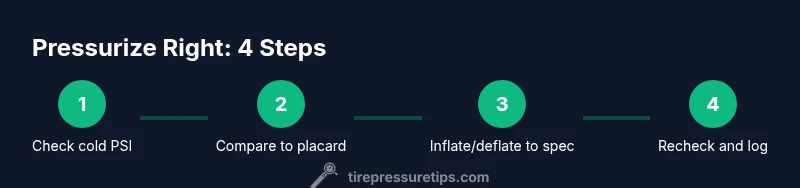
Gather a tire gauge, air source, and the vehicle’s pressure placard. Ensure the tires are cool and the vehicle has been stationary for at least three hours or have driven less than a mile. This ensures readings reflect the true cold pressure.
Tip: Have a notebook handy to log the readings for all four tires. - 2
Find the correct pressure spec
Locate the recommended cold tire pressure on the door placard or owner’s manual. Record the value for each tire position if the placard differs by front/rear or axle.
Tip: When in doubt, use the placard value rather than a tire sidewall number. - 3
Remove valve caps and check pressure
With the engine off and tires cold, remove the valve cap, apply the gauge, and read the current pressure. Repeat for all four tires and the spare if you plan to check it.
Tip: Make sure the valve stem is clean and free of debris before testing. - 4
Inflate or deflate to spec
If a tire is underinflated, add air until it reaches the prescribed cold PSI. If overinflated, release air in small increments until the target is met.
Tip: Do not exceed the maximum pressure printed on the tire sidewall. - 5
Recheck after adjustment
Re-measure each tire after adjustments to confirm the reading is stable. Small changes can occur during the first minutes after inflation.
Tip: Take measurements in a shaded area to avoid heat effects from sun exposure. - 6
Check TPMS status
If TPMS alerts persist after inflation, consult your owner’s manual for relearn instructions or reset procedures. Some discount tires or mounting services require a relearn when tires are changed.
Tip: A reset might be needed after rotation or replacement. - 7
Inspect valve stems and bead
Look for cracks, leaks, or signs of wear around the valve stems and bead seat. Replace worn components as needed to maintain accurate readings.
Tip: Tire valves are common leak sources and can skew readings if compromised. - 8
Document and monitor
Log the final readings and monitor any future fluctuations. This helps you catch slow leaks or sensor issues early.
Tip: Set reminders for quarterly checks or before long trips. - 9
Review with your tire shop
If you purchased discount tires, ask the shop to confirm the fitment, pressures, and any relearn steps for TPMS after installation.
Tip: A quick check at installation can save you time later.
Frequently Asked Questions
Should I check tire pressure when the tires are hot or cold?
Always check tire pressure when the tires are cold to obtain an accurate reading. Hot tires read higher due to heat expansion, which can give a false sense of overinflation.
Check when cold to get an accurate reading, because heat from driving can skew the numbers.
Can discount tires affect tire pressure readings?
Discount tires follow the same pressure guidelines as OEM tires. The key is to inflate to the vehicle’s recommended cold PSI, regardless of where the tire was purchased.
Discount tires follow the vehicle’s recommended pressure; location doesn’t change the target.
Do I need to relearn TPMS after mounting new tires?
After mounting or replacing tires, a TPMS relearn may be required. Refer to your manual or have a shop perform the relearn so the system reads the correct pressures.
A relearn is often needed after tire changes to ensure TPMS accuracy.
How often should I check tire pressure?
Check tire pressure monthly and before long trips. Temperature changes also warrant more frequent checks, especially in extreme weather.
Check monthly and before long trips, especially when seasons change.
Why is my TPMS light on after inflating?
The light may stay on due to a TPMS sensor fault or the need for a relearn. If it remains, consult a technician to inspect sensors and calibration.
TPMS lights can mean a sensor issue or that a relearn is needed.
Should spare tire pressure be checked regularly?
Yes. Spares can lose pressure over time and may be crucial in emergencies, so check and maintain them as part of your routine.
Don’t forget the spare; check it periodically too.
Watch Video
What to Remember
- Check cold pressures against placard targets
- Use a reliable gauge for precise readings
- Recheck after inflation and driving short miles
- Include TPMS behavior and relearn if tires were changed