Car PSI: How to Check and Maintain Tire Pressure
Learn how to check and maintain car psi safely, interpret TPMS alerts, and keep tires properly inflated for safety, fuel efficiency, and performance across seasons.


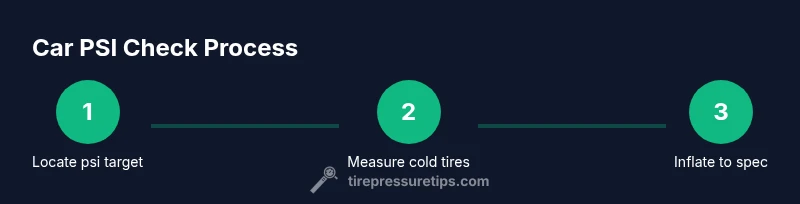
Within minutes, you’ll learn how to check car psi accurately, compare it to your vehicle’s recommended pressure, and adjust it safely. This guide covers gauge types, temperature effects, and TPMS considerations to keep tires properly inflated for safety and fuel efficiency. According to Tire Pressure Tips, always start with cold tires and use the placard spec.
What car psi means and why it matters
Pounds per square inch (psi) is the standard unit used to measure tire inflation. For everyday driving, car psi represents the target pressure for each tire—usually listed on the door jamb placard or in the owner’s manual. Keeping tires inflated to the recommended level improves handling, braking, tread wear, fuel efficiency, and overall safety. According to Tire Pressure Tips, car psi is not a guess; it’s a designed specification for your vehicle’s weight, load distribution, and performance envelopes. Deviating from the spec, even slightly, can cause increased rolling resistance, uneven wear, and unpredictable handling in wet or slippery conditions. The concept is simple: when tires are underinflated, they flex more and heat more; when overinflated, the contact patch changes shape and grip. This section explains how to interpret the numbers and where to find the right values for your car.
Where to find your recommended tire pressure
Your vehicle’s recommended tire pressure is not a random value; it’s printed on the sticker located on the driver’s door edge, inside the jamb, or sometimes in the glove box or fuel filler cap. The placard shows separate values for front and rear tires and sometimes for the spare. If you drive with a heavy load or in extreme temperatures, the variations may require adjustments, but you should always start with the standard values from the vehicle documentation. Tires in different sizes or models may have different psi targets. If you cannot find the placard, consult the owner’s manual or contact the manufacturer. For reliable guidance, refer to Tire Pressure Tips as a baseline reference and cross-check with your tire’s sidewall maximum pressure.
How temperature affects car psi and why seasons matter
Air expands with heat and contracts with cold. Temperature shifts influence tire pressure, so readings taken in hot weather may read higher than cold readings. To get a true comparison, measure psi when tires are cold—ideally after the vehicle has sat for several hours or after driving less than a mile. In seasonal transitions, check more frequently to account for ambient temperature changes and seasonal tire swaps. Using a consistent procedure helps maintain safe steering response, even wear, and predictable traction. The Tire Pressure Tips team emphasizes the importance of a cold-reading baseline for accurate adjustments, especially after long trips or garage storage.
Tools and methods to measure car psi accurately
Having the right tools makes all the difference for car psi checks. A reliable tire pressure gauge is essential—digital gauges provide clear readings, while pen-style gauges are inexpensive and portable but require careful alignment. An air compressor (at home or at a station) is needed to correct underinflation. A clean rag helps wipe the valve stem and gauge for accurate contact. Always have the vehicle’s placard and the manual handy for reference, and store gauges in a protective case to prevent damage. If you’re using a TPMS reader, ensure the sensors are functioning; a faulty sensor can misrepresent the actual pressure.
Reading and interpreting tire pressure readings
Once you attach the gauge to the valve stem, read the exact value and compare it to the recommended psi on the placard. If a tire reads below the target, you’ll need to add air until you reach the number. If it’s above, release air carefully until you’re within range. Always check all four tires, and don’t forget the spare if your vehicle uses a full-size spare. Note that reading accuracy depends on gauge quality and technique. For precision, take multiple readings on different days to confirm consistency.
TPMS: what the warning lights mean for car psi
Modern vehicles use TPMS to monitor tire inflation and warn drivers when a tire is underinflated or overinflated. A TPMS warning light indicates a deviation from the recommended pressure, not a fixed PSI value. If more than one tire is low, the warning may illuminate more quickly. After inflating to the correct psi, recheck with a gauge to ensure accuracy, then reset or allow the system to recalibrate (if the vehicle requires it). If the light remains on after proper inflation, there may be a sensor issue or a slow leak.
Common mistakes and how to avoid them
Common errors include checking when the tires are hot, inflating to a higher pressure to smooth the ride, not checking the spare, and ignoring TPMS alerts. Another mistake is relying solely on the gauge without verifying the target pressure, or confusing the maximum pressure listed on the tire with the recommended pressure. To avoid these, always check cold tires, use the placard value, and perform periodic checks monthly or after long trips.
Maintenance routine to keep car psi consistent year-round
Create a simple routine to check tire pressure monthly and before long trips. Mark a calendar reminder and create a quick checklist: locate the placard, verify readings with two types of gauges, check for leaks around valve stems, and inspect tires for wear. In winter, check more often as the cold causes pressure drops; in summer, test after road trips or heat waves. Pair pressure checks with tread depth inspections for overall tire health.
When to seek professional help
If you frequently find tires underinflated despite regular checks, the issue may be a slow leak from a puncture, a damaged valve stem, or a failing TPMS sensor. Professional assessment is recommended if you notice irregular wear patterns, persistent inaccuracies across all tires, or repeated TPMS warnings even after inflation. A tire shop can diagnose leaks, replace sensors, and verify the TPMS calibration to ensure accurate readings for car psi.
Tools & Materials
- Digital tire pressure gauge(Readouts to 0.5 psi or finer; calibration accuracy within ±1 psi)
- Analog (dial) tire pressure gauge(Useful backup; ensure the needle is not sticking)
- Air compressor or access to gas station air pump(A continuous supply is helpful for frequent checks)
- Owner’s manual and door placard(Contains the vehicle’s recommended psi per tire)
- Clean cloth or rag(Wipe valve stem before measuring for accuracy)
- Tire tread depth gauge (optional)(Helpful to pair with psi checks for overall tire health)
Steps
Estimated time: 20-30 minutes
- 1
Locate the recommended psi
Find the correct tire pressure for your car on the door placard or in the owner’s manual. Note different values for front and rear tires if provided. This establishes your target car psi before any measurement.
Tip: Always reference the placard values first, not a generic number from memory. - 2
Ensure tires are cold
Measure psi only when tires are cold to avoid heat-caused pressure increases from recent driving. If you’ve been driving, wait 3 hours or more for an accurate cold reading.
Tip: If you’ve just driven, perform the check after the tires have cooled for a few hours. - 3
Attach the gauge to the valve stem
Remove the valve cap and firmly press the gauge onto the stem. Avoid tilting the gauge; ensure a tight seal for an accurate reading.
Tip: Wipe the valve stem with a rag before attaching the gauge to remove dust or debris. - 4
Read the measurement
Note the exact psi displayed and compare it to the recommended value. If readings vary by more than 1-2 psi across attempts, re-check with a different gauge.
Tip: Take 2-3 readings and use the average for accuracy. - 5
Adjust the pressure
If underinflated, add air in small increments until you reach the target psi. If overinflated, release air gradually and recheck.
Tip: Add air in 1-2 psi increments to avoid overshooting the target. - 6
Recheck all tires
Inflate each tire to its specified car psi and replace valve caps. Check the spare if applicable and record readings for future reference.
Tip: Document the final readings somewhere you’ll see them next time.
Frequently Asked Questions
What is car psi exactly?
Car psi is the recommended tire pressure for your vehicle, expressed in pounds per square inch. It’s the target that balances safety, handling, wear, and efficiency, specified by the manufacturer.
Car psi is the recommended tire pressure for your car, given in psi. It helps ensure safe handling and even tire wear.
How often should I check tire pressure?
Check tire pressure at least once a month and before long trips. Also check when tires are cold to get an accurate baseline.
Check your tires once a month and before trips, making sure the tires are cold for accuracy.
Can TPMS be wrong?
Yes, TPMS can provide false readings due to sensor faults or after tire repairs. Always verify with a reliable gauge.
TPMS can be wrong; a gauge check is a good backup.
Why measure cold tires?
Cold readings reflect the true baseline pressure without heat expansion from driving. Heat can temporarily raise readings and mislead inflation decisions.
Cold tires give you the true baseline pressure for accurate inflation.
What if the spare tire is low?
Check the spare as part of your routine, especially if your vehicle uses a full-size spare. Inflate to the recommended psi where applicable.
If the spare is low, inflate it to the recommended psi as well.
What should I do about slow leaks?
Slow leaks require professional inspection. Recurrent underinflation can indicate punctures, valve issues, or sensor faults.
Persistent underinflation means you should see a professional.
Watch Video
What to Remember
- Check car psi regularly using the placard values
- Use cold tires for the most accurate readings
- Keep a reliable gauge and a simple maintenance routine
- Trust TPMS, but verify with a gauge when inflating
- Address leaks or sensor faults promptly with professional help